Little Women, by Louisa May Alcott

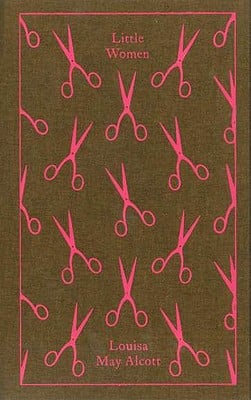
Meg, Jo, Amy, Beth: Those of us who grew up with the March girls didn’t know that what we were reading was not what Alcott originally published in 1865.

Book One of this classic novel covers a year in the life of the four March girls, from one Christmas to another. The sisters try to be good so as not to worry Marmee, Father being away with the war. Mostly they succeed, despite the usual sisterly feuds and jealousies sparked by four very different temperaments. Book Two was an afterthought, following them as they grow up and marry (or not).

Being only ten or so when I first read it, I didn’t pay much attention to Book 2. Of course, Jo was the only one who mattered to me, rebellious Jo with her apples and writing, her reading in the attic, her desire for  some privacy. Like Jo, I hid away to read. I made up plays for my (too) many siblings to enact. I devised outdoor games for us and the other neighborhood children. All my friends also identified with Jo—no surprise given that we were climbing trees and wearing pants which were all a bit shocking still in the 1950s.

I can draw a straight line from Jo, who was based on Alcott herself, to my later obsession with Emily Brontë. I moved quickly from the books by the Brontë sisters to their lives in that lonely stone house in Haworth. Of course I was drawn to rebellious Emily, independent Emily who loved the moors and being alone and refused to behave like a proper girl. Writing about her as a child, Emily’s father described her strong will. I hid mine to stay out of trouble, but it was there all right.

With their brother Branwell, the three sisters carved into two pairs: Charlotte and Branwell, Emily and Anne, just as the March sisters did: Meg and Amy, Jo and Beth. There are other parallels: delicate and good Anne like Beth, practical Charlotte like Meg. However, the Brontë siblings did not have a wise and loving Marmee. With their mother dead and their father cold and righteous, they were cared for by their aunt Elizabeth Branwell. She’s usually described as a stern disciplinarian, but now there’s some evidence that she was actually a devoted and caring parental figure.

Although we know Alcott drew on incidents from her own life, I wonder if she was thinking of the Brontës when she started drafting Little Women. The Alcotts were assiduous readers, and the dates fit. Wuthering Heights came out in 1847 and the first U.S. edition was a year later. Alcott started writing Little Women in May of 1868 and sent it to her publisher in June. Book One was published October 1868 and Book Two a few months later (January, 1869).

It is with the 1880 version, combining the two books into a single volume, that the mischief occurs. Her publisher asked Alcott to make certain changes designed to make it—especially the depiction of Jo—more bland and acceptable. In her brilliant introduction to the recent reissue of the original version, Elaine Showalter suggests that later editors probably made additional changes. She explains that many of the literary references were removed, Jo’s speech was smoothed out, and her behaviour made more ladylike. Even the description of Marmee was romanticised.

Original: “. . . a stout, motherly lady, with a ‘can I help you’ look about her, which was truly delightful. She wasn’t a particularly handsome person, but mothers are always lovely to their children…”

Revised: “. . . a tall, motherly lady, with a ‘can I help you’ look about her, which was truly delightful. She was not elegantly dressed, but a noble-looking woman, and the girls thought the grey cloak and unfashionable bonnet covered the most splendid mother in the world.”

Interesting, eh? The original, with Showalter’s introduction is available from Penguin Classics (2010). Showalter has also added footnotes, some of which identify the sources of those pesky literary references. I was tickled to stumble upon a reference that she hadn’t footnoted: In Chapter 21, Jo backs away from one of Laurie’s wild schemes and says “ ‘Prunes and prisms’ are my doom, and I may as well make up my mind to it.”

That’s from Charles Dickens’s Little Dorrit:

“Papa is a preferable mode of address,” observed Mrs General. “Father is rather vulgar, my dear. The word Papa, besides, gives a pretty form to the lips. Papa, potatoes, poultry, prunes, and prism are all very good words for the lips: especially prunes and prism. You will find it serviceable, in the formation of a demeanour, if you sometimes say to yourself in company—on entering a room, for instance—Papa, potatoes, poultry, prunes and prism, prunes and prism.”

What do you think? Is it so weird to see both Jo and Emily as my wild sisters? Should girls stick to prunes and prisms? Is a part of you still in an attic reading books and eating apples with Jo?

What do you carry with you from an early reading of Little Women?
The Ones Who Never Left, by Gabrielle Mullarkey

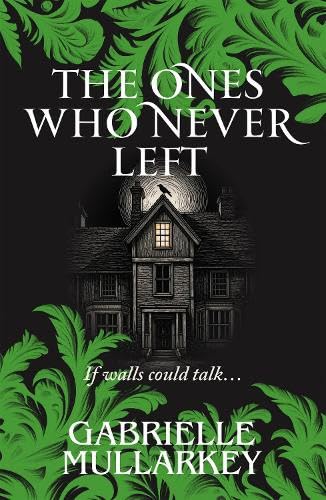
A frustrated and stalled artist, Lucy has thrown away all her work so far because none of it was worth keeping. Now, about to turn 30, she decides to try being impulsive like Hugh. After knowing him for only seven months, she’s married Hugh and two days later is setting to meet him in rural Yorkshire where he’s signed them up as property guardians for an old manor house that’s rumored to be haunted.

In Rook House they find a study that Hugh, a struggling writer of supernatural fiction, appropriates while Lucy turns the attic into a studio. They mostly spend the rest of their time in the kitchen because the dining room is empty and the living room features an unnerving portrait of the original owner of the house, a painting that seems to have a mind of its own.

These two babes in the wood know nothing about living the country. Lucy’s just bought her first car, a bit of a wreck, while Hugh doesn’t even know how to drive. They rely on the occasional housekeeper, Mrs. Bird, to teach them how to use the Rayburn so they’ll have heat and hot water. They hear peculiar noises and debate whether it’s safe to walk in the woods.

As they learn more about the history of the house, the family who owned it, and the ghosts who supposedly haunt it, the two young people encounter strange happenings. The bedroom they use, the only one furnished, is papered with a design of birds stealing strawberries. Not too strange so far.

Next, they explored the remaining six bedrooms, all uncurtained and empty of furniture . . . The smallest bedroom had an open fireplace and bird-free wallpaper—also William Morris—featuring old-gold and pale-green leaves in snake-like coils. “Acanthus leaves,” Lucy identified.

Glancing at the faded paper, she had the strange sensation, just for a second, that the curling leaves were flowing and reforming into Rorschach ink blots, as if the pattern—maybe even the wall itself—was writhing with dark, silent life.

But Lucy is subject to migraines, so perhaps that is what’s happening to her. As the incidents come faster and go from alarming to frightening, it’s unclear what’s causing them: maybe ghosts, a Bertha in the attic, or simply their imaginations? To make things worse, Hugh’s impulsiveness begins to look more like the self-centered recklessness of a spoiled child, and Lucy finds it harder and harder to connect with him.

Although the plot accelerates nicely, Lucy and Hugh’s relationship becomes less interesting as it devolves into squabbling and secrets. They are both only children and perhaps lack the emotional tools for a relationship. Orphaned Lucy loathes her stepmother, while Hugh courts disapproval from his cold, wealthy parents even as he accepts their money.

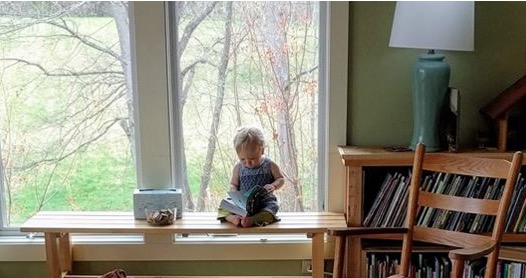
Still, I cannot resist a story about a haunted manor on the edge of a Yorkshire moor, reminding me as it does of my introduction to gothic fiction when I was fifteen. I’ll never forget that November dusk when I curled up on a windowseat in the living room and opened Jane Eyre for the first time.

The plot in Mullarkey’s novel kept me turning the pages. There are plenty of shivers and surprises. What makes the scary parts so effective, besides being well-placed in the story, is how they call on fears that many of us experience. These days in particular, we know in our hearts and bones what it’s like to be misunderstood, to be in danger, to feel powerless.

I love the title which came, Mullarkey says in her note, from her wondering if the former inhabitants of the houses we occupy ever truly leave. Now there’s a thought. Many of us experience strong vibrations in the houses we enter. I thought perhaps the strong emotions within may have seeped into wood and stone and become subtle exhalations. But after this book, I’m considering the places I’ve lived and wondering what part of me might linger there. I think, too, of those who lived in them before me, the ones I know of anyway. This is where the gothic space begins to open: that uncanny disorientation that suggests maybe we don’t know so much after all.

What novel have you read recently that unsettled you?

Disclosure of Material Connection: I received a copy of this book free from the publisher. I was not required to write a positive review. The opinions I have expressed are my own.

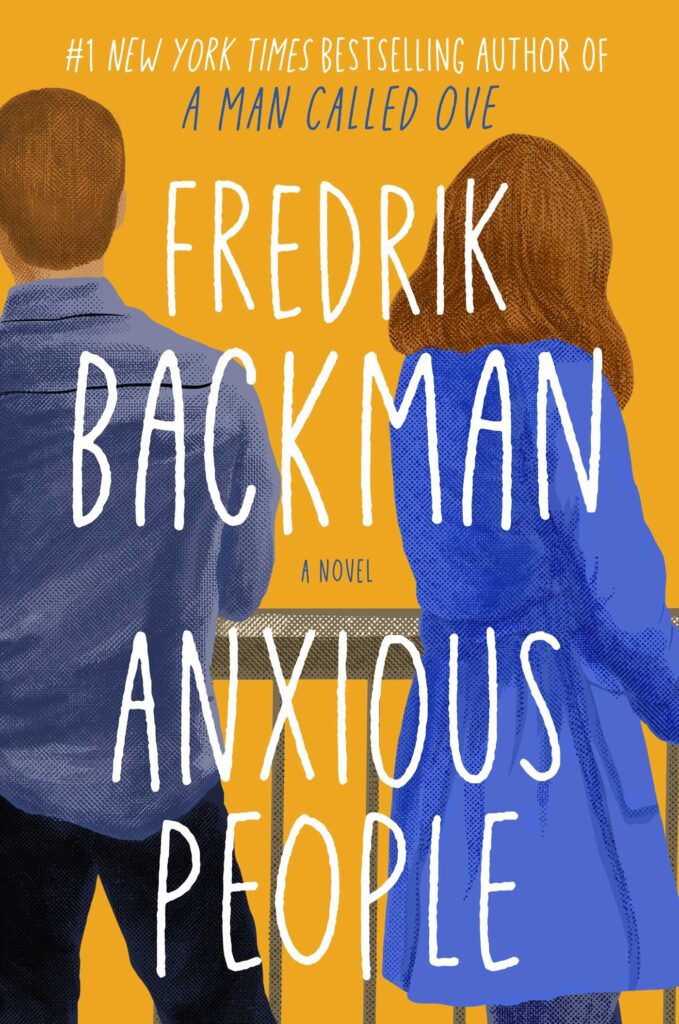
Anxious People, by Fredrik Backman

In this 2019 novel by the author of A Man Called Ove, a bank robber fleeing the police takes refuge in an apartment and, finding that it is being shown to a group of potential buyers, takes them all hostage. Actually, that’s the background given by the rather bossy narrator. The story begins in the police station with the hostages being interviewed by a pair of police officers, a father and son. 

My book club unanimously loved the earlier book, but had mixed reactions to this one. Certainly some—most—liked it very much. However, some folks were confused about plot details and especially about the characters and the relationship between them. I think that confusion is meant to be, as we say nowadays, a feature not a bug. Yet it’s hard to enjoy a book if you can’t figure out, at least by the end, what’s going on.

As a result, we spent the first part of the evening comparing notes on who was who. As we got further into discussing the plot, even more elucidation was needed.

One person asked what the book is about. We all laughed. On the first page, the narrator tells us:

This story is about a lot of things, but mostly about idiots. So it needs saying from the outset that it’s very, always very easy to declare that other people are idiots, but only if you forget how idiotically difficult being human is.

On a side note, I wasn’t thrilled by the use of “idiot” throughout the book, but perhaps it has a different connotation in Sweden. Maybe the author or translator was thinking of the Greek word it’s derived from which means “common man.”

We discussed several ways to describe what the book is about: suicide, grief, marriage, change, connection. That last one points to the theme of the book which is similar to the theme of Ove.

The book’s structure is interesting: We have the interviews shown as dialogue only, like a transcript. I was amused by the first interview, but a little went a long way, and they increasingly irritated me as the book progressed. Later they made sense, yet I think if it hadn’t been for my book club, I wouldn’t have finished the book. I did remain interested in the longer dramatic scenes between the interviews which are flashbacks to what happened in the apartment.

As I mentioned, the narrator is quite bossy, ordering the reader about and fulminating about all kinds of things such as young people and cell phones. The narrator stays out of the interviews since they record what the two people said, but intrudes into the dramatic scenes, commenting on the action, the characters, society, etc. I may be misremembering, but I think in Ove, the get-off-my-lawn opinions are spouted by a character rather than a narrator. 

I thought about George Eliot’s use of a narrator in Middlemarch. It felt a little intrusive at first  since such a persistent narrator is rare in today’s novels. However, I came to appreciate the narrator’s explanations about the characters and warnings that a character may not be as bad as they appear. Perhaps the voice of Backman’s narrator in this book just isn’t my cup of tea, as the little ones in my life say when I offer them a new dish.

Several of us were not fans of the many coincidences in the story and the neatly tied-up ending. We suggested that it read like a fable or fairy tale, which is perhaps not inconsistent with Backman’s brand.

A lawyer among us recounted a long-ago incident in court—no names or identifying details—in which the prosecutor went for an unexpectedly light sentence. Later they told my friend that they just wanted to give the person on trial a little grace.

I had to stop and let that settle. Isn’t that what we hope for from each other: just a little grace? We all carry burdens, some visible and some not.

Maybe this book is my cup of tea after all.

Have you read a novel that changed the way you look at something?


DNF

I had more Did-Not-Finish books in January than I’ve ever had in a single month. Even though reading is near the top of my list of favorite activities, I don’t force myself to finish every book if I’m not enjoying it; there are too many other books to read. Sometimes I’ll look at reviews or ask friends in case there’s something later on in the book worth continuing with it. However, each of the five January DNF books tossed me out of the story in some way. Perhaps exploring those ways—without naming the books—could be helpful.

A case could be made that the books themselves are not to blame. Certainly I’ve been distracted by worry over our increasingly perilous country and busy with responding to those threats. Another situation where the book itself is not at fault is when, in the past, I’ve occasionally given up on an audiobook because the narrator’s voice is annoying or, in one case, too ponderous.

This month, one highly-praised novel had a premise that sounded fascinating. It rumbled along slowly, but a slow pace is not necessarily a deal-breaker for me. What made my heart sink every time I thought about picking up the book again were the cardboard characters; stereotypes rather than real people. Worse, the secondary characters represented a particular population, all embodying the most common negative stereotypes for that group.

Another book was obviously going to be a light read—I needed a break—but seemed interesting. However, the plot meandered around without a enough of a problem to create suspense or concern for the main character. There may have been one later, but not enough of what Donald Maass calls bridging tension to keep me going. Not the book’s fault, I suppose, that it was a lighter read than I expected.

Two others didn’t hold my attention because, while the protagonists did have problems to solve, I found I didn’t care whether they did or not. There are several theories about how to inspire readers to care about a character. In Save the Cat, Blake Snyder says that having the protagonist do a good deed right away will have readers cheering for even a evil character.

Another theory holds that empathy comes from seeing the character’s goal and finding it a worthy one. The goal has to be big enough to power the whole book, and it has to have a strong emotional charge so that it matters to the reader as well as the protagonist. I especially appreciate a main character with a moral code that is threatened by the story. In these two stories, the goals did not carry that emotional charge for me. Also, perhaps unfairly for one of the books, the ugly cover made me flinch every time I picked it up.

The fifth book I wanted to like, and did at first. Then it got very confusing. I had trouble telling the dual narrators apart; the change from one to another was not signaled clearly enough for me. And then the whole thing turned into another story altogether with different characters. Part of settling a reader into a story is letting them know what the genre is. Getting well into a story in one genre and then suddenly switching to another lost me. Perhaps if there had been a signal in the beginning that it was going to be a genre-bending read, I might have been okay.

Lest you think I’m too picky, let me say that I finished quite a few other books in January and enjoyed them immensely.

Have you ever started a book and not finished it? What made you give up on it?