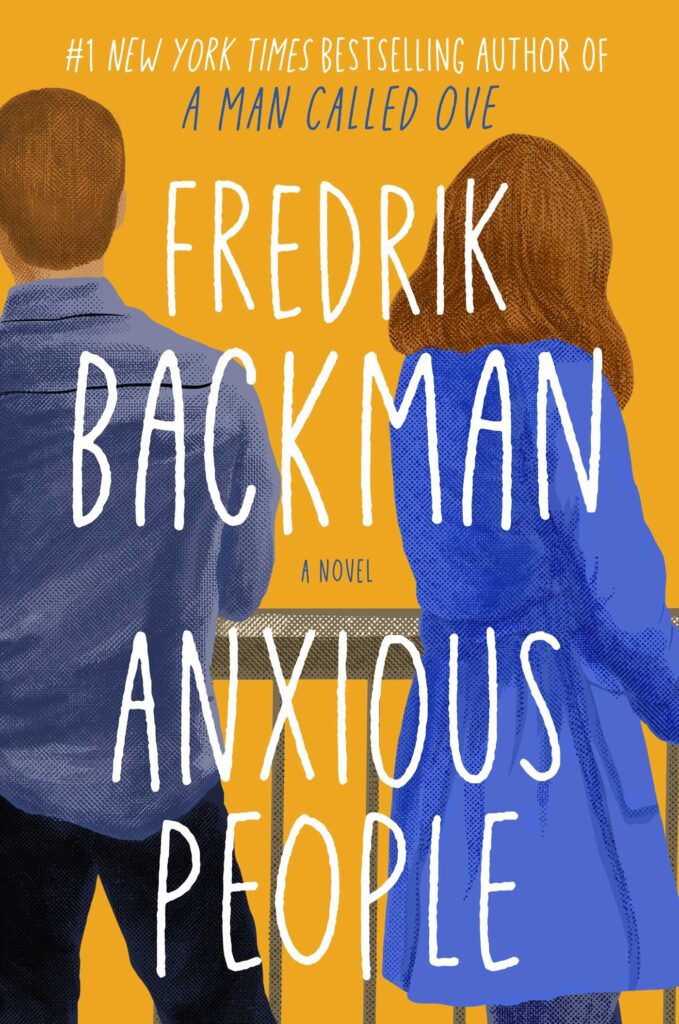
In this 2019 novel by the author of A Man Called Ove, a bank robber fleeing the police takes refuge in an apartment and, finding that it is being shown to a group of potential buyers, takes them all hostage. Actually, that’s the background given by the rather bossy narrator. The story begins in the police station with the hostages being interviewed by a pair of police officers, a father and son.
My book club unanimously loved the earlier book, but had mixed reactions to this one. Certainly some—most—liked it very much. However, some folks were confused about plot details and especially about the characters and the relationship between them. I think that confusion is meant to be, as we say nowadays, a feature not a bug. Yet it’s hard to enjoy a book if you can’t figure out, at least by the end, what’s going on.
As a result, we spent the first part of the evening comparing notes on who was who. As we got further into discussing the plot, even more elucidation was needed.
One person asked what the book is about. We all laughed. On the first page, the narrator tells us:
This story is about a lot of things, but mostly about idiots. So it needs saying from the outset that it’s very, always very easy to declare that other people are idiots, but only if you forget how idiotically difficult being human is.
On a side note, I wasn’t thrilled by the use of “idiot” throughout the book, but perhaps it has a different connotation in Sweden. Maybe the author or translator was thinking of the Greek word it’s derived from which means “common man.”
We discussed several ways to describe what the book is about: suicide, grief, marriage, change, connection. That last one points to the theme of the book which is similar to the theme of Ove.
The book’s structure is interesting: We have the interviews shown as dialogue only, like a transcript. I was amused by the first interview, but a little went a long way, and they increasingly irritated me as the book progressed. Later they made sense, yet I think if it hadn’t been for my book club, I wouldn’t have finished the book. I did remain interested in the longer dramatic scenes between the interviews which are flashbacks to what happened in the apartment.
As I mentioned, the narrator is quite bossy, ordering the reader about and fulminating about all kinds of things such as young people and cell phones. The narrator stays out of the interviews since they record what the two people said, but intrudes into the dramatic scenes, commenting on the action, the characters, society, etc. I may be misremembering, but I think in Ove, the get-off-my-lawn opinions are spouted by a character rather than a narrator.
I thought about George Eliot’s use of a narrator in Middlemarch. It felt a little intrusive at first since such a persistent narrator is rare in today’s novels. However, I came to appreciate the narrator’s explanations about the characters and warnings that a character may not be as bad as they appear. Perhaps the voice of Backman’s narrator in this book just isn’t my cup of tea, as the little ones in my life say when I offer them a new dish.
Several of us were not fans of the many coincidences in the story and the neatly tied-up ending. We suggested that it read like a fable or fairy tale, which is perhaps not inconsistent with Backman’s brand.
A lawyer among us recounted a long-ago incident in court—no names or identifying details—in which the prosecutor went for an unexpectedly light sentence. Later they told my friend that they just wanted to give the person on trial a little grace.
I had to stop and let that settle. Isn’t that what we hope for from each other: just a little grace? We all carry burdens, some visible and some not.
Maybe this book is my cup of tea after all.
Have you read a novel that changed the way you look at something?