Changing trains on his way home for Christmas from his first term at school, Kay Harker meets an old man who asks Kay to help him lift his large case onto his back. “ ‘Only I do date from pagan times and age makes joints to creak.’ ” Once on the train Kay, who seems to be around eleven or twelve, is approached by two suspicious men dressed as clergymen who entice him into playing cards for money.
When Kay disembarks in Condicote, he finds that his wallet and watch are missing. He meets the old man again, now revealed as a Punch-and-Judy man, who asks him to pass on a warning that “the wolves are running” to a woman outside Bob’s bakery. Carolina Louise, Kay’s guardian while his parents are absent, agrees to the stop and also tells him that the four Jones children will be staying with them at Seekings over Christmas: Peter who is near his age, Jemima, Susan, and young Maria with her revolvers. “ ‘I shall shoot and I shall shock, as long as my name’s Maria,’ ” the girl says later. She might be my favorite character.
The old man, Cole Hawlings, comes to Seekings to give a Punch and Judy show for the children, which he follows with a magical adventure where one thing turns into another, such as when “[i]t seemed to the children that the ceiling above them opened into a forest in a tropical night: they could see giant trees, with the stars in their boughs and fireflies gleaming out.”
Later he entrusts Kay with the magical box of the title with a knob on the outside which enables him to “go small” or “go swift.” Also, each time Kay opens the box, he’s transported into the past where he might meet up with Herne the Hunter, the Lady of the Oak, fairies, or a Roman legion. However, the wolves—human and animal—are after the box and the action accelerates with the robbers “scrobbling” people left, right and center and chasing after the children.
A beloved Christmas favorite in England since 1935, The Box of Delights is now available in the U.S. from the New York Review of Books in a revised edition that restores sections cut from previous versions and has been corrected from the manuscript. John Masefield was a well-known poet (author of “Sea Fever,” my mother’s favorite poem) and poet laureate for England from 1930-1967.
After finishing this book, I learned that it’s the sequel to The Midnight Folk, which I haven’t read. This could be why I was so confused at the beginning. I couldn’t figure out who Carolina Louise was—another child?—or where all the parents were? Yet my discombobulation turned out to be good preparation for the wild proceedings to come; the book does come at you fast and furious, with kidnappings, chases, robberies, and terrifying escapes. We’re told as writers to teach our readers how to read our book. Mission accomplished, Mr. Masefield!
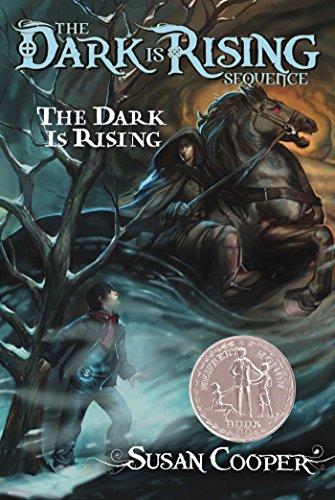
It seems clear that Masefield’s book influenced many later children’s stories: T.H. White’s Sword in the Stone (1938), Elizabeth Goudge’s The Well of the Star (1941), C. S. Lewis’s Narnia books such as The Lion, the Witch and the Wardrobe (1948), Susan Cooper’s The Dark Is Rising (1973), and probably even J. K. Rowling’s Harry Potter books.
Today’s children might have trouble untangling the period slang, historical references, and folklore. Also, unlike the books mentioned above, the plot, if it exists at all, seems almost beside the point until we get towards the end. Instead, we fall from a fairly ordinary train journey into a series of increasingly odd adventures which are indeed delightful but can leave the reader feeling unmoored. Still, I hope children will try it; adults, too.
This is a book I will return to during the holiday season, as so many others do. I’ll probably skip around to favorite bits rather than read it straight through, but we’ll see.
Is there a book you like to reread in December?