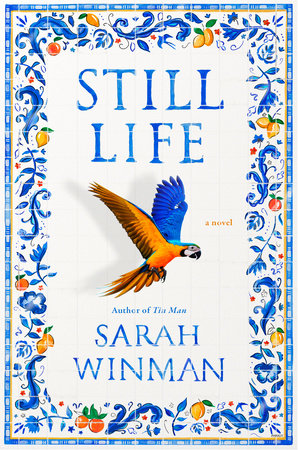
Tuscany, August, 1944. Taking a walk after lunch, Evelyn Skinner sees a jeep and waves it down. As an art historian with decades of experience, she’s in Italy to help with the artworks from museums and churches that have been hidden in the hills during the war, identifying them and assessing the damage. She asks the young English soldier driving the jeep, Private Ulysses Temper, to help her contact the Allied Military Government.
Even in this brief scene, these two people capture the imagination, while Tuscany itself seizes the senses. Ulysses is on his way to pick up Captain Darnley, who has opened his eyes to glories of Italy and art and literature, and takes Evelyn along. Then we jump to London where we meet Ulysses’s wife Peg, Col who runs the bar where she sings, Cress who converses with a tree, the parrot Claude who lives in the bar and quotes Shakespeare, and others. From that point on the novel alternates between London and Florence.
I picked up this book wanting to spend some time in Italy in the middle of the twentieth century. The description are luscious, but the true beauty of the book comes from showing how the fragile threads we throw out to each can, over time, become a beloved community and a motley group of eccentrics can become a family.
There’s never any confusion with the wide cast of characters spread between the two cities. Each person vibrates with life, their adventures by turns dangerous, hilarious and poignant. We meet them as they gather in the sort of places we’ve started to call the commons: a pub, a café, a plaza. We follow them over the decades as they, and we, begin to see how these relationships that began so casually have become a web that can support them during the worst times.
Some people in my book club were bothered by the many unlikely coincidences, but most of us enjoyed the fairy tale quality of the story. We also appreciated the subtle use of symbols and the way different kinds of arts were folded into the story: music, paintings, sculpture, poetry, literature. The descriptions of places and people seduced me, and the dialogue is some of the best I’ve read.
However, the decision to present dialogue without quotation marks poses a problem. It’s a cool, modern thing to do, but this fiction is set in the past. Worse, I often couldn’t tell what was dialogue and what was narrative. Some stories manage to make this clear without the punctuation, but not this one. Most of the people in my book club had trouble getting into the book; they started and stopped, tempted to give up, or they had to reread parts near the beginning a few times before taking the plunge. They thought the lack of quotation marks played a part in their confusion.
Writers often struggle with beginnings and endings. In some of my reviews, you’ll find a complaint about an ending that seems too abrupt or that ties things up too neatly. Here, I found the opposite problem: the last section should have been cut. Unfortunately it leaves behind the rich cast of characters we’ve come to love in order to follow a single one, and introduces a slew of new characters here at the end of the book. The section is well-written, but unnecessary to the story. It felt like padding. I was disappointed, too, that it took some wonderfully evocative allusions from earlier in the book and ran them into the ground, just in case we didn’t get them.
Yet even with these concerns, I don’t know when I’ve enjoyed a novel as much as this one. Each time I picked it up, I felt as though I were sinking into a rich, delicious dream. What a wonderful, luxurious summer read!
What novel set in Tuscany have you enjoyed?