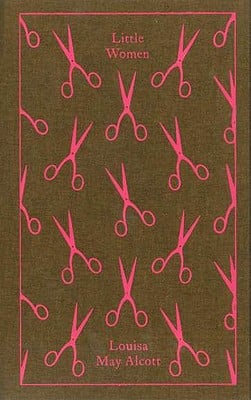
Meg, Jo, Amy, Beth: Those of us who grew up with the March girls didn’t know that what we were reading was not what Alcott originally published in 1865.
Book One of this classic novel covers a year in the life of the four March girls, from one Christmas to another. The sisters try to be good so as not to worry Marmee, Father being away with the war. Mostly they succeed, despite the usual sisterly feuds and jealousies sparked by four very different temperaments. Book Two was an afterthought, following them as they grow up and marry (or not).
Being only ten or so when I first read it, I didn’t pay much attention to Book 2. Of course, Jo was the only one who mattered to me, rebellious Jo with her apples and writing, her reading in the attic, her desire for some privacy. Like Jo, I hid away to read. I made up plays for my (too) many siblings to enact. I devised outdoor games for us and the other neighborhood children. All my friends also identified with Jo—no surprise given that we were climbing trees and wearing pants which were all a bit shocking still in the 1950s.
I can draw a straight line from Jo, who was based on Alcott herself, to my later obsession with Emily Brontë. I moved quickly from the books by the Brontë sisters to their lives in that lonely stone house in Haworth. Of course I was drawn to rebellious Emily, independent Emily who loved the moors and being alone and refused to behave like a proper girl. Writing about her as a child, Emily’s father described her strong will. I hid mine to stay out of trouble, but it was there all right.
With their brother Branwell, the three sisters carved into two pairs: Charlotte and Branwell, Emily and Anne, just as the March sisters did: Meg and Amy, Jo and Beth. There are other parallels: delicate and good Anne like Beth, practical Charlotte like Meg. However, the Brontë siblings did not have a wise and loving Marmee. With their mother dead and their father cold and righteous, they were cared for by their aunt Elizabeth Branwell. She’s usually described as a stern disciplinarian, but now there’s some evidence that she was actually a devoted and caring parental figure.
Although we know Alcott drew on incidents from her own life, I wonder if she was thinking of the Brontës when she started drafting Little Women. The Alcotts were assiduous readers, and the dates fit. Wuthering Heights came out in 1847 and the first U.S. edition was a year later. Alcott started writing Little Women in May of 1868 and sent it to her publisher in June. Book One was published October 1868 and Book Two a few months later (January, 1869).
It is with the 1880 version, combining the two books into a single volume, that the mischief occurs. Her publisher asked Alcott to make certain changes designed to make it—especially the depiction of Jo—more bland and acceptable. In her brilliant introduction to the recent reissue of the original version, Elaine Showalter suggests that later editors probably made additional changes. She explains that many of the literary references were removed, Jo’s speech was smoothed out, and her behaviour made more ladylike. Even the description of Marmee was romanticised.
Original: “. . . a stout, motherly lady, with a ‘can I help you’ look about her, which was truly delightful. She wasn’t a particularly handsome person, but mothers are always lovely to their children…”
Revised: “. . . a tall, motherly lady, with a ‘can I help you’ look about her, which was truly delightful. She was not elegantly dressed, but a noble-looking woman, and the girls thought the grey cloak and unfashionable bonnet covered the most splendid mother in the world.”
Interesting, eh? The original, with Showalter’s introduction is available from Penguin Classics (2010). Showalter has also added footnotes, some of which identify the sources of those pesky literary references. I was tickled to stumble upon a reference that she hadn’t footnoted: In Chapter 21, Jo backs away from one of Laurie’s wild schemes and says “ ‘Prunes and prisms’ are my doom, and I may as well make up my mind to it.”
That’s from Charles Dickens’s Little Dorrit:
“Papa is a preferable mode of address,” observed Mrs General. “Father is rather vulgar, my dear. The word Papa, besides, gives a pretty form to the lips. Papa, potatoes, poultry, prunes, and prism are all very good words for the lips: especially prunes and prism. You will find it serviceable, in the formation of a demeanour, if you sometimes say to yourself in company—on entering a room, for instance—Papa, potatoes, poultry, prunes and prism, prunes and prism.”
What do you think? Is it so weird to see both Jo and Emily as my wild sisters? Should girls stick to prunes and prisms? Is a part of you still in an attic reading books and eating apples with Jo?
What do you carry with you from an early reading of Little Women?