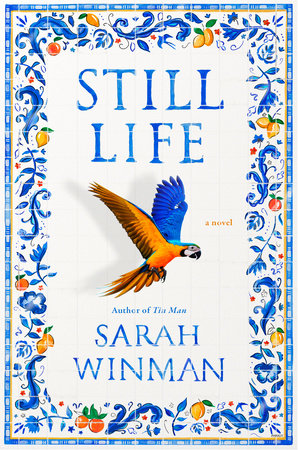
Still Life, by Sarah Winman

Tuscany, August, 1944. Taking a walk after lunch, Evelyn Skinner sees a jeep and waves it down. As an art historian with decades of experience, she’s in Italy to help with the artworks from museums and churches that have been hidden in the hills during the war, identifying them and assessing the damage. She asks the young English soldier driving the jeep, Private Ulysses Temper, to help her contact the Allied Military Government.

Even in this brief scene, these two people capture the imagination, while Tuscany itself seizes the senses. Ulysses is on his way to pick up Captain Darnley, who has opened his eyes to glories of Italy and art and literature, and takes Evelyn along. Then we jump to London where we meet Ulysses’s wife Peg, Col who runs the bar where she sings, Cress who converses with a tree, the parrot Claude who lives in the bar and quotes Shakespeare, and others. From that point on the novel alternates between London and Florence.

I picked up this book wanting to spend some time in Italy in the middle of the twentieth century. The description are luscious, but the true beauty of the book comes from showing how the fragile threads we throw out to each can, over time, become a beloved community and a motley group of eccentrics can become a family.

There’s never any confusion with the wide cast of characters spread between the two cities. Each person vibrates with life, their adventures by turns dangerous, hilarious and poignant. We meet them as they gather in the sort of places we’ve started to call the commons: a pub, a café, a plaza. We follow them over the decades as they, and we, begin to see how these relationships that began so casually have become a web that can support them during the worst times.

Some people in my book club were bothered by the many unlikely coincidences, but most of us enjoyed the fairy tale quality of the story. We also appreciated the subtle use of symbols and the way different kinds of arts were folded into the story: music, paintings, sculpture, poetry, literature. The descriptions of places and people seduced me, and the dialogue is some of the best I’ve read.

However, the decision to present dialogue without quotation marks poses a problem. It’s a cool, modern thing to do, but this fiction is set in the past. Worse, I often couldn’t tell what was dialogue and what was narrative. Some stories manage to make this clear without the punctuation, but not this one. Most of the people in my book club had trouble getting into the book; they started and stopped, tempted to give up, or they had to reread parts near the beginning a few times before taking the plunge. They thought the lack of quotation marks played a part in their confusion.

Writers often struggle with beginnings and endings. In some of my reviews, you’ll find a complaint about an ending that seems too abrupt or that ties things up too neatly. Here, I found the opposite problem: the last section should have been cut. Unfortunately it leaves behind the rich cast of characters we’ve come to love in order to follow a single one, and introduces a slew of new characters here at the end of the book. The section is well-written, but unnecessary to the story. It felt like padding. I was disappointed, too, that it took some wonderfully evocative allusions from earlier in the book and ran them into the ground, just in case we didn’t get them. 

Yet even with these concerns, I don’t know when I’ve enjoyed a novel as much as this one.  Each time I picked it up, I felt as though I were sinking into a rich, delicious dream. What a wonderful, luxurious summer read!

What novel set in Tuscany have you enjoyed?
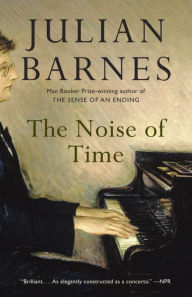
The Noise of Time, by Julian Barnes

9781101971185_p0_v1_s192x300

In this new (2016) book from Julian Barnes, we enter the world of composer Dmitri Shostakovich. After a brief prologue, we find ourselves next to the lift in his apartment building, a small suitcase at his feet. He debates bringing a chair from the apartment, but he’s too nervous to sit and anyway, “it would look decidedly eccentric, sitting down to wait for the lift.”

The year is 1936 and Shostakovich in undergoing the first of three “conversations with power” that will alter the course of his career, his life, and his self-respect. When we learn why he is waiting by the lift, we understand that the stakes couldn’t be higher.

Life for an artist under Stalin is a series of compromises. One could choose the heroic gesture, but probably only get one chance since it inevitably would lead to imprisonment and/or death. In a series of exquisitely calibrated musings, Shostakovich ponders cowardice and compromise, and his interactions with the powerful. We follow rabbit trails into his past and present, but always his thoughts center around his music. I want to go back and look more closely at how Barnes has constructed this story so effectively.

Shostakovich is trying to navigate a narrow path that will enable him to continue composing what he wants without getting himself and his family killed. This is not an easy task since those in power define not only what is good art but also the actual purpose of art.

The book is structured in three parts, corresponding to his three encounters with the head of the Soviet state, each twelve years apart. I was particularly struck by the inside view of what life is like under a tyrant. Sadly, this seems to be a preview of things to come in the U.S. and what is already happening in countries like Hungary.

I relished the inside view of this man who is quite ordinary and quite remarkable at the same time. I am endlessly fascinated by what it means to live a good life, what choices and compromises we are faced with and how we negotiate them. Shostakovich criticises others, second-guesses himself, wonders what music he might have written if he hadn’t been constrained by the Soviet state. He counts over his awards half-heartedly, turning his thoughts more often to his defenses and failures.

All his life he had relied on irony. He imagined that the trait had been born in the usual place: in the gap between how we imagine, or suppose, or hope life will turn out, and the way it actually does.

In addition to considering the difficulty of leading a good life, Shostakovich also imagines what it is like to be one of the sycophants sucking up to Stalin or the tyrant himself. He declares that Shakespeare’s plays are no longer relevant: “for all that he was unparalleled in depicting tyrants knee-deep in blood, Shakespeare was a little naive. Because his monsters had doubts, bad dreams, pangs of conscience, guilt.” Shostakovich doubts that his tormenters ever see “the spirits of the dead rising to reproach them.”

As readers of this blog can probably deduce, Barnes is one of my favorite writers. I bought this book without even looking to see what it was about; I knew if it was by him I would be intrigued and challenged and ultimately changed. I have been, it’s true. And also chilled by this look at what seems to be coming to my country and too many others.

What books have you read about trying to work as an artist under a dictatorship?

Stirring the Mud: On Swamps, Bogs, and Human Imagination, by Barbara Hurd

9780820331522_p0_v1_s118x184

I loved this book so much that the person from whom I borrowed it actually gave it to me (thanks, Anne!). Reading it, I was reminded of Annie Dillard’s Pilgrim at Tinker Creek, a book about encountering the natural world and the human condition, a book that stunned me. So much so, now that I think of it, that the person from whom I borrowed it gave it to me (thanks, Jill!).

Stirring the Mud is a slight book, only nine essays, but I’ve been reading and rereading it for weeks, pondering the images and leaps of thought.

To love a swamp . . . is to love what is muted and marginal, what exists in the shadows, what shoulders its way out of mud and scurries along the damp edges of what is most commonly praised.

My love for the natural world tends to lean toward trees and streams, long walks on ocean beaches, and the rosemary and warm tomatoes in my garden. I’ve had an inchoate fear of swamps since childhood, when one third of our property by the Chesapeake Bay was a swamp. Or at least, that’s what my mother called it, warning us to stay out of it because it was full of snakes.

What unnerves me now about swamps and bogs, having stumbled into more than a few, is the uncertainty, the way what seems solid suddenly gives way under you. Hurd persuades me to treasure this experience. She reminds me that this feeling is both the fear and the joy of creativity: each time I start to write, I plunge into uncertainty.

Reading these essays, I came to love standing with Hurd as she lets her shoes sink into the mud, water seeping in to wet her socks, thinking about what grows there, what is lost there, what is preserved there. She examines the liminality of these places, how mysteriously hidden their edges are.

When by some act of grace, the lines we think are there dissolve, something else appears, something timeless and rich, an intermediate zone, languid and latent, the lushness of something about to be and in no particular hurry to make it happen.

I appreciate the information she includes to provide context, telling us for example that Finzel Swamp is a palustrine wetland and explaining what that means. Most of all, I love her close observation of the swamps she visits and the way she includes us in the experience.

One time, not far from the alders at Finzel, I found a small congregation of Indian pipes sprouting out of the leaf mold. Two inches high, these albino plants resemble a sculpture of dripped wax turned upside down in the dirt. The color of breast milk, bluish, almost translucent, they are saprophytic plants, meaning they need decay in order to live. I don’t know what it is about such ghostly whiteness that suggests silence, as if color were also sound and the absence of one means the absence of the other. Lovers of the damp, they don’t look like pipes to me but like nuns, their heads bowed, lips open, mouthing a constant and silent syllable.

Look at the lovely consistency of imagery in that description: congregation, dripping wax, ghosts and nuns. Even their name suggests the pipes of the organ with their open mouths, singing. And other images set against them, muddling them: breast milk, decay, absence.

I know I will keep coming back to this book. For the last few years I’ve been pondering margins and thresholds, but Hurd’s essays have caused a fundamental shift in my thoughts. I realised I’d been thinking of margins and thresholds as horizontal, stepping through a door for instance. Hurd makes me consider the vertical, what is below me, invisible if my eyes are trained on what may be in front of me. Similarly, based on reading poet David Hinton’s work, I’ve been letting go of the idea of time as linear and instead thinking of it as a constantly changing present, a present that I am sinking into ever more deeply.

What do you associate with swamps or bogs?

Playlist 2015

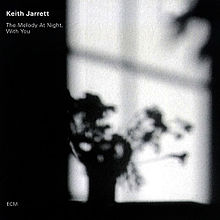
220px-The-melody-at-night-with-you

Songs, whether vocal or instrumental, are stories too. And sometimes poetry. I listen to a lot of classical music and–when I want calm and comfort–to Keith Jarrett’s The Melody at Night, with You. The playlist below filled the rest of my musical hours; they are the songs I kept coming back to this year. Many thanks to my friends for their music.

Desperado, Johnny Cash
Marching Through Georgia Lament, Jacqueline Schwab
Johnny Has Gone For A Soldier, Jacqueline Schwab
And Am I Born To Die, Béla Fleck & Abigail Washburn
New South Africa, Béla Fleck & Abigail Washburn
Bitter Boy, Kate Rusby
Times A-Getting Hard, Happy Traum
Shebeg An Sheemor, Happy Traum
Gypsy Davey, Happy Traum
Sail Away Ladies/A Roof for the Rain/Snake River Reel, Ken Kolodner & Brad Kolodner
Black Jack David, Sweet Felons All
Raggle Taggle Gypsies, Sweet Felons All
Cornish Lads, Sweet Felons All
Adieu Adieu, Sweet Felons All
The Star Of The County Down, Walt Michael & Company
Ruins by the Shore, The Paul McKenna Band
Flying Through Flanders, The Paul McKenna Band
Slängpolskor, Lydia & Andrea
Schottis till Tom, Lydia & Andrea
Sweet Thames Flow Softly, Ian Robb

51DSEQNPl-L._SS135_SL160_

I also have to add that I’ve been listening to Ryland Angel’s mostly a capella Christmas CD The New Voice of Christmas. His voice is quite lovely–I should say all his voices, since he sings multiple parts. What a range! I especially like an old favorite: In the Bleak Midwinter, and a hymn new to me: Be Thou My Vision.

What music have you been listening to?