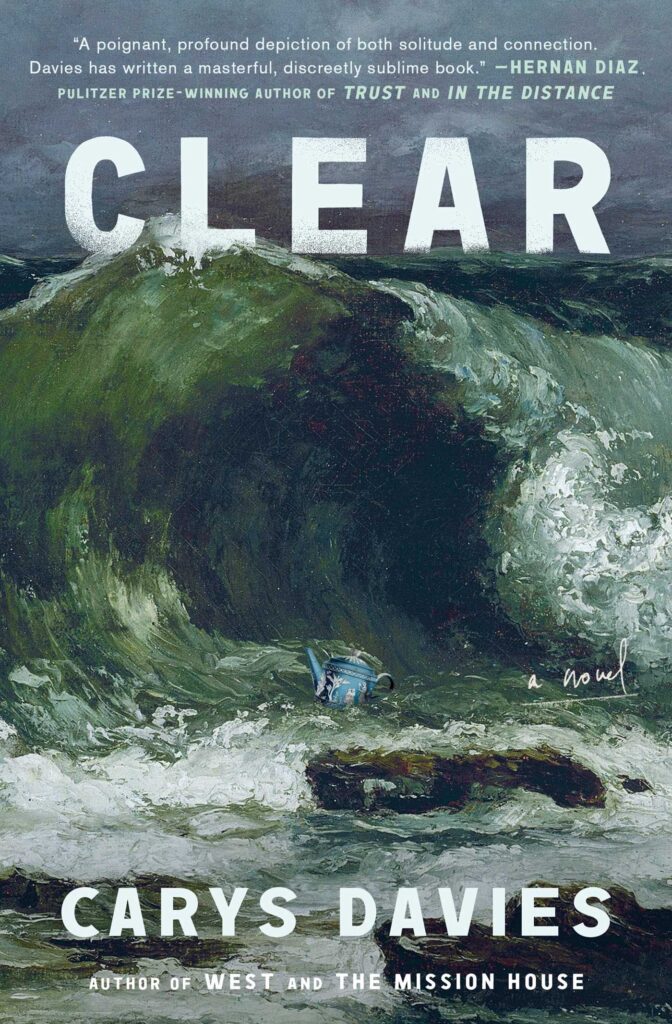
In 1840s Scotland, John Ferguson makes the difficult decision to become one of the evangelical ministers leaving the Church of Scotland to help form the Free Church of Scotland. It means giving up his job and income, but at least his church will be free of patronage and interference from the British Government. Also, it’s not the life he’d promised his wife Mary, but she accepts his choice.
The other major political upheaval besides the Disruption of the Church of Scotland is the ongoing Highland Clearances in Scotland which saw wealthy rural landowners evicting tenant farmers to clear the land for cattle or sheep. Most of the people in my book club were not familiar with the Clearances, which caused immense poverty and fury among the rural poor. A couple of us knew about them through our reading or family stories, but none of us had heard of the Disruption.
Desperate for funds, John jumps at the offer of a temporary, well-paying job as a factor. His assignment is to travel to a remote Scottish island and evict the lone remaining inhabitant—Ivar—so the island may be turned over to sheep. However, soon after arriving on the island he’s badly injured in a fall from a cliff.
Ivar finds the unconscious man and takes him into his home to nurse him. For a long period, John does not remember why he is there and busies himself learning Norn, the ancient language used by Ivar, so the two can communicate.
This lovely story is told in through three perspectives: Ivar, John and Mary. The author’s descriptions of the lonely island and Ivar’s life there are stunning both for their beauty and their authenticity. I especially enjoyed the language lessons, using actual Norn words that are poetic in their precision, such as the word “for the moment before something happens; for the state of being on the brink of something.”
It’s also a story of connection, of how a life of isolation and solitude can be transformed by the arrival of another human being. The author’s spare, elegant prose turns the book into, as one member of my book club said, a real gem.
Curiously, everyone in the book club understood the ending differently. No spoilers here, though many reviewers have criticised the ending as abrupt and unearned. For us, even though we read it aloud several times, we still understood it to mean different things.
That’s okay with me. I don’t mind endings where the story seems to go on after you close the book. In fact, the different endings we came up with said more about each of us that they did about the book. One person suggested we write to the author and ask her to write a sequel, though that mostly reflected our desire to spend more time with the characters.
I do mind when the ending is unearned. I believe the story could have prepared the ground for it a little better, but I actually liked it as it is.
If you enjoyed Small Things Like These, you might enjoy this story. I certainly did, and that was one thing that my book club did agree on: we all were immensely glad to have read it.
What books set on a Scottish island have you enjoyed?