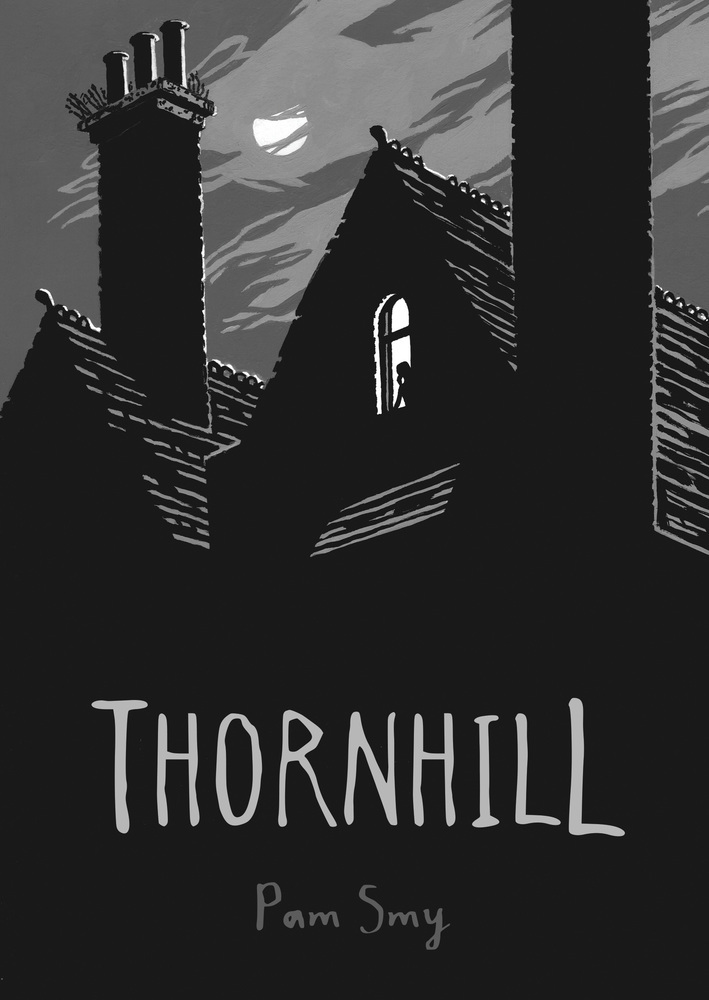
This unusual Young Adult (YA) novel is perfect end-of-October reading: stark, a little sad and a lot spooky. Part graphic novel and part journal, it’s a stunning portrayal of what many people experience, especially those on the tender, unpredictable cusp of adolescence.
Lonely Ella has just moved to town, her modern-day story told in striking black-and-white graphics, the only words being those occasionally written on items in the scene. We see an upstairs room, packing boxes, a window—and through that window a strange gothic ruin of a house buried in an overgrown garden.
The Thornhill Institute for Children, a boarding school for abandoned and orphaned children, closed in 1982. Mary is one of the last to leave, and it is her journal that runs parallel to the silent pictures depicting Ella’s life. Mary writes of terrible goings-on at Thornhill, especially the bullying directed at her. She takes refuge in her attic room, locking the door against the nightly bangings of her chief persecutor. There she makes puppets and dolls—creating her own friends—and reading.
Ella’s mother has apparently died, and her busy father seems to have little time for her. Sometimes we see through a crow’s eyes; is it the crow or Ella who first sees a shadow in an attic window of the dilapidated Thornhill? Ella finds a way into the property and begins exploring.
The book made me consider what we see and what we don’t see. The adults at Thornhill don’t see Mary’s suffering, nor does Ella’s father see her loneliness and her grief for the loss of her mother. Mary’s diary reveals her uncertainty about whether to trust what she sees, such as overtures of friendship from her persecutor. It also shows her hiding from view in her room, more and more as the story continues.
We readers see only Mary’s words and the pictures of Ella’s life. I found this distancing effective because it made me create their stories myself. That happens with the best traditional novels, of course, but I felt newly challenged here. I was reminded of what writer/teacher/agent Donald Maass has said about creating emotion in our stories. Just describing the emotion doesn’t make the reader feel it. Instead, we have to set up a situation that invites the reader to remember feeling that emotion themselves; their own memories then supply the emotional heft.
I certainly found that to be true here. I was flooded with memories of that awkward, in-between time. Mostly I remember glorious days, enchanted moments, etc. but I was reminded that there were some bullying and loneliness; there was the need for a friend.
Another part of my thinking about what we see and how we see it was remembering a show of Andrew Wyeth’s paintings at the National Gallery entitled “Looking Out, Looking In.” His paintings of windows and doors made up the exhibition and sent me down a path considering point of view in a way that had nothing to do with first or third person but everything to do with where we are standing, whether we are inside or outside.
In Thornhill, we have windows and doors, walls and secret gardens, mysteries and ghosts. It’s a quick read, but the story may stay with you a long time.
What are some of your favorite spooky reads for October?