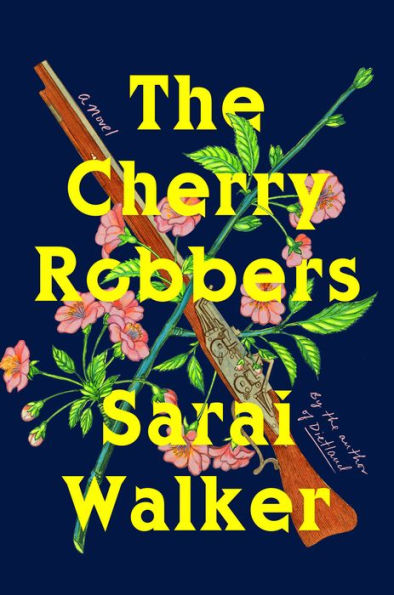
The Cherry Robbers, by Sarai Walker

Reclusive Sylvia Wren is a famous artist, now in her eighties, living in New Mexico and painting flowers that resemble women’s private parts. Her peaceful life is upended when a journalist discovers her long-buried secret: She is actually Iris Chapel, an heiress who has been missing for sixty years. Concerned that her story might be distorted or sensationalised, she begins to write it herself.

With that, we leave the frame story and plunge in the life of Iris Chapel, the fifth of the six Chapel sisters, born in the 1930s and all named after flowers. Their strict father is a gun baron, owner of Chapel Firearms, while their mother is a distant woman, obsessed by her own fears and her belief that the victims of those guns are haunting her. Alternating between screams and silence, Belinda also believes that the women of her family are cursed, and tries to keep her daughters from marrying

However, as the sisters begin to come of age in the 1950s, marriage seems to be the only way to get out of their restrictive home. Some of them long to live “normal” lives and head for that escape hatch, certain that the curse is just part of their mother’s madness. Iris comments:

It’s easier to say that women like my mother are crazy. Then you don’t have to listen to them. And so maybe in a way she became crazy. Maybe she could communicate only by screaming.

This novel was recommended to me when I was reading ghost stories around the solstice last month. I love the way Walker handles the spooky side of the story. People are haunted for sure, and sometimes ghosts are mentioned, but the story remains in a liminal space where the reader can believe in the ghosts or not. What is unmistakable is the underlying unease, a sense that something is dangerously wrong, and the way that unease intensifies as the story unfolds.

Iris alone believes her mother and tries to help her sisters. I loved the depiction of the communal life of the sisters, with their quarrels and tenderness, their jealousies and generosity. Like the plucky heroine beloved of gothic novels, Iris tries to be the compliant, self-sacrificing young woman her society demands, but says:

When you live in defiance of yourself, you can adapt to your circumstances, but remnants of who you are at your core remain. A bit of wildness that can’t be tamed.

With Iris as an engaging narrator, the first part of the story absorbed me. I found the  characters strong; the setting atmospheric, and the pacing excellent. However, the story went on too long and became repetitious. Also, coming back to the frame story at the end felt a little flat and predictable.

The use of Georgia O’Keeffe’s life and work to characterise Sylvia Wren disturbed me. Walker did acknowledge the artist in her note at the end, and she has a right to imitate O’Keeffe this way, since the artist is considered a public figure. If O’Keeffe were still alive would she object to this imitation? I don’t know, but somehow feel that this depiction is as jarring as commercials of Fred Astaire dancing with a vacuum cleaner. Similarly, using Sarah Winchester’s supposed fears as the centerpiece for Iris’s mother earned a raised eyebrow. I’m reminded of Milan Kundera’s Immortality where he delves into the morality of manipulating a person’s image and reputation after they are dead and cannot protest.

The title comes from D. H. Lawrence’s poem with its sensuality, blood and tears. While the metaphor of the cherry seems almost too direct, the poem brings more context to the uneasiness summoned by the image of a robber. I ended up liking the title and glad I read this book.

What do you look for in a ghost story?
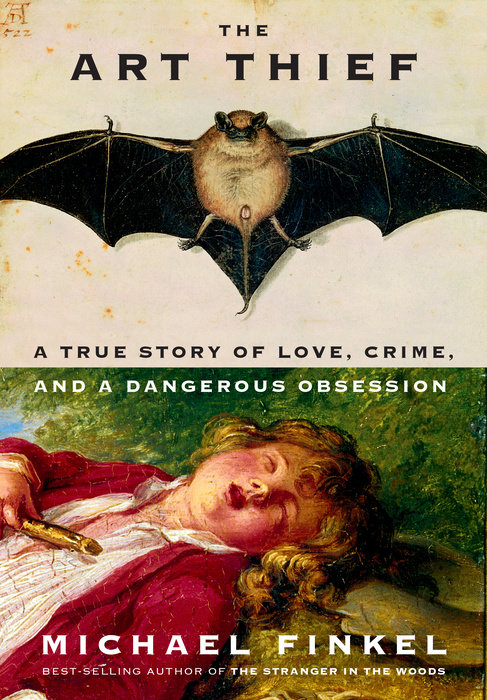
The Art Thief, by Michael Finkel

Why would a young man commit over 200 heists, stealing artworks and stuffing them into his attic bedroom? Finkel investigates the true story of Stéphane Breitwieser who stole nearly $2 billion worth of art—paintings, sculpture, tapestries, etc.—mostly from small museums that couldn’t afford a lot of security. Unlike other art thieves, he didn’t do it for the money. He claimed he did it to surround himself with beauty.

The first pieces he carefully displayed in his bedroom in the attic of his mother’s home in the French city of Mulhouse, but he couldn’t stop stealing and his loot began to pile up, as in any other hoarder’s lair. Breitwieser had no friends and didn’t work, but he did have a girlfriend who helped him pull off his heists.

Finkel’s earlier nonfiction book The Stranger in the Woods, about Chris Knight who spent 27 years living alone in a tent in the Maine woods, surprised me. Though curious to know a little more about Wright, I thought the story wouldn’t be substantial enough to fill a book—a feature article in a magazine, sure, but not a book. I was wrong. The depth of Finkel’s research, including in-person interviews with Knight and forays into the lives of the solitaries, kept me reading. I couldn’t help but catch his fascination with and curiosity about his subject.

Similarly here, Finkel keeps up the suspense to the last page. My book club all expressed their surprise at how spellbound they were by Finkel’s in-depth character study and by the artworks themselves.

We do have artists among us and all of us appreciate art. We’ve visited museums large and small, recognising sadly how scanty the security measures often are at the latter. How could they afford more? I remember many a small museum in Europe where, after paying a small fee at the door, I was free to wander about, no guards in the rooms and few other patrons.

We were also compelled by curiosity about Breitwieser himself. What kind of person would commit such selfish crimes? Not only did he endanger the art by taking it out of its controlled environment, but he hid it where only he and his girlfriend could enjoy it, denying the rest of us access. We were also interested in the two women who enabled him, the girlfriend who actively assisted him and his mother who pretended not to see what he was taking upstairs.

We called on the experts on law and psychology among us and speculated about his pathology. We all thought him such a strange person to act this way. But when we considered all the people these days who are greedily grabbing whatever attention, power, and money that they can, without the least regard for other people’s feelings, much less our lives and well-being—well, he’s not so strange after all. 

Also, while we deplored the thefts, we did feel a twinge of sympathy. A funny thing happened near the end of our discussion. One person admitted that every time they visit a museum she and her partner played a game of identifying which piece they wished they could take home with them. Several of us admitted to doing the same; I added that I usually tried to find a postcard of my chosen piece in the museum gift shop. We had a good laugh about how narrow the line is between our art appreciation and Breitwieser’s thefts. Yet it is a line none of us would ever consider crossing.

And therein lies the value of stories such as this. We’re not so different as we might think. Yet that difference is an important one.

What true crime story have you read that surprised you?

The Wonder, by Emma Donoghue

Like some of Donoghue’s other novels, such as Room and Haven,  this story again follows people confined in a tiny location. In 1850s Ireland Elizabeth (Lib) Wright, an English nurse, is sent to a rural area to stay with an 11-year-old girl who supposedly can survive without food. Anna and her parents say she has not eaten anything for four months, only water and—Anna says—manna from heaven.

A committee made up of villagers, including the doctor and priest, want to prove that the girl is truly not eating anything. Their motives are mixed, as we learn, but they are deeply influenced by the Catholic church and its stories of saints and miracles. To show their earnest motives, they hire both Lib Wright, who’s been trained in scientific nursing principles by Florence Nightingale, and a nun to take turns keeping watch over Anna.

Donoghue is too good a writer to let the women be flat symbols of science and religion. They are far more complex than that, and both waver into the liminal area between them. The story is told from Lib’s point of view, and she rails about the malign influence of the Catholic church and the way superstition and ambition play on the members of the committee.

Most of the story takes place in Anna’s small bedroom in the rough, rustic cottage where Lib requires the girl be isolated to ensure no one is slipping food to her. Even the parents must keep their distance except for a morning and evening greeting from her mother. Lib often clashes with the mother, such as insisting that pilgrims no longer crowd the cottage to see The Wonder and beg for her to bless them—before leaving a monetary offering of course.

Catholic doctrine and rituals guide the family’s days and nights. Anna prays constantly; her only books are religious texts. Lib herself is a sceptic and not religious at all. A veteran of the Crimean war and a short-lived marriage, she is determined to unmask the fraud quickly, so she can return to her hospital in England. Yet Anna, so smart and so sincere, begins to affect her during the long eight-hour shifts, just the two of them in the tiny room.

Among the other themes percolating through the story are ideas about food—it has not been that long since the potato famine in Ireland—and grief and the effects of isolation. I treasured the tiny hints of family, such as the destitute young cousin the family has taken in, and community where neighbors generously come up with scarce items such as extra mattresses and pillows.

Writers often talk about the ‘sagging middle’ where stories begin and end strongly but not much happens in the middle, leading to the reader giving up on the book. I gave up on this book several times. It seemed to drag on without much happening. Lib’s complaints about the Catholic church became repetitious as well, though perhaps that’s my fault, and  I’ve just read one too many books about the very real suffering of the Irish under the rule of a power-hungry church.

One solution to the ‘sagging middle’ is to include a turn in the very middle of the story. Sometimes called the fulcrum, hinge, or mirror moment, something happens that dramatically changes the protagonist and the course of the story. Not giving anything away, there is such a turn here which was interesting. However, I still struggled until the story picked up near the end.

I think what kept me going was my strong interest in that liminal moment in the 19th century when science challenged the church’s teaching. It seems important to revisit that time now when science is once again being thrown out in favor of gossip and superstition. And as a result, children are dying.

What period in the past gives you insight into today’s challenges?

Best Books I Read in 2025

As a writer, I learn something from every book I read. In no particular order, these are twelve of the best books I read in 2025. Please check the links to the blog archive for a fuller discussion of those I’ve reviewed.

Fiction

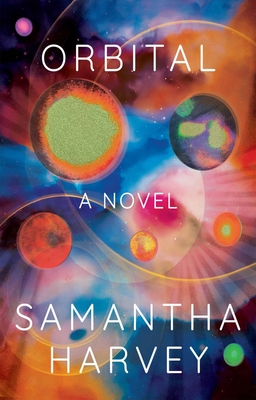
1. Orbital, by Samantha Harvey
Put six people from five countries into the International Space Station orbiting Earth and leave them there for several years. Now write about a single day, which encompasses sixteen orbits, meaning sixteen sunrises and sixteen sunsets. I immediately imagined around a dozen different stories that could come out of this premise. I never imagined Samantha Harvey’s Orbital.

2. The Painter of Silence, by Georgina Harding
In 1950s Romania a nurse named Safta recognises a new patient as her childhood companion. They’ve been separated by the war and the years and the changes wrought by Stalinist rule. Deaf and mute, Tinu only communicates through his art. This is the novel I have been waiting for. Hoping for. It is quiet and asks much of the reader as it unfolds.

3. In the Fall, by Jeffrey Lent 
In Virginia during the last days of the Civil War, a wounded Union soldier becomes separated from his comrades and is found near death by an escaped slave who saves him. Norman Pelham and Leah Mebane become inseparable and, after he is demobilised and they marry, the two decide to walk to his home in Randolph, Vermont. This story of three generations of Pelhams made me forget everything else in order to finish it.

4. The Summer Book, by Tove Jansson
The twenty-two chapters that make up this brief novel combine surprisingly poignant discussions between two women, one very young and one very old, with closely observed details of the natural world  on a tiny island in the Gulf of Finland. The chapters are deceptively plain yet leave the reader aware that each seemingly normal summer adventure holds a deeper meaning. Jansson’s simple and direct language leaves a silence similar to the white space around a line of poetry, space where a reader can bring forward her own memories.

5. Mrs. Dalloway, by Virginia Woolf
Reading this classic novel now, more than fifty years since I first encountered it as an undergrad, is quite a different experience. Back then I was confused and thrilled by Woolf’s modernist, experimental style that expanded forever my idea of what a novel could be. Now I see it as a story of midlife, in several senses of the word.

6. Middlemarch, by George Eliot
What stood out to me on rereading this classic is the theme of what it means to live a good life. By that I mean a life of integrity, one we can be satisfied with when we lie on our deathbeds. In Middlemarch we have all these lives, all of these people intending to do the right thing yet derailed by temptations and compromises and the pressures of daily life. As we follow each storyline, we get to see various permutations of what a good life might look like—or not.

7. Birds of Paradise, by Paul Scott.
A reread of one of my favorite books, I found this story of William Conway looking back and trying to make sense of his life as good as I remembered. Conway revisits people and memories from his childhood in India during the Raj, his English education, and his suffering in a Japanese prison camp during WWII. So much is obscured in our lives, so much we don’t understand at the time.

8. Brother of the More Famous Jack, by Barbara Trapido
I looked for some light reads this year and this one really tickled me.

Nonfiction

1. A Woman in the Polar Night, by Christiane Ritter
In 1934, the painter Christiane Ritter leaves her comfortable life in Austria to join her husband Hermann for a year in Spitsbergen, an island in the Svalbard archipelago, which lies between mainland Norway and the North Pole. Ritter’s journal summons the experience of surviving such a punishing climate and its surprising rewards.

2. Spell Freedom: The Underground Schools That Built the Civil Rights Movement, by Elaine Weiss
This well-researched and engaging book tells the story of some of the less well-known leaders of the Civil Rights Movement, courageous people who came before the famous speeches and laid the foundations for the Movement’s success by creating the citizen schools that prepared Black Americans in the Jim Crow South to register to vote.

3. Ghostland: In Search of a Haunted Country, by Edward Parnell 
A fusion of travelogue, literary review, and memoir that reminded me of (and mentions) W. G. Sebald’s Rings of Saturn, it sent me off to read many of the books I didn’t already know. And I discovered a story that sent me to the heart of something that has haunted me for a while.

4. The Lost Words, by Robert MacFarlane and Jackie Morris
When the Oxford Junior Dictionary was updated, it was found that around forty common words had been dropped—all of them words to do with nature. In response, MacFarlane and Morris came together to create what they call a spell book to help young readers rediscover the natural world, believing that unless we experience and learn to love the world of nature around us, we will not work to save it. This is the most beautiful book I’ve seen in a long, long while.

What are the best books you read in 2025?