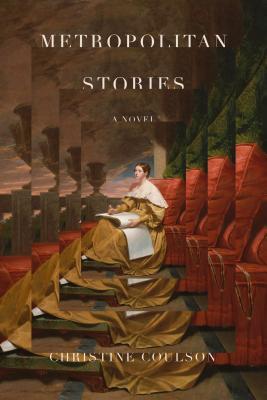
This month’s pick seemed perfect for one of my book clubs. Advertised as a behind-the-scenes look at The Metropolitan Museum of Art in New York by someone who’d worked there for twenty-five years, it seemed designed to appeal to frequent visitors and fans like us. Indeed, we all enjoyed revisiting a favorite place. Most of our group praised it, some enthusiastically, some less so, but still finding it light-hearted fun.
My own reactions were mixed. I found some of the stories amusing, some poignant, and a couple astonishing. However, I felt perturbed through the whole book, as though I were waiting for it to settle down and actually get started. Part of that feeling came from the uneven quality of the stories as well as from their different styles. Although the cover declares that the book is a novel, in fact it is a collection of short stories with almost nothing to connect them except that they all take place at the Met. It is true that occasionally a character or item turns up in another story.
The styles of the stories are inconsistent, ranging from magical realism to satire to naturalism. The surreal aspect to some of the stories—artworks personified, instances of time travel—is well done. Still, the piecemeal nature of the stories left me longing for some kind of thematic through-line other than the museum itself. I wondered if the stories could have been arranged differently to provide better transitions between them. Again, though, almost everyone else in my book club enjoyed it immensely as is.
The other part of my feeling perturbed is a result of my expectations for the book. Not only did it not qualify as a novel, there was little of the promised behind-the-scenes aspect. Yes, we visited the basement and the office of the director. We shared a neurotic curator’s worries about an upcoming exhibition and attended a fund-raising dinner. It was all rather superficial, though. Once you take away the ghosts and talking artworks, it seemed no different from any other office workplace and many of the characters the sort of people you’d find in any business.
Maybe I shouldn’t have expected much of a theme or emotional depth from what’s clearly meant to be a light read. Yet a couple of the stories do achieve both with brilliant results, so I found myself wishing the author had done more. Even in the superficial stories, there are hints of themes that could be developed.
The Met itself raises some expectations. Despite their delight in the book, some members of my book club were disappointed that with all of the wonderful art at the Met, little was made of the emotional impact of the art itself. We expected more wonder perhaps. A rare exception is this description of one piece of sculpture..
This particular Adam was a favorite of scholars, but not of the visitors who crowded around other, more famous sculptures at the Met. His pure white form was the first life-sized nude of the Renaissance, idealized and simplified, with uninterrupted planes of muscle and a soft, dreamy grace. Supported by his right leg, his left foot lifted lightly off the ground, Adam was an art historian’s work of art: garden sculpture to most, but revolutionary to those who understood his historical force.
Of course, it’s the author’s book and her choice, and readers’ expectations are their problem, not the author’s. However, in this case, expectations could have been managed by not calling it a novel and not emphasizing behind-the-scenes revelations. Another way to manage expectations would be to order the stories to better lead the reader into the world of the museum. For example, I and one other member of my book club were offended by one of the stories, and since it was right up front, it colored my reading of the whole book. I might have had a different reaction to the book if that story had been later.
Perhaps some of these decisions came from the publishers. This author clearly had terrific writing skills; the couple of astonishing stories in this collection prove that. I’m saddened to find that she passed away earlier this year, a terrible loss to her friends and family as well as to the literary and art worlds. I wonder if this book might have been different if she’d had more time to work on it. I plan to read her other book and her shorter pieces which are available on her website.
What novel have you read that’s set in a museum?