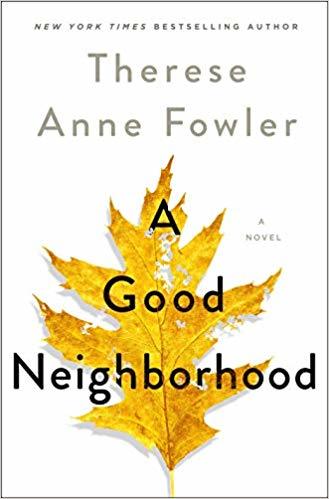
A Good Neighborhood, by Therese Anne Fowler

In Oak Knoll, a diverse and modest North Carolina neighborhood full of trees and ranch houses,  professor of forestry and ecology Valerie Alston-Holt is concerned about the people who’ve just moved in next door. Flush with new money, the Whitmans have ignored the character of the neighborhood and instead cleared all the trees from their plot and built a McMansion complete with in-ground pool.

Although Valerie is worried about the health of her beloved and historic oak tree, its root system disrupted by all the digging, she tries to find a way to get along with her new neighbors, inviting Ms. Whitman—Julia—to a book club meeting. Then Valerie’s bright and talented biracial son Xavier meets Julia’s teenaged daughter Juniper.

In order to shield her daughters Juniper and young Lily from the hardscrabble life she led until marrying her boss, the up-and-coming millionaire Brad Whitman, Julia had the family join an evangelical church. Juniper agreed to take the church’a purity vow in which she agreed that her virginity belongs to God and, until she marries, to his representative on earth: her stepfather Brad. Having just watched the Neflix documentary Trust Me, this vow gave me the creeps. Already Julia’s purity vow has opened her up to bullying at her new school.

Meanwhile, Xavier, a classical guitar prodigy, is off to college in the fall on a music scholarship. He has close friends to hang out and play music with. He’s had two brief relationships with classmates, but his heart wasn’t really in either. When he meets Juniper, though, he discovers the power and glory of love. And miracle of miracles: she, too, falls for him.

Fowler makes this familiar story both urgent and utterly engaging with a relatable setting, masterful pacing, and vivid characters. I like that she works against stereotypes with some characters, but wonder if she doesn’t go too far, making them either too good to be true or too evil.

What really makes the book stand out, though, is the use of the neighborhood itself to narrate the novel. They say right on the first page: “[W]e never wanted to take sides.” They come back as a chorus throughout the story, reminding me of Euripides’ plays and other Greek tragedies. Just as the main characters are changed in the course of the story, so too is the collective group.

Using the first person plural “we” as the point of view in a novel is unusual and difficult to do well. I loved Then We Came to the End, by Joshua Ferris, where he maintained that point of view until near the end of the book. Here the chorus appearing between more traditional third-person scenes adds to a sense of looming tragedy. Even more importantly, it includes the reader as part of the “we,” making us complicit in their attitudes and opinions.

What a brilliant way to work issues of class, race and women’s lives into an old story! Because of our involvement, we readers are put on the spot: What we really think it means to be a good neighbor? How can we share our community with those who may be different from us?

Fowler’s story is more important than ever during this time when resurgent racism is polluting our  society. We may not want to take sides, but standing aside while tragedy unfolds carries its own consequences.

Have you read a novel with an unusual point of view?
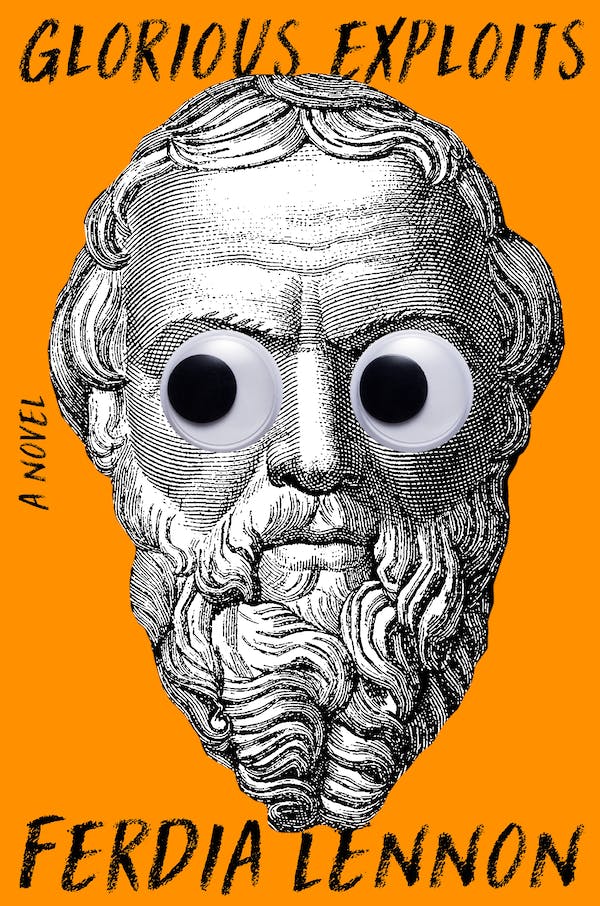
Glorious Exploits, by Ferdia Lennon

Syracuse, 412 BCE: The Athenians’ invasion has surprisingly been defeated and the surviving invaders stuck in an old quarry where they are dying in droves from malnutrition and ill-treatment. According to Plutarch, some of their captors so loved the plays of Euripides that they offered prisoners food in exchange for lines of verse.

Lennon, with degrees in History, Classics and writing, takes this morsel of history and creates something both fantastic and deeply human. Two out-of-work potters—Gelon who loves Euripides’ plays and Lampo who loves wine and fun times—make their way into the quarry armed with olives, bread and wine in search of verse. Eventually they decide to put on a fully staged performance of two plays by Euripides: Medea and The Trojan Women.

Lampo narrates the story in full-blown Irish vernacular, which is a little startling at first. He’s illiterate and doesn’t share his friend Gelon’s devotion to Athenian tragedy, but why not go along with it? He has nothing else to do. “Gelon says that’s what the best plays do. If they’re true enough you’ll recognize it even if it all seems mad at first, and this is why we give a shit about Troy, though for all we know, it was just some dream of Homer’s.”

It does all seem mad. But Lampo’s voice is irresistible. His wisecracks and pranks contribute much of the promised humor. However, as members of my book club said, for a book advertised as a comedy, most of it isn’t funny at all.

At first Lampo gloats about the prisoners’ suffering, saying of the stink in the quarry: “Ah, and I like the way they smell. It’s awful, bult it’s wonderful awful. They smell like victory and more. Every Syracusan feels it when they get that smell. Even the slaves feel it.” Yet, as they proceed with the plays, he cannot ignore the prisoners’ humanity. For me the most interesting aspect of the book is how the characters, especially Lampo, deal with setbacks and successes, finding parts of themselves they never knew existed and looking at others in ways they never thought possible.

I don’t think I’d have read this book if one of my book clubs hadn’t selected it. The premise didn’t seem like something I’d choose, especially in this time of too many stupid wars and inhumane concentration camps. I’m glad I did.

This story surprised me in ways that few novels do these days and moved me even when I didn’t want to be moved. It’s oddly light-hearted despite the grim circumstances. It seems to me to be a buddy caper like Butch and Sundance with a bit of Mickey Rooney/Judy Garland hey-let’s-put-on-a-show’s energy. Lennon doesn’t press his themes hard but leaves us to take what we will from this remarkable story.

What novel have you read that surprised you?

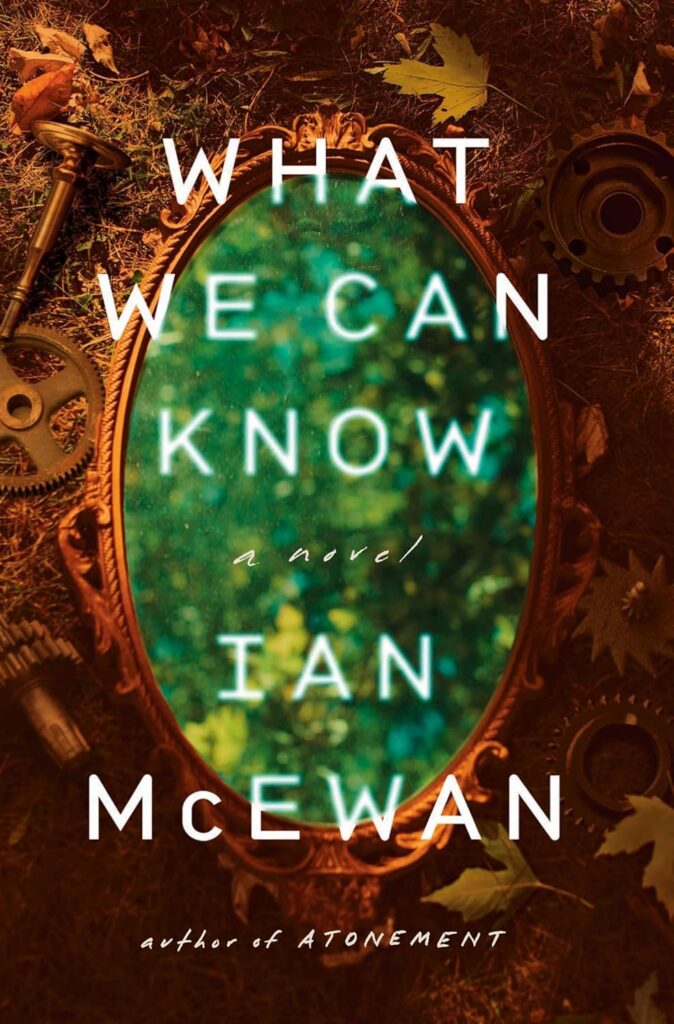
What We Can Know, by Ian McEwan

In McEwan’s latest novel it’s 2119 and the world has achieved a tenuous stability after the long-predicted climate catastrophe. Combined with a nuclear accident, climate change led to what’s known as “The Inundation,” a tsunami which devasted continents, leaving the UK an archipelago of former mountaintops, Nigeria the wealthiest nation and storehouse of knowledge, and the U.S. in fragments run by heavily armed warlords.  

The digital world has been preserved, though, and scholars of the 22nd century have access to everything previously stored in the cloud including our emails, DMs, and social media posts. Nostalgic for the lost pre-Inundation world, Thomas Metcalfe, a scholar of literature from 1990 to 2030, is fascinated by a poem called “A Corona for Vivien,” written in 2014.

Thomas has the facts: Francis Blundy, a famous poet, composed it for his wife Vivien and read it aloud at her birthday dinner in October 2014. It has since been lost. Francis is determined to find it and thus make his name in the world of academia. He’s read everything he can find on Francis, Vivien and their friends and, as a result, believes he understands their feelings and motives, so much so that he feels entitled to fill in gaps with what he imagines they must have felt and thought.

However, as we learn, Thomas doesn’t understand at all. He visits the Bodleian Library, now on a peak in Snowdonia. Then he and his sometime-girlfriend Rose, another academic who mocks Thomas’s obsessions, take off on a quest to find the poem itself, leading to an entirely different second half of the book.

The novel is an interesting intellectual exercise about the limits of our knowledge of the past and, indeed, of ourselves and the people around us. However, as I’ve mentioned before, his characters seem cold and impersonal to me. I often have difficulty believing in them as anything more than  convenient pawns to move the plot forward. I couldn’t accept Thomas’s complete cluelessness, Rose’s patience with her man-child,  Vivian’s mix of passivity and sexual hunger, or Francis’s nacissism.

I’ve reviewed many of McEwan’s books, mostly because my book club likes to include them in our schedule. This time we encountered a curious split. Some people liked the first, dystopian part and thought the second part contrived, while others thought the second part realistic and the first part boring.

We all agreed, though, about the quality of McEwan’s prose. Sentence by sentence, there is much to be learned by studying his work. We also agreed that his description of the heartbreaking difficulty of caring for someone with dementia truly captured that reality.

As often with his novels, the adjacent discussions were the most interesting. We talked about history and the way details are selected and presented by historians, who (like all of us) have their own ideas and preconceptions. We also talked about the inevitably performative aspect of our interaction with others. The manner we adopt when we stand up to teach a class is different from the one we use when sitting around a table with wine and cheese to discuss a book with friends. There’s nothing dishonest in this. We contain multitudes, as Walt Whitman famously declared of himself.

So McEwan’s novel, for all its flaws (to my mind, anyway), is a potent reminder of our limits. We fumble about with our partial knowledge of ourselves, others, and the world, forming opinions and making decisions that have consequences. We do the best we can with what we know.

However, when I think of Thomas filling in the gaps in the records, I’m reminded of an issue that I often confront as writer of memoir and other forms of creative nonfiction: How do I respectfully write about the real people who are present in my piece? I can change names or obscure details. I can try to write the emotional truth of a scene even if I don’t remember exact words or details. I can depict them as the complex people they are instead of one-sided caricatures.

Yet I still feel I’m in danger of invading their privacy. This book warns me against the arrogance of believing I know anyone sufficiently to believe I can depict them in their fullness. And it reminds me of the hurt caused by appropriating someone else’s story. At the same time, I believe in the power of stories and hope they will continue to be told many years into the future.

What do you think our world will be like in a hundred years?

The History of Sound, by Ben Shattuck

In 1984 a renowned singer and music scholar receives a box of wax cylinders. Lionel knows what they are: the long-lost recordings from a trip he took in the summer of 1919, accompanying his friend and lover David who planned to record folksongs in rural Maine.

I was hooked right away because of my long-ago research into the song-collecting travels of Maud Karpeles, Cecil Sharp, and Anne and Frank Warner, as well as my more recent interest in the methodology. In Shattuck’s title story, Lionel is the shy novice while David is the persistent charmer who wears down reluctant backwoods singers.

The intensity of emotion mingles with the immersive setting of the woods to create a kind of dream. Yet we know from the beginning of the story that Lionel ends up alone, and that “this cylinder reminded me of what I’d missed—which is, I think, a life that I didn’t know but of which David was a part. The real one. And how ridiculously short it had been.”

Lionel tries to analyse the “bone-deep” emotions roused in him by the sight of the cylinders and the prospect of once again hearing David’s voice. “How to put it? This type of sadness. Not nostalgia. Not grief. Just the obvious and sudden fact that my life looked an inch shorter than it could have been. That the best year really had come when I was twenty.”

In an interview with The Adroit Journal, Shattuck describes exploring the idea that the “relationship between those in the present and past isn’t static — anyone who has discovered a secret about their family’s past knows this, that you can be changed by the past as it becomes illuminated.” How Lionel is changed by these artifacts from the past makes for a powerful experience.

Each of the remaining eleven stories is equally powerful, their waters troubled by the rip tide of history. As I enter my later years, I think often about my past, how it informs my present but also what I may have misunderstood back then. In this collection the mingling of past and present occurs not only within the stories but also between the pairs of stories.

For Shattuck has structured the collection, as he describes in a note at the beginning, using the “hook-and-chain” song or poem format popular in 18th century New England, where we have five pairs of stories, held within the first and last: A BB CC DD EE FF A. The second story in each set might provide some insight or twist to the first. It might be set before the first or long after.

All of these stories summon strong emotions independent of their time periods, universal emotions, refuting L.P. Hartley’s famous opening sentence “The past is a foreign country; they do things differently there.” Maybe, but emotions are the same. The primary one a few members of my book club found was regret. Some of the characters didn’t follow their hearts; some did and perhaps were sorry later. Yet there’s also humor in some of the author’s choices and playful stabs at how academics and historians misinterpret the past.

I fell into each of these mysterious stories so profoundly that I could only read one a day. Each story called me to sit with it a while, think about it, try to grasp what it meant to me. It was as though each one left me with a handful of shells, or stones perhaps, that I had to examine, turning them over and over, rubbing one or another to see what it might tell me.

I loved Shattuck’s use of an unusual structure and that he didn’t try to mimic period dialogue. I also liked the variations of point of view—first or third, close or distant—and verb tense—present or past—which keep the stories from falling into a rut. Most of all, though, I loved the surprising tenderness of the stories. He is gentle with his characters while keeping the writing strong and unsentimental. I’ve found that this kind of tenderness is what I love in the work of many authors I enjoy; their characters have good hearts.

The stories are spun together by theme and setting, yet can stand alone. They contain much that speaks to me and perhaps my own obsessions: the song collecting, the New England settings, the tenderness, the interplay of past and present. Yet it’s not just me; my book club was unanimous in its praise. They found the stories as moving and mysterious as I did.

This is my favorite book of the year so far, and that’s saying a lot. What has been your favorite book in 2026?