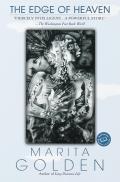
The Edge of Heaven, by Marita Golden

9780345431721

It’s been a few years since I read this novel by the incredible Marita Golden. In her work she consistently takes on issues so delicate that most are afraid to discuss them at all. Golden approaches them with intelligence and humanity, forcing us to envision and inhabit lives that may be different from our own. To me this is what make literature one of the highest callings: that it nurtures our empathy.

The story opens with twenty-year-old Teresa Singletary and her mother, Lena, facing a major turning point in their lives: Lena is being released from prison.

As Teresa’s grandmother (and Lena’s mother) Ma Adele says, “‘She’ll need you to love her, love her to the bone.’” But Lena isn’t at all sure she’s ready to do that. She bitterly resents the losses that her mother’s actions caused and misses the father who left them shortly before events spun out of control. Ryland has been too absorbed in his own grief to be much of a father to Teresa, leaving her to Ma Adele’s steadfast care.

All of these characters have a turn, as the story moves between Teresa’s first-person point of view and the third-person point of view of the others, particularly Lena. Their actions and memories balance Teresa’s and add context and depth.

Through this “chorus of voices” as Golden describes it in the Reader’s Guide, the story conveys the terrible damage not just to the person imprisoned, but also to her or his family. This theme is what brought me back to this book, now when it seems as though our society may finally be ready to confront the massive racial inequality in the U.S. prison system.

I’ve learned so much from Marita Golden’s workshops. Her skill is evident on every page. Look at how Ma Adele is introduced. About to leave for work, Teresa stops to see her grandmother, entering a bedroom full of plants and flowers. “Some days I heard her behind her door conversing with the plants. She had names the cactus Butch and the azaleas that hung from the ceiling Aretha.” From this we get a picture of Ma Adele as nurturing and having a sense of humor.

Further we find that she is still in bed reading the newspaper, signaling an active intellectual involvement in the world. “The TV remote control, a paperback mystery, an aged, tattered leather phone book, knitting needles, a ball of yarn, and a stack of bills littered my grandmother’s bed.” We are reminded that Ma Adele is perhaps tired, spending much of her time in bed, a woman asked in her old age to raise another child.

Among the litter on the bed is a stack of letters from Lena. Teresa says, “Each time I looked at my grandmother’s face I saw the shadow and the promise of my mother and myself.” By now we know how complicated her emotions are about this seemingly commonplace observation.

This is just one example. The story takes us deep into the history of these individuals and their experience as a family. While the journey is sometimes dark and the human cost is huge, it is in the end a story of love’s possibilities.

I hope with all my heart that we can learn to live inside the lives of others and, seeing the world as they do, make better choices. Stories such as these help us get there.

What novel have you read that illuminated a life different from your own?
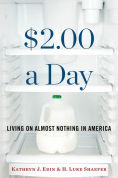
$2.00 a Day: Living on Almost Nothing in America, by Kathryn J. Edin & H. Luke Shaefer

9780544303188_p0_v3_s118x184

Did you think that the days of extreme poverty in the U.S. were over? Did you think there was a safety net in place? Think again.

After over 20 years of poverty research, Kathryn Edin began to see an entirely new level of despair: families in the U.S. getting by with almost no cash income. Luke Shaefer, an expert on the Survey of Income and Program Participation administered by the U.S. Census Bureau, didn’t believe her. He decided to prove Edin was wrong, using the World Bank’s poverty threshold as his upper limit. After crunching the numbers, however, he found that in 2011, “1.5 million households with roughly 3 million children were surviving on cash incomes of no more than $2 per person, per day in any given month.”

How could this happen in a country so prosperous? We hear a lot about income inequality these days, but not about this kind of extreme poverty. Through stories of individual families backed by solid research, the authors detail the reasons why this kind of poverty has been increasing since 1996, “and at a distressingly fast pace. As of 2011, the number of families in $2-a-day poverty had more than doubled in just a decade and a half.”

1996: you remember. That was the year welfare reform destroyed the safety net. No longer was there any guarantee for those whose severe poverty qualified them for assistance. And what federal money remained was changed to go to the states as block grants with wide leeway on how they could spend it; it didn’t actually have to go to poor people. As documented in this book, people are so routinely denied—often being told there is no more money—that most poor people don’t bother applying. Many don’t even know there is a benefit for which they qualify. The authors call the commentators who in 1996 foresaw the coming catastrophe “remarkably prescient”, but those of us who’d been poor saw it all too clearly; we knew how fragile and under siege our benefits had always been.

The other factor, of course, is the ever-worsening lack of jobs. Even if they can get a job—as everyone interviewed has done in the past—the pay is so low, the hours unreliable, the benefits non-existent, that it is not enough to lift them out of poverty. And that’s not even considering the ways that bosses take advantage of their employees, since it’s a buyer’s market for them.

How is it even possible to manage without a cash income? You can only use food stamps for actual food, not soap or kids’ shoes or rent or light. We meet many families in this book, each with their own strategies. Their stories are told with the calm of a social scientist, tempered by compassion. You cannot help but be moved by the stories of people like Modonna Harris standing in line for hours to apply for benefits only to be turned away. “Everyone knows you have to get here by at least 7:30, a full hour before the office opens.” We learn about her background, her search for work, everything that led her to this point.

The authors see this work experience as a cause for hope: those they interview have worked in the past and are desperate to work again. I found the same thing when I was on welfare 40 years ago. In the final chapter Edin and Shaefer lay out a roadmap for getting people back to work and helping those who cannot work.

My only disagreement with them is their blithe statement that “reverting to the old welfare system is not the answer.” I agree that in addition to money, Aid to families with Dependent Children (AFDC) dispensed stigma and isolation. As a former AFDC recipient, I experienced both and the hopelessness that comes with them. However, I would take that stigma and isolation a thousand times over to spare my children what happened to the children we get to know in this book: chronic malnourishment, abuse by sexual predators in overcrowded households, the temptation for a tenth-grade girl when a teacher offers her food in exchange for sex. I would make the same decision I made all those years ago when I said to myself: the kids come first.

Of course, I know there’s no going back to AFDC, even though it would be better than what we have now. The voting public has been too blinded by politicians determined to demonize the poor—such a handy target! so powerless to fight back. They have also been blinded by their own comfortable lifestyle, not recognising the privilege that got them there, or, for those in a lower income bracket, their fear of falling into poverty themselves.

I do endorse the authors’ proposed solutions. However, it will take a huge groundswell of public opinion to overcome our society’s bias against helping the poor. It will take all of us speaking out.

I hope you are moved. I hope you read this book. I hope you act.