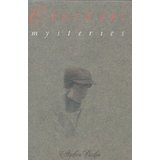
Ordinary Mysteries, by Stephen Vicchio

51pCnr2qcGL._AC_US160_

It’s been almost 15 years since I first read this collection of short essays by Vicchio, longtime Philosophy professor at Notre Dame College of Maryland. Even then I recalled having already encountered a few of the pieces in the local paper; this was back when Op-Ed pages sometimes carried such diversions.

The essays, which rarely run more than three or four pages, are what we would now call creative nonfiction. Truer to Montaigne’s original definition than to the formal school essays to which we’ve become accustomed, Vicchio’s ponderings range from funny to profound. Reading them is like having the best dinner conversation ever.

He takes the most ordinary occasions—looking at the clouds, going to a toy store, watching students raise their hands in class—and carries us more deeply into the experience. As a man who has read widely and thought deeply, Vicchio surrounds each simple experience with a web of echoes and associations.

For example, in “Music is its Roar” he writes about listening to the ocean on the last night of vacation in Bethany Beach, Delaware. After placing us in the moment by describing his porch and the beach and the children playing there earlier “looking like small King Canutes”, he tells us that “this evening everything has disappeared.” What follows are descriptions of the sounds and the thoughts roused by them, ranging from the Byron quote which provided the title, through baseball, Hindu priests and Darwin before coming to rest in Plato. Although this may sound forced and dauntingly erudite, believe me: It is not. The sentences flow one into another in a beautifully quiet rhythm, leading in only two short pages to a satisfying conclusion.

Others of his pieces take off from a news item. Since most of these pieces were written in the 1980s, you’d think old news would be boring. Unfortunately, though the names may have changed, we still have dishonest preachers, muggers, and mass murderers. We still have the mentally ill, shoved onto the street when the back wards were emptied, left to die alone, stifled by their delusions like Gladys Finkenbinder. The plastic she’d taped over her windows to keep the voices out prevented anyone from noticing the fire in her kitchen until it was too late.

In some essays, Vicchio writes about his childhood, summoning up a world now gone, a world of dancing to Buddy Deane with his sisters, cutting mass to have a cherry coke at the Rexall drugstore’s soda fountain, feeling awkward at CYO dances, watching Sky King on Saturdays, fearing the school incinerator and its terrifying keeper. Such pieces brought back many memories for me, but the grounding of experience in each is universal enough to appeal to those growing up in another time or place.

I especially loved the essays that touch on time and memory. This is a collection I know I’ll come back to again. And if you’re looking for some good dinner conversation, invite Stephen Vicchio by picking up this or another of his essay collections.

What essays have you read lately that set you thinking?
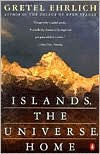
Islands, the Universe, Home, by Gretel Ehrlich

9780140109078_p0_v1_s192x300

My friend Laura recommended Ehrlich’s work to me, and I enjoyed Ehrlich’s novel, Heart Mountain. However, this collection of essays is truly stunning. In the things of her world Ehrlich finds tangible evidence for the thoughts and ideas jostling in her head, anchoring them to coherence.

Her world is primarily her ranch in Wyoming, its five-acre lake, the nearby mountains. In the short essay that opens the book, “Looking for a Lost Dog”, she starts by grounding us in concrete action: “I started off this morning looking for a lost dog.” She uses a couple of sentences to bring the dog to life, with the surprising image of a saddleshoe to describe his markings and the quick sense of ranch life from learning that his right front leg is crooked because it froze to the ground on the thirty-below-zero night he was born. Clearly the stakes are high in this environment.

Then she tells us, “I walk and I listen.” This is a good description of her modus operandi throughout the book and, indeed, for the essays that I have most loved, like Barbara Hurd’s Stirring the Mud and Annie Dillard’s Pilgrim at Tinker Creek. These writers combine close attention to the natural world with fragments of information and memory, not randomly thrown together, but carefully crafted to challenge us to open our minds. What we take away from this mosaic may be different for each of us.

Ehrlich in this essay never strays far from her concrete experience. She remembers another time when the dog was lost, and she found him by putting her ear to the ground to listen for him whining. This leads to thinking about what the construction of our ears, their limited range, says about humans, and the memory of a musician friend talking about the music of the world, “’the great suspiration of life everywhere.’”

But then she goes back to her search and describes the falls she heads towards, the raven overhead. From then on, she leaves the narrative only for a paragraph, a sentence, but each digression adds another dimension to the experience. We have all looked for what is lost, and sometimes tried to lose what has been found. Living through this essay awakened echoes in me, that resonated with the images she conjures up, deepening into chords, creating a new and strange music.

Many of the other essays in this book also take events on the ranch as their starting place. It is a life closely tied to the weather, as her explorations of the permutations within each season make clear.

It’s spring again, and I wasn’t finished with winter. That’s what I said at the end of summer too. I stood on the ten-foot-high haystack and yelled, “No!” as the first snow fell . . . It’s spring, but I was still cataloguing the different kinds of snow: snow that falls dry but is rained on; snow that melts down into hard crusts; wind-driven snow that looks blue; powder snow on hard pack on powder . . .

Other essays take us further afield: a search for the source of the Yellowstone River, a trip to Japan to follow in Bashō’s footsteps, a visit to the Santa Barbara Channel Islands to learn about the Chumash, a culture and language pulled back from the brink of vanishing by the work of a few dedicated people. I’d never heard of the Chumash before.

For eight thousand years or more, the Chumash lived in isolation and peace. One of at least sixty tribal groups in California, they once numbered fifteen thousand. They had no neighboring enemies and no warrior cult.

Their beliefs, their history, their experiences after being discovered are seamlessly integrated into Ehrlich’s journey to San Miguel, known to the Chumash as Tuqan.

In all of these journeys, Ehrlich’s gives her close attention to her immediate experience while layering in information, quotations, and feelings. Whatever conclusions she may have reached, whatever overall pattern she has found, Ehrlich does not force a lesson on us. We are left to draw our own conclusions from sharing her journeys. As she says in the brilliant first essay about searching for her lost dog, “I walk with a purpose but no destination.” Whatever destinations we find in these essays come from the resonances between the pieces of her mosaic and the echoes they call up in our own hearts.

What have you learned from the natural world?

Stirring the Mud: On Swamps, Bogs, and Human Imagination, by Barbara Hurd

9780820331522_p0_v1_s118x184

I loved this book so much that the person from whom I borrowed it actually gave it to me (thanks, Anne!). Reading it, I was reminded of Annie Dillard’s Pilgrim at Tinker Creek, a book about encountering the natural world and the human condition, a book that stunned me. So much so, now that I think of it, that the person from whom I borrowed it gave it to me (thanks, Jill!).

Stirring the Mud is a slight book, only nine essays, but I’ve been reading and rereading it for weeks, pondering the images and leaps of thought.

To love a swamp . . . is to love what is muted and marginal, what exists in the shadows, what shoulders its way out of mud and scurries along the damp edges of what is most commonly praised.

My love for the natural world tends to lean toward trees and streams, long walks on ocean beaches, and the rosemary and warm tomatoes in my garden. I’ve had an inchoate fear of swamps since childhood, when one third of our property by the Chesapeake Bay was a swamp. Or at least, that’s what my mother called it, warning us to stay out of it because it was full of snakes.

What unnerves me now about swamps and bogs, having stumbled into more than a few, is the uncertainty, the way what seems solid suddenly gives way under you. Hurd persuades me to treasure this experience. She reminds me that this feeling is both the fear and the joy of creativity: each time I start to write, I plunge into uncertainty.

Reading these essays, I came to love standing with Hurd as she lets her shoes sink into the mud, water seeping in to wet her socks, thinking about what grows there, what is lost there, what is preserved there. She examines the liminality of these places, how mysteriously hidden their edges are.

When by some act of grace, the lines we think are there dissolve, something else appears, something timeless and rich, an intermediate zone, languid and latent, the lushness of something about to be and in no particular hurry to make it happen.

I appreciate the information she includes to provide context, telling us for example that Finzel Swamp is a palustrine wetland and explaining what that means. Most of all, I love her close observation of the swamps she visits and the way she includes us in the experience.

One time, not far from the alders at Finzel, I found a small congregation of Indian pipes sprouting out of the leaf mold. Two inches high, these albino plants resemble a sculpture of dripped wax turned upside down in the dirt. The color of breast milk, bluish, almost translucent, they are saprophytic plants, meaning they need decay in order to live. I don’t know what it is about such ghostly whiteness that suggests silence, as if color were also sound and the absence of one means the absence of the other. Lovers of the damp, they don’t look like pipes to me but like nuns, their heads bowed, lips open, mouthing a constant and silent syllable.

Look at the lovely consistency of imagery in that description: congregation, dripping wax, ghosts and nuns. Even their name suggests the pipes of the organ with their open mouths, singing. And other images set against them, muddling them: breast milk, decay, absence.

I know I will keep coming back to this book. For the last few years I’ve been pondering margins and thresholds, but Hurd’s essays have caused a fundamental shift in my thoughts. I realised I’d been thinking of margins and thresholds as horizontal, stepping through a door for instance. Hurd makes me consider the vertical, what is below me, invisible if my eyes are trained on what may be in front of me. Similarly, based on reading poet David Hinton’s work, I’ve been letting go of the idea of time as linear and instead thinking of it as a constantly changing present, a present that I am sinking into ever more deeply.

What do you associate with swamps or bogs?