The Frozen River, by Ariel Lawhon

The blizzards that have been pummeling New England recently might hold us up for a while until the plows come through. They might send us scrambling for generators and firewood while waiting for the power to be restored, or putting on snowshoes to go out and assess the damage from fallen trees.

But what if we were in Maine in 1789 when the Kennebec River freezes and stalls activity in our small community? What if the river freezes early and traps a man’s body? Midwife Martha Ballard learns that two men fell through the ice that dark night: Sam Dawin who escaped and Joshua Burgess who didn’t. 

Called to examine the body Martha determines that Burgess was beaten and hanged before being thrown into the river. She’s interrupted by Dr. Page, a recent Harvard graduate and newcomer to town, who calls her an amateur and declares the death an accidental drowning. She later learns that her son Cyrus fought with Burgess shortly before the man’s death. Burgess and Judge North have been accused of raping a local woman, one of many secrets swirling in the village.

We follow Martha’s investigation through her activities as well as through the journal she keeps to record her work as a midwife and community events. Her story is “inspired” by the real Martha Ballard who lived in Hallowell, Maine, delivered over 800 babies, and left a diary covering 30 years of her life. While the author draws on the diary, a nonfiction biography of Ballard, and court transcripts, this story is firmly categorised as historical fiction.

I liked the use of the journal. Even when fictionalised, documents add veracity to a story. Although they sometimes repeated events already dramatised, these sections brought home the physical labor of using ink and quill. I also liked the use of a flashback at the end of each section to fill in information about Martha and her beloved husband Ephraim. These brief forays into the past come just when the information is needed.

The overriding image of the river is powerful; everyone depends on it and is controlled by it. The patriarchal limits on women are powerful as well. Martha’s work makes her an anomaly at a time when women had almost no power and rarely worked in a profession. A woman could not testify in court without her husband accompanying her. Midwives were being supplanted by male doctors who often lacked rudimentary knowledge of sanitation and dismissed women with complaints as lazy or crazy.

Being already well aware of these conditions for women in the 18th century, I found their frequent and unsubtle deployment made the story drag, as did the pace of events now and then. At the same time, I recognise that the slower pace is appropriate to life at the time, when it might take days or weeks to travel between towns, and that there are many readers who might not know about the limitations women suffered then. Similarly, the bullies and corrupt locals seemed exaggerated until I looked around at what is going on here today.

Without giving the ending away, I will say that I appreciated the story’s unusual path to resolution. I also appreciated how the Martha of this story adapts her strategies as needed during the investigation, sometimes backing down, sometimes attacking, sometimes negotiating.

The story also made me think about the body. Not just the dead man, the necessary start to a murder mystery, but also how we inhabit our bodies, whether it’s pushing a quill pen across rough paper or delivering a baby into the world, making love with a husband of 35 years or trying to move quickly through deep snow, riding a horse or dealing with the effects of rape.

Things have changed in the centuries since this story takes place, but not human nature, its insecurity and greedy grasp for power on the one hand and its generous care for everyone in the community on the other. And no matter how much we may think we’ve controlled the natural world since then, it only takes a blizzard to remind us how wrong we are.

What is frozen in your life? What will it take to unfreeze it?
Little Women, by Louisa May Alcott

Meg, Jo, Amy, Beth: Those of us who grew up with the March girls didn’t know that what we were reading was not what Alcott originally published in 1865.

Book One of this classic novel covers a year in the life of the four March girls, from one Christmas to another. The sisters try to be good so as not to worry Marmee, Father being away with the war. Mostly they succeed, despite the usual sisterly feuds and jealousies sparked by four very different temperaments. Book Two was an afterthought, following them as they grow up and marry (or not).

Being only ten or so when I first read it, I didn’t pay much attention to Book 2. Of course, Jo was the only one who mattered to me, rebellious Jo with her apples and writing, her reading in the attic, her desire for  some privacy. Like Jo, I hid away to read. I made up plays for my (too) many siblings to enact. I devised outdoor games for us and the other neighborhood children. All my friends also identified with Jo—no surprise given that we were climbing trees and wearing pants which were all a bit shocking still in the 1950s.

I can draw a straight line from Jo, who was based on Alcott herself, to my later obsession with Emily Brontë. I moved quickly from the books by the Brontë sisters to their lives in that lonely stone house in Haworth. Of course I was drawn to rebellious Emily, independent Emily who loved the moors and being alone and refused to behave like a proper girl. Writing about her as a child, Emily’s father described her strong will. I hid mine to stay out of trouble, but it was there all right.

With their brother Branwell, the three sisters carved into two pairs: Charlotte and Branwell, Emily and Anne, just as the March sisters did: Meg and Amy, Jo and Beth. There are other parallels: delicate and good Anne like Beth, practical Charlotte like Meg. However, the Brontë siblings did not have a wise and loving Marmee. With their mother dead and their father cold and righteous, they were cared for by their aunt Elizabeth Branwell. She’s usually described as a stern disciplinarian, but now there’s some evidence that she was actually a devoted and caring parental figure.

Although we know Alcott drew on incidents from her own life, I wonder if she was thinking of the Brontës when she started drafting Little Women. The Alcotts were assiduous readers, and the dates fit. Wuthering Heights came out in 1847 and the first U.S. edition was a year later. Alcott started writing Little Women in May of 1868 and sent it to her publisher in June. Book One was published October 1868 and Book Two a few months later (January, 1869).

It is with the 1880 version, combining the two books into a single volume, that the mischief occurs. Her publisher asked Alcott to make certain changes designed to make it—especially the depiction of Jo—more bland and acceptable. In her brilliant introduction to the recent reissue of the original version, Elaine Showalter suggests that later editors probably made additional changes. She explains that many of the literary references were removed, Jo’s speech was smoothed out, and her behaviour made more ladylike. Even the description of Marmee was romanticised.

Original: “. . . a stout, motherly lady, with a ‘can I help you’ look about her, which was truly delightful. She wasn’t a particularly handsome person, but mothers are always lovely to their children…”

Revised: “. . . a tall, motherly lady, with a ‘can I help you’ look about her, which was truly delightful. She was not elegantly dressed, but a noble-looking woman, and the girls thought the grey cloak and unfashionable bonnet covered the most splendid mother in the world.”

Interesting, eh? The original, with Showalter’s introduction is available from Penguin Classics (2010). Showalter has also added footnotes, some of which identify the sources of those pesky literary references. I was tickled to stumble upon a reference that she hadn’t footnoted: In Chapter 21, Jo backs away from one of Laurie’s wild schemes and says “ ‘Prunes and prisms’ are my doom, and I may as well make up my mind to it.”

That’s from Charles Dickens’s Little Dorrit:

“Papa is a preferable mode of address,” observed Mrs General. “Father is rather vulgar, my dear. The word Papa, besides, gives a pretty form to the lips. Papa, potatoes, poultry, prunes, and prism are all very good words for the lips: especially prunes and prism. You will find it serviceable, in the formation of a demeanour, if you sometimes say to yourself in company—on entering a room, for instance—Papa, potatoes, poultry, prunes and prism, prunes and prism.”

What do you think? Is it so weird to see both Jo and Emily as my wild sisters? Should girls stick to prunes and prisms? Is a part of you still in an attic reading books and eating apples with Jo?

What do you carry with you from an early reading of Little Women?

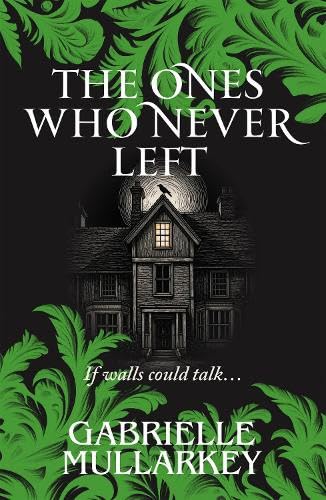
The Ones Who Never Left, by Gabrielle Mullarkey

A frustrated and stalled artist, Lucy has thrown away all her work so far because none of it was worth keeping. Now, about to turn 30, she decides to try being impulsive like Hugh. After knowing him for only seven months, she’s married Hugh and two days later is setting to meet him in rural Yorkshire where he’s signed them up as property guardians for an old manor house that’s rumored to be haunted.

In Rook House they find a study that Hugh, a struggling writer of supernatural fiction, appropriates while Lucy turns the attic into a studio. They mostly spend the rest of their time in the kitchen because the dining room is empty and the living room features an unnerving portrait of the original owner of the house, a painting that seems to have a mind of its own.

These two babes in the wood know nothing about living the country. Lucy’s just bought her first car, a bit of a wreck, while Hugh doesn’t even know how to drive. They rely on the occasional housekeeper, Mrs. Bird, to teach them how to use the Rayburn so they’ll have heat and hot water. They hear peculiar noises and debate whether it’s safe to walk in the woods.

As they learn more about the history of the house, the family who owned it, and the ghosts who supposedly haunt it, the two young people encounter strange happenings. The bedroom they use, the only one furnished, is papered with a design of birds stealing strawberries. Not too strange so far.

Next, they explored the remaining six bedrooms, all uncurtained and empty of furniture . . . The smallest bedroom had an open fireplace and bird-free wallpaper—also William Morris—featuring old-gold and pale-green leaves in snake-like coils. “Acanthus leaves,” Lucy identified.

Glancing at the faded paper, she had the strange sensation, just for a second, that the curling leaves were flowing and reforming into Rorschach ink blots, as if the pattern—maybe even the wall itself—was writhing with dark, silent life.

But Lucy is subject to migraines, so perhaps that is what’s happening to her. As the incidents come faster and go from alarming to frightening, it’s unclear what’s causing them: maybe ghosts, a Bertha in the attic, or simply their imaginations? To make things worse, Hugh’s impulsiveness begins to look more like the self-centered recklessness of a spoiled child, and Lucy finds it harder and harder to connect with him.

Although the plot accelerates nicely, Lucy and Hugh’s relationship becomes less interesting as it devolves into squabbling and secrets. They are both only children and perhaps lack the emotional tools for a relationship. Orphaned Lucy loathes her stepmother, while Hugh courts disapproval from his cold, wealthy parents even as he accepts their money.

Still, I cannot resist a story about a haunted manor on the edge of a Yorkshire moor, reminding me as it does of my introduction to gothic fiction when I was fifteen. I’ll never forget that November dusk when I curled up on a windowseat in the living room and opened Jane Eyre for the first time.

The plot in Mullarkey’s novel kept me turning the pages. There are plenty of shivers and surprises. What makes the scary parts so effective, besides being well-placed in the story, is how they call on fears that many of us experience. These days in particular, we know in our hearts and bones what it’s like to be misunderstood, to be in danger, to feel powerless.

I love the title which came, Mullarkey says in her note, from her wondering if the former inhabitants of the houses we occupy ever truly leave. Now there’s a thought. Many of us experience strong vibrations in the houses we enter. I thought perhaps the strong emotions within may have seeped into wood and stone and become subtle exhalations. But after this book, I’m considering the places I’ve lived and wondering what part of me might linger there. I think, too, of those who lived in them before me, the ones I know of anyway. This is where the gothic space begins to open: that uncanny disorientation that suggests maybe we don’t know so much after all.

What novel have you read recently that unsettled you?

Disclosure of Material Connection: I received a copy of this book free from the publisher. I was not required to write a positive review. The opinions I have expressed are my own.

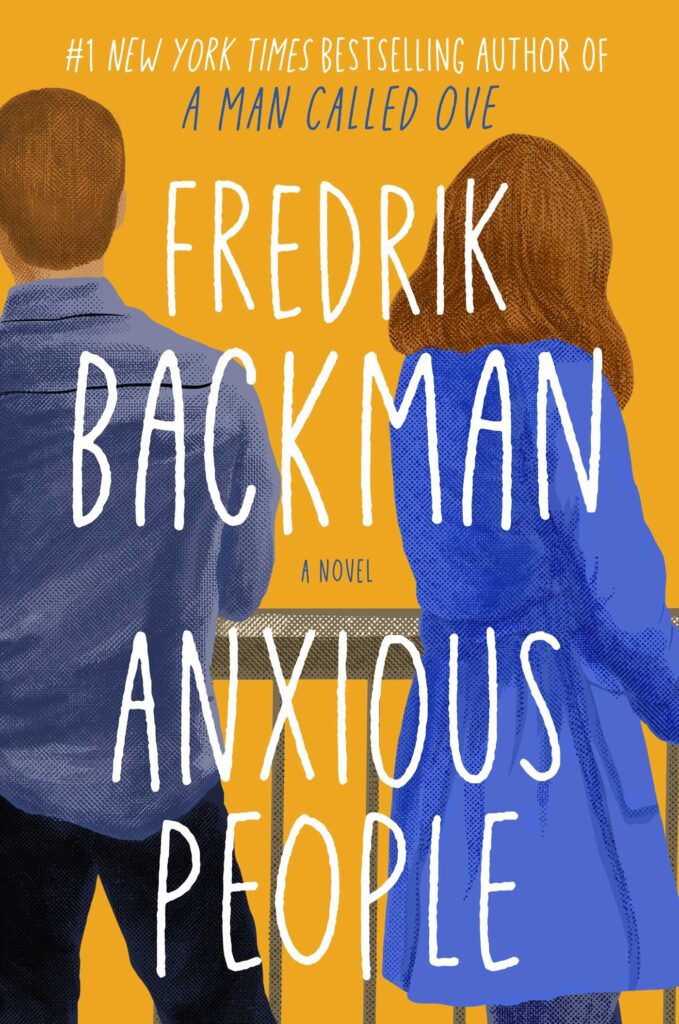
Anxious People, by Fredrik Backman

In this 2019 novel by the author of A Man Called Ove, a bank robber fleeing the police takes refuge in an apartment and, finding that it is being shown to a group of potential buyers, takes them all hostage. Actually, that’s the background given by the rather bossy narrator. The story begins in the police station with the hostages being interviewed by a pair of police officers, a father and son. 

My book club unanimously loved the earlier book, but had mixed reactions to this one. Certainly some—most—liked it very much. However, some folks were confused about plot details and especially about the characters and the relationship between them. I think that confusion is meant to be, as we say nowadays, a feature not a bug. Yet it’s hard to enjoy a book if you can’t figure out, at least by the end, what’s going on.

As a result, we spent the first part of the evening comparing notes on who was who. As we got further into discussing the plot, even more elucidation was needed.

One person asked what the book is about. We all laughed. On the first page, the narrator tells us:

This story is about a lot of things, but mostly about idiots. So it needs saying from the outset that it’s very, always very easy to declare that other people are idiots, but only if you forget how idiotically difficult being human is.

On a side note, I wasn’t thrilled by the use of “idiot” throughout the book, but perhaps it has a different connotation in Sweden. Maybe the author or translator was thinking of the Greek word it’s derived from which means “common man.”

We discussed several ways to describe what the book is about: suicide, grief, marriage, change, connection. That last one points to the theme of the book which is similar to the theme of Ove.

The book’s structure is interesting: We have the interviews shown as dialogue only, like a transcript. I was amused by the first interview, but a little went a long way, and they increasingly irritated me as the book progressed. Later they made sense, yet I think if it hadn’t been for my book club, I wouldn’t have finished the book. I did remain interested in the longer dramatic scenes between the interviews which are flashbacks to what happened in the apartment.

As I mentioned, the narrator is quite bossy, ordering the reader about and fulminating about all kinds of things such as young people and cell phones. The narrator stays out of the interviews since they record what the two people said, but intrudes into the dramatic scenes, commenting on the action, the characters, society, etc. I may be misremembering, but I think in Ove, the get-off-my-lawn opinions are spouted by a character rather than a narrator. 

I thought about George Eliot’s use of a narrator in Middlemarch. It felt a little intrusive at first  since such a persistent narrator is rare in today’s novels. However, I came to appreciate the narrator’s explanations about the characters and warnings that a character may not be as bad as they appear. Perhaps the voice of Backman’s narrator in this book just isn’t my cup of tea, as the little ones in my life say when I offer them a new dish.

Several of us were not fans of the many coincidences in the story and the neatly tied-up ending. We suggested that it read like a fable or fairy tale, which is perhaps not inconsistent with Backman’s brand.

A lawyer among us recounted a long-ago incident in court—no names or identifying details—in which the prosecutor went for an unexpectedly light sentence. Later they told my friend that they just wanted to give the person on trial a little grace.

I had to stop and let that settle. Isn’t that what we hope for from each other: just a little grace? We all carry burdens, some visible and some not.

Maybe this book is my cup of tea after all.

Have you read a novel that changed the way you look at something?


DNF

I had more Did-Not-Finish books in January than I’ve ever had in a single month. Even though reading is near the top of my list of favorite activities, I don’t force myself to finish every book if I’m not enjoying it; there are too many other books to read. Sometimes I’ll look at reviews or ask friends in case there’s something later on in the book worth continuing with it. However, each of the five January DNF books tossed me out of the story in some way. Perhaps exploring those ways—without naming the books—could be helpful.

A case could be made that the books themselves are not to blame. Certainly I’ve been distracted by worry over our increasingly perilous country and busy with responding to those threats. Another situation where the book itself is not at fault is when, in the past, I’ve occasionally given up on an audiobook because the narrator’s voice is annoying or, in one case, too ponderous.

This month, one highly-praised novel had a premise that sounded fascinating. It rumbled along slowly, but a slow pace is not necessarily a deal-breaker for me. What made my heart sink every time I thought about picking up the book again were the cardboard characters; stereotypes rather than real people. Worse, the secondary characters represented a particular population, all embodying the most common negative stereotypes for that group.

Another book was obviously going to be a light read—I needed a break—but seemed interesting. However, the plot meandered around without a enough of a problem to create suspense or concern for the main character. There may have been one later, but not enough of what Donald Maass calls bridging tension to keep me going. Not the book’s fault, I suppose, that it was a lighter read than I expected.

Two others didn’t hold my attention because, while the protagonists did have problems to solve, I found I didn’t care whether they did or not. There are several theories about how to inspire readers to care about a character. In Save the Cat, Blake Snyder says that having the protagonist do a good deed right away will have readers cheering for even a evil character.

Another theory holds that empathy comes from seeing the character’s goal and finding it a worthy one. The goal has to be big enough to power the whole book, and it has to have a strong emotional charge so that it matters to the reader as well as the protagonist. I especially appreciate a main character with a moral code that is threatened by the story. In these two stories, the goals did not carry that emotional charge for me. Also, perhaps unfairly for one of the books, the ugly cover made me flinch every time I picked it up.

The fifth book I wanted to like, and did at first. Then it got very confusing. I had trouble telling the dual narrators apart; the change from one to another was not signaled clearly enough for me. And then the whole thing turned into another story altogether with different characters. Part of settling a reader into a story is letting them know what the genre is. Getting well into a story in one genre and then suddenly switching to another lost me. Perhaps if there had been a signal in the beginning that it was going to be a genre-bending read, I might have been okay.

Lest you think I’m too picky, let me say that I finished quite a few other books in January and enjoyed them immensely.

Have you ever started a book and not finished it? What made you give up on it?

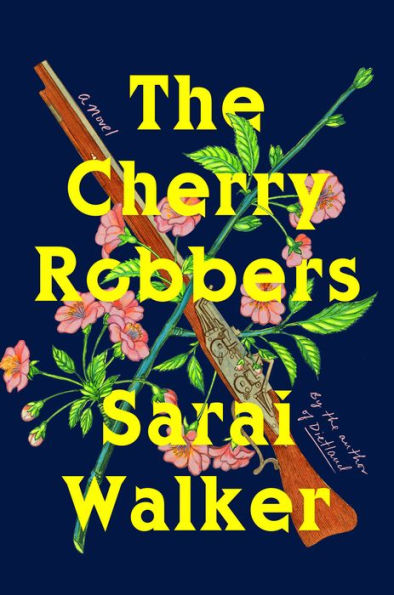
The Cherry Robbers, by Sarai Walker

Reclusive Sylvia Wren is a famous artist, now in her eighties, living in New Mexico and painting flowers that resemble women’s private parts. Her peaceful life is upended when a journalist discovers her long-buried secret: She is actually Iris Chapel, an heiress who has been missing for sixty years. Concerned that her story might be distorted or sensationalised, she begins to write it herself.

With that, we leave the frame story and plunge in the life of Iris Chapel, the fifth of the six Chapel sisters, born in the 1930s and all named after flowers. Their strict father is a gun baron, owner of Chapel Firearms, while their mother is a distant woman, obsessed by her own fears and her belief that the victims of those guns are haunting her. Alternating between screams and silence, Belinda also believes that the women of her family are cursed, and tries to keep her daughters from marrying

However, as the sisters begin to come of age in the 1950s, marriage seems to be the only way to get out of their restrictive home. Some of them long to live “normal” lives and head for that escape hatch, certain that the curse is just part of their mother’s madness. Iris comments:

It’s easier to say that women like my mother are crazy. Then you don’t have to listen to them. And so maybe in a way she became crazy. Maybe she could communicate only by screaming.

This novel was recommended to me when I was reading ghost stories around the solstice last month. I love the way Walker handles the spooky side of the story. People are haunted for sure, and sometimes ghosts are mentioned, but the story remains in a liminal space where the reader can believe in the ghosts or not. What is unmistakable is the underlying unease, a sense that something is dangerously wrong, and the way that unease intensifies as the story unfolds.

Iris alone believes her mother and tries to help her sisters. I loved the depiction of the communal life of the sisters, with their quarrels and tenderness, their jealousies and generosity. Like the plucky heroine beloved of gothic novels, Iris tries to be the compliant, self-sacrificing young woman her society demands, but says:

When you live in defiance of yourself, you can adapt to your circumstances, but remnants of who you are at your core remain. A bit of wildness that can’t be tamed.

With Iris as an engaging narrator, the first part of the story absorbed me. I found the  characters strong; the setting atmospheric, and the pacing excellent. However, the story went on too long and became repetitious. Also, coming back to the frame story at the end felt a little flat and predictable.

The use of Georgia O’Keeffe’s life and work to characterise Sylvia Wren disturbed me. Walker did acknowledge the artist in her note at the end, and she has a right to imitate O’Keeffe this way, since the artist is considered a public figure. If O’Keeffe were still alive would she object to this imitation? I don’t know, but somehow feel that this depiction is as jarring as commercials of Fred Astaire dancing with a vacuum cleaner. Similarly, using Sarah Winchester’s supposed fears as the centerpiece for Iris’s mother earned a raised eyebrow. I’m reminded of Milan Kundera’s Immortality where he delves into the morality of manipulating a person’s image and reputation after they are dead and cannot protest.

The title comes from D. H. Lawrence’s poem with its sensuality, blood and tears. While the metaphor of the cherry seems almost too direct, the poem brings more context to the uneasiness summoned by the image of a robber. I ended up liking the title and glad I read this book.

What do you look for in a ghost story?

The Wonder, by Emma Donoghue

Like some of Donoghue’s other novels, such as Room and Haven,  this story again follows people confined in a tiny location. In 1850s Ireland Elizabeth (Lib) Wright, an English nurse, is sent to a rural area to stay with an 11-year-old girl who supposedly can survive without food. Anna and her parents say she has not eaten anything for four months, only water and—Anna says—manna from heaven.

A committee made up of villagers, including the doctor and priest, want to prove that the girl is truly not eating anything. Their motives are mixed, as we learn, but they are deeply influenced by the Catholic church and its stories of saints and miracles. To show their earnest motives, they hire both Lib Wright, who’s been trained in scientific nursing principles by Florence Nightingale, and a nun to take turns keeping watch over Anna.

Donoghue is too good a writer to let the women be flat symbols of science and religion. They are far more complex than that, and both waver into the liminal area between them. The story is told from Lib’s point of view, and she rails about the malign influence of the Catholic church and the way superstition and ambition play on the members of the committee.

Most of the story takes place in Anna’s small bedroom in the rough, rustic cottage where Lib requires the girl be isolated to ensure no one is slipping food to her. Even the parents must keep their distance except for a morning and evening greeting from her mother. Lib often clashes with the mother, such as insisting that pilgrims no longer crowd the cottage to see The Wonder and beg for her to bless them—before leaving a monetary offering of course.

Catholic doctrine and rituals guide the family’s days and nights. Anna prays constantly; her only books are religious texts. Lib herself is a sceptic and not religious at all. A veteran of the Crimean war and a short-lived marriage, she is determined to unmask the fraud quickly, so she can return to her hospital in England. Yet Anna, so smart and so sincere, begins to affect her during the long eight-hour shifts, just the two of them in the tiny room.

Among the other themes percolating through the story are ideas about food—it has not been that long since the potato famine in Ireland—and grief and the effects of isolation. I treasured the tiny hints of family, such as the destitute young cousin the family has taken in, and community where neighbors generously come up with scarce items such as extra mattresses and pillows.

Writers often talk about the ‘sagging middle’ where stories begin and end strongly but not much happens in the middle, leading to the reader giving up on the book. I gave up on this book several times. It seemed to drag on without much happening. Lib’s complaints about the Catholic church became repetitious as well, though perhaps that’s my fault, and  I’ve just read one too many books about the very real suffering of the Irish under the rule of a power-hungry church.

One solution to the ‘sagging middle’ is to include a turn in the very middle of the story. Sometimes called the fulcrum, hinge, or mirror moment, something happens that dramatically changes the protagonist and the course of the story. Not giving anything away, there is such a turn here which was interesting. However, I still struggled until the story picked up near the end.

I think what kept me going was my strong interest in that liminal moment in the 19th century when science challenged the church’s teaching. It seems important to revisit that time now when science is once again being thrown out in favor of gossip and superstition. And as a result, children are dying.

What period in the past gives you insight into today’s challenges?

Best Books I Read in 2025

As a writer, I learn something from every book I read. In no particular order, these are twelve of the best books I read in 2025. Please check the links to the blog archive for a fuller discussion of those I’ve reviewed.

Fiction

1. Orbital, by Samantha Harvey
Put six people from five countries into the International Space Station orbiting Earth and leave them there for several years. Now write about a single day, which encompasses sixteen orbits, meaning sixteen sunrises and sixteen sunsets. I immediately imagined around a dozen different stories that could come out of this premise. I never imagined Samantha Harvey’s Orbital.

2. The Painter of Silence, by Georgina Harding
In 1950s Romania a nurse named Safta recognises a new patient as her childhood companion. They’ve been separated by the war and the years and the changes wrought by Stalinist rule. Deaf and mute, Tinu only communicates through his art. This is the novel I have been waiting for. Hoping for. It is quiet and asks much of the reader as it unfolds.

3. In the Fall, by Jeffrey Lent 
In Virginia during the last days of the Civil War, a wounded Union soldier becomes separated from his comrades and is found near death by an escaped slave who saves him. Norman Pelham and Leah Mebane become inseparable and, after he is demobilised and they marry, the two decide to walk to his home in Randolph, Vermont. This story of three generations of Pelhams made me forget everything else in order to finish it.

4. The Summer Book, by Tove Jansson
The twenty-two chapters that make up this brief novel combine surprisingly poignant discussions between two women, one very young and one very old, with closely observed details of the natural world  on a tiny island in the Gulf of Finland. The chapters are deceptively plain yet leave the reader aware that each seemingly normal summer adventure holds a deeper meaning. Jansson’s simple and direct language leaves a silence similar to the white space around a line of poetry, space where a reader can bring forward her own memories.

5. Mrs. Dalloway, by Virginia Woolf
Reading this classic novel now, more than fifty years since I first encountered it as an undergrad, is quite a different experience. Back then I was confused and thrilled by Woolf’s modernist, experimental style that expanded forever my idea of what a novel could be. Now I see it as a story of midlife, in several senses of the word.

6. Middlemarch, by George Eliot
What stood out to me on rereading this classic is the theme of what it means to live a good life. By that I mean a life of integrity, one we can be satisfied with when we lie on our deathbeds. In Middlemarch we have all these lives, all of these people intending to do the right thing yet derailed by temptations and compromises and the pressures of daily life. As we follow each storyline, we get to see various permutations of what a good life might look like—or not.

7. Birds of Paradise, by Paul Scott.
A reread of one of my favorite books, I found this story of William Conway looking back and trying to make sense of his life as good as I remembered. Conway revisits people and memories from his childhood in India during the Raj, his English education, and his suffering in a Japanese prison camp during WWII. So much is obscured in our lives, so much we don’t understand at the time.

8. Brother of the More Famous Jack, by Barbara Trapido
I looked for some light reads this year and this one really tickled me.

Nonfiction

1. A Woman in the Polar Night, by Christiane Ritter
In 1934, the painter Christiane Ritter leaves her comfortable life in Austria to join her husband Hermann for a year in Spitsbergen, an island in the Svalbard archipelago, which lies between mainland Norway and the North Pole. Ritter’s journal summons the experience of surviving such a punishing climate and its surprising rewards.

2. Spell Freedom: The Underground Schools That Built the Civil Rights Movement, by Elaine Weiss
This well-researched and engaging book tells the story of some of the less well-known leaders of the Civil Rights Movement, courageous people who came before the famous speeches and laid the foundations for the Movement’s success by creating the citizen schools that prepared Black Americans in the Jim Crow South to register to vote.

3. Ghostland: In Search of a Haunted Country, by Edward Parnell 
A fusion of travelogue, literary review, and memoir that reminded me of (and mentions) W. G. Sebald’s Rings of Saturn, it sent me off to read many of the books I didn’t already know. And I discovered a story that sent me to the heart of something that has haunted me for a while.

4. The Lost Words, by Robert MacFarlane and Jackie Morris
When the Oxford Junior Dictionary was updated, it was found that around forty common words had been dropped—all of them words to do with nature. In response, MacFarlane and Morris came together to create what they call a spell book to help young readers rediscover the natural world, believing that unless we experience and learn to love the world of nature around us, we will not work to save it. This is the most beautiful book I’ve seen in a long, long while.

What are the best books you read in 2025?

Wakenhyrst, by Michelle Paver

For the winter solstice I wanted to return to East Anglia and the fens, a time and a place when the veil between our world and another seems to thin. Paver’s novel fit my mood perfectly with its luminous and sometimes eerie descriptions of life in fen country.

Many Gothic novels use a frame story, usually told by an ordinary person, someone the reader can identify with. Then the inner story plunges into the darker twists and turns of human nature before ending with a return to the realistic world, reassuring perhaps, yet still haunted by a suspicion of unease.

Here the frame story takes place in 1966, starting with a magazine article. The first paragraph lands us right in the story.

Like a witch’s lair in a fairytale the ancient manor house crouches in its tangled garden. I can’t take my eyes off the ivy-choked window above the front door. It was from that window in 1913 that 16-year old Maud Sterne watched her father set off down the steps with an ice-pick, a geological hammer—and murder in his heart.

The article’s author describes a visit to the now elderly Maud, alone in her crumbling manor, Wake’s End, in Suffolk. He suggests that Edmund Sterne might have been innocent, adding, “We only have Maud’s word that he did it.” Then comes an exchange of letters between Maud and an academic culminating in her inviting him to Wake’s End.

From there we go into the larger story, beginning in 1906 with young Maud as our guide. The house is situated by Guthlaf’s Fen, one of the few fens that hasn’t been drained to create more farmland. Her father Edmund hates it and won’t allow any of the windows on that side of the house to be opened, but Maud loves it.

To her the fen was a forbidden realm of magical creatures and she longed for it with a hopeless passion. In summer the scent of meadowsweet drifted across the Lode and the reeds rang with the eep-eep of frogs. In winter Maud could hear the ice cracking on the Mere and the skies were alive with vast skeins of geese. One afternoon they’d flown right over the garden, and the beat of their winds had lifted Maud as if she were flying.

The sense of dread grows as Maud’s mother suffers multiple unsuccessful pregnancies. “ ‘Perhaps not every night,’ ” the doctor advises, but Edmund brushes him aside. Maud finds her father’s private journal where she learns of the foggy afternoon when Edmund walked by the church in the nearby hamlet of Wakenhyrst. “The church loomed, deep black against the charcoal sky. It seemed not a place of sanctuary, but the menacing relic  of a savage and haunted past.”

Then he tripped over the planks he’d ordered stripped from the chancel arch as part of the renovations. Seeing an eye peering up at him from the grass, he felt a strange sense of guilt and caught “a strong marshy whiff from the fen.”

It turns out that the planks hold a medieval painting that had been whitewashed by the Puritans, a Doom that depicts the Last Judgment, dominated by the gleeful devils torturing the damned. It is restored and mounted in a separate room in the church, yet the painting clings to his imagination until he begins to see devils everywhere.

With the unearthing of the Doom, he comes to believe that “Something has been let loose…” The old superstitions still have a hold, not only on the church-going residents of Wakenhyrst, but also on the manor house where servants tell Maud stories of the fens, and now they gradually take hold of Edmund himself.

Maud finds, though, that her father won’t give up his autocratic grip on the household and is frustrated in her attempts to educate herself. The sense of intrigue grows as she begins to unearth other secrets even as the claustrophobic atmosphere tightens around her.

What I liked about this story was its slow burn. It moves within that liminal space between the ancient mysteries and the modern world without completely spilling over into either horror or rational explanation. I found plenty of tension and suspense, but they are curiously muted by the proximity of reality; somehow that intensifies them.

Framed narratives like this one, with their multiple narrative voices, do increase suspense and also create a sense of unease through the blurring of reality and fiction. There are some daring moves on the author’s part, such as revealing so much in the first paragraph and then staying within that liminal space between the natural and supernatural worlds. I thought she succeeded and look forward to reading more of her work.

Can you recommend a good Gothic novel or perhaps a literary novel with some Gothic attributes?

The Box of Delights, by John Masefield

Changing trains on his way home for Christmas from his first term at school, Kay Harker meets an old man who asks Kay to help him lift his large case onto his back. “ ‘Only I do date from pagan times and age makes joints to creak.’ ” Once on the train Kay, who seems to be around eleven or twelve, is approached by two suspicious men dressed as clergymen who entice him into playing cards for money.

When Kay disembarks in Condicote, he finds that his wallet and watch are missing. He meets the old man again, now revealed as a Punch-and-Judy man, who asks him to pass on a warning that “the wolves are running” to a woman outside Bob’s bakery. Carolina Louise, Kay’s guardian while his parents are absent, agrees to the stop and also tells him that the four Jones children will be staying with them at Seekings over Christmas: Peter who is near his age, Jemima, Susan, and young Maria with her revolvers. “ ‘I shall shoot and I shall shock, as long as my name’s Maria,’ ” the girl says later. She might be my favorite character.

The old man, Cole Hawlings, comes to Seekings to give a Punch and Judy show for the children, which he follows with a magical adventure where one thing turns into another, such as when “[i]t seemed to the children that the ceiling above them opened into a forest in a tropical night: they could see giant trees, with the stars in their boughs and fireflies gleaming out.”

Later he entrusts Kay with the magical box of the title with a knob on the outside which enables him to “go small” or “go swift.” Also, each time Kay opens the box, he’s transported into the past where he might meet up with Herne the Hunter, the Lady of the Oak, fairies, or a Roman legion. However, the wolves—human and animal—are after the box and the action accelerates with the robbers “scrobbling” people left, right and center and chasing after the children.

A beloved Christmas favorite in England since 1935, The Box of Delights is now available in the U.S. from the New York Review of Books in a revised edition that restores sections cut from previous versions and has been corrected from the manuscript. John Masefield was a well-known poet (author of “Sea Fever,” my mother’s favorite poem) and poet laureate for England from 1930-1967.

After finishing this book, I learned that it’s the sequel to The Midnight Folk, which I haven’t read. This could be why I was so confused at the beginning. I couldn’t figure out who Carolina Louise was—another child?—or where all the parents were? Yet my discombobulation turned out to be good preparation for the wild proceedings to come; the book does come at you fast and furious, with kidnappings, chases, robberies, and terrifying escapes. We’re told as writers to teach our readers how to read our book. Mission accomplished, Mr. Masefield!

It seems clear that Masefield’s book influenced many later children’s stories: T.H. White’s Sword in the Stone (1938), Elizabeth Goudge’s The Well of the Star (1941), C. S. Lewis’s Narnia books such as The Lion, the Witch and the Wardrobe (1948), Susan Cooper’s The Dark Is Rising (1973), and probably even J. K. Rowling’s Harry Potter books. 

Today’s children might have trouble untangling the period slang, historical references, and folklore. Also, unlike the books mentioned above, the plot, if it exists at all, seems almost beside the point until we get towards the end. Instead, we fall from a fairly ordinary train journey into a series of increasingly odd adventures which are indeed delightful but can leave the reader feeling unmoored. Still, I hope children will try it; adults, too.

This is a book I will return to during the holiday season, as so many others do. I’ll probably skip around to favorite bits rather than read it straight through, but we’ll see.

Is there a book you like to reread in December?