Little Women, by Louisa May Alcott

Meg, Jo, Amy, Beth: Those of us who grew up with the March girls didn’t know that what we were reading was not what Alcott originally published in 1865.

Book One of this classic novel covers a year in the life of the four March girls, from one Christmas to another. The sisters try to be good so as not to worry Marmee, Father being away with the war. Mostly they succeed, despite the usual sisterly feuds and jealousies sparked by four very different temperaments. Book Two was an afterthought, following them as they grow up and marry (or not).

Being only ten or so when I first read it, I didn’t pay much attention to Book 2. Of course, Jo was the only one who mattered to me, rebellious Jo with her apples and writing, her reading in the attic, her desire for  some privacy. Like Jo, I hid away to read. I made up plays for my (too) many siblings to enact. I devised outdoor games for us and the other neighborhood children. All my friends also identified with Jo—no surprise given that we were climbing trees and wearing pants which were all a bit shocking still in the 1950s.

I can draw a straight line from Jo, who was based on Alcott herself, to my later obsession with Emily Brontë. I moved quickly from the books by the Brontë sisters to their lives in that lonely stone house in Haworth. Of course I was drawn to rebellious Emily, independent Emily who loved the moors and being alone and refused to behave like a proper girl. Writing about her as a child, Emily’s father described her strong will. I hid mine to stay out of trouble, but it was there all right.

With their brother Branwell, the three sisters carved into two pairs: Charlotte and Branwell, Emily and Anne, just as the March sisters did: Meg and Amy, Jo and Beth. There are other parallels: delicate and good Anne like Beth, practical Charlotte like Meg. However, the Brontë siblings did not have a wise and loving Marmee. With their mother dead and their father cold and righteous, they were cared for by their aunt Elizabeth Branwell. She’s usually described as a stern disciplinarian, but now there’s some evidence that she was actually a devoted and caring parental figure.

Although we know Alcott drew on incidents from her own life, I wonder if she was thinking of the Brontës when she started drafting Little Women. The Alcotts were assiduous readers, and the dates fit. Wuthering Heights came out in 1847 and the first U.S. edition was a year later. Alcott started writing Little Women in May of 1868 and sent it to her publisher in June. Book One was published October 1868 and Book Two a few months later (January, 1869).

It is with the 1880 version, combining the two books into a single volume, that the mischief occurs. Her publisher asked Alcott to make certain changes designed to make it—especially the depiction of Jo—more bland and acceptable. In her brilliant introduction to the recent reissue of the original version, Elaine Showalter suggests that later editors probably made additional changes. She explains that many of the literary references were removed, Jo’s speech was smoothed out, and her behaviour made more ladylike. Even the description of Marmee was romanticised.

Original: “. . . a stout, motherly lady, with a ‘can I help you’ look about her, which was truly delightful. She wasn’t a particularly handsome person, but mothers are always lovely to their children…”

Revised: “. . . a tall, motherly lady, with a ‘can I help you’ look about her, which was truly delightful. She was not elegantly dressed, but a noble-looking woman, and the girls thought the grey cloak and unfashionable bonnet covered the most splendid mother in the world.”

Interesting, eh? The original, with Showalter’s introduction is available from Penguin Classics (2010). Showalter has also added footnotes, some of which identify the sources of those pesky literary references. I was tickled to stumble upon a reference that she hadn’t footnoted: In Chapter 21, Jo backs away from one of Laurie’s wild schemes and says “ ‘Prunes and prisms’ are my doom, and I may as well make up my mind to it.”

That’s from Charles Dickens’s Little Dorrit:

“Papa is a preferable mode of address,” observed Mrs General. “Father is rather vulgar, my dear. The word Papa, besides, gives a pretty form to the lips. Papa, potatoes, poultry, prunes, and prism are all very good words for the lips: especially prunes and prism. You will find it serviceable, in the formation of a demeanour, if you sometimes say to yourself in company—on entering a room, for instance—Papa, potatoes, poultry, prunes and prism, prunes and prism.”

What do you think? Is it so weird to see both Jo and Emily as my wild sisters? Should girls stick to prunes and prisms? Is a part of you still in an attic reading books and eating apples with Jo?

What do you carry with you from an early reading of Little Women?

The Box of Delights, by John Masefield

Changing trains on his way home for Christmas from his first term at school, Kay Harker meets an old man who asks Kay to help him lift his large case onto his back. “ ‘Only I do date from pagan times and age makes joints to creak.’ ” Once on the train Kay, who seems to be around eleven or twelve, is approached by two suspicious men dressed as clergymen who entice him into playing cards for money.

When Kay disembarks in Condicote, he finds that his wallet and watch are missing. He meets the old man again, now revealed as a Punch-and-Judy man, who asks him to pass on a warning that “the wolves are running” to a woman outside Bob’s bakery. Carolina Louise, Kay’s guardian while his parents are absent, agrees to the stop and also tells him that the four Jones children will be staying with them at Seekings over Christmas: Peter who is near his age, Jemima, Susan, and young Maria with her revolvers. “ ‘I shall shoot and I shall shock, as long as my name’s Maria,’ ” the girl says later. She might be my favorite character.

The old man, Cole Hawlings, comes to Seekings to give a Punch and Judy show for the children, which he follows with a magical adventure where one thing turns into another, such as when “[i]t seemed to the children that the ceiling above them opened into a forest in a tropical night: they could see giant trees, with the stars in their boughs and fireflies gleaming out.”

Later he entrusts Kay with the magical box of the title with a knob on the outside which enables him to “go small” or “go swift.” Also, each time Kay opens the box, he’s transported into the past where he might meet up with Herne the Hunter, the Lady of the Oak, fairies, or a Roman legion. However, the wolves—human and animal—are after the box and the action accelerates with the robbers “scrobbling” people left, right and center and chasing after the children.

A beloved Christmas favorite in England since 1935, The Box of Delights is now available in the U.S. from the New York Review of Books in a revised edition that restores sections cut from previous versions and has been corrected from the manuscript. John Masefield was a well-known poet (author of “Sea Fever,” my mother’s favorite poem) and poet laureate for England from 1930-1967.

After finishing this book, I learned that it’s the sequel to The Midnight Folk, which I haven’t read. This could be why I was so confused at the beginning. I couldn’t figure out who Carolina Louise was—another child?—or where all the parents were? Yet my discombobulation turned out to be good preparation for the wild proceedings to come; the book does come at you fast and furious, with kidnappings, chases, robberies, and terrifying escapes. We’re told as writers to teach our readers how to read our book. Mission accomplished, Mr. Masefield!

It seems clear that Masefield’s book influenced many later children’s stories: T.H. White’s Sword in the Stone (1938), Elizabeth Goudge’s The Well of the Star (1941), C. S. Lewis’s Narnia books such as The Lion, the Witch and the Wardrobe (1948), Susan Cooper’s The Dark Is Rising (1973), and probably even J. K. Rowling’s Harry Potter books. 

Today’s children might have trouble untangling the period slang, historical references, and folklore. Also, unlike the books mentioned above, the plot, if it exists at all, seems almost beside the point until we get towards the end. Instead, we fall from a fairly ordinary train journey into a series of increasingly odd adventures which are indeed delightful but can leave the reader feeling unmoored. Still, I hope children will try it; adults, too.

This is a book I will return to during the holiday season, as so many others do. I’ll probably skip around to favorite bits rather than read it straight through, but we’ll see.

Is there a book you like to reread in December?

Reprise: Diamond in the Window, by Jane Langton

In one of my book clubs, we decide on a theme for the month and then each talk about the book we read. Our choices inspire great conversations and often end up on each other’s to-be-read lists. Our last theme was a favorite childhood book, so of course I chose this one which I wrote about in the early days of my blog. Here’s my earlier post about it. Note: the previous week I’d written about March, by Geraldine Brooks.

…………………………………

Before leaving the Transcendentalists, I wanted to reread this young adult book where I first heard about them.  I found it one cold, rainy day at Whippoorwill Girl Scout camp where—having escaped from the prescribed activities—I was poking around some bookshelves in a dark corner of the hall.  Behind some mildewed Readers Digest Condensed Books, I found one with corners of the cover frayed by mice and the pages brown-spotted with damp.  I hid behind a chair to read it and got through the first few chapters before being discovered by one of the leaders and told to put it back.

It took me almost two years to find the book again and finish it.  I couldn’t remember the title or the author’s name, only the story, and after a while I began to believe that I had dreamed it.  When I finally came across it on my local library’s shelves, I couldn’t believe it.  It was as though a fantasy had suddenly become real.

Ned and Nora live in a Gothic monstrosity of a house in Concord, Massachusetts, with their aunt and uncle.  Aunt Lily teaches piano lessons to support the family because Uncle Freddy—who used to be a famous scholar—has lost his mind and spends his days arguing with marble busts of Thoreau and Emerson.  The children have a run-in with a couple of town worthies who consider the house and the family a blot on their sacred soil and threaten to take it for unpaid taxes and burn it down.

The children discover a mysterious room at the top of the house with some dusty toys and two twin beds.  Confronting Aunt Lily, they learn that Lily and Freddy’s youngest sister and brother had gone missing from that room as children, followed by Lily’s sweetheart, Prince Krishna.  Ned and Nora decide to sleep in the room themselves.  However, in their dreams, they are plunged into magical adventures, adventures which turn dangerous.

There are a few books I read as a child whose images have become so ingrained in my thoughts that they have become part of my private mythology.  This is one of them.  It wasn’t until I was grown and had read Emerson and Thoreau for myself that I recognised that each adventure embodies one of the Transcendentalist ideas and images, such as the rough wooden harp they found while climbing in an elm tree, an aeolian harp, although it is not named in the book.  The wind blowing across the harp strings translated the voices of nature into sounds they could understand:  “ ‘These trees and stones are audible to me,’ ” as Uncle Freddy quoted Emerson.

The adventure that I think about most often, though, is the one where they go into a mirror and find two statues of each of them, a little older than their current age.  Ned and Nora separate, each choosing one of their statues.  Behind that one stand two more.  Their choices eventually lead them to statues of themselves as adults, at which point they are able to see if they have chosen wisely.  Unlike real life, though, they are able to go back and make different choices.

What was one of your favorite books as a child?

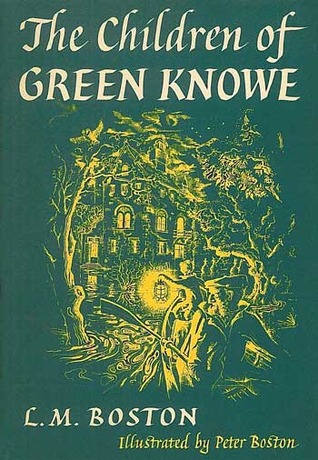
The Children of Green Knowe, by L. M. Boston

Seven-year-old Tolly’s father and stepmother are in Burma, so he usually spends holidays at his boarding school. However, this December he’s off to live with the great-grandmother he’s never met, traveling by train through flooded fields in East Anglia. An imaginative child, he wishes it were the Flood and his destination the Ark.

He’s not far wrong. After a perilous journey by taxi through the watery landscape, Tolly—his full name is Toseland—is saved from having to swim to the house by the arrival of Mr. Boggis in a rowboat. The house, originally known as Green Knowe, is now called Green Noah. Tolly’s family has lived there for over 300 years, and there has always been a Mr. Boggis who works there.

The room seemed to be the ground floor of a castle, much like the ruined castles that he had explored on school picnics, only this was not a ruin. It looked as if it never possibly could be. Its thick stone walls were strong, warm and lively. It was furnished with comfortable, polished old-fashioned things as though living in castles was quite ordinary. Toseland stood just inside the door and felt it must be a dream.

While his great-grandmother is immensely old, she hasn’t lost that sense of the mysterious world that flickers just behind our ordinary surroundings. She tells Tolly of three children who used to live there in the 17th century, teaches him to summon the birds, and inspires him to listen for the hoofbeats of the great horse Feste who belonged to one of the children.

Lucy Boston wrote this delightful middle-grade story for her own enjoyment after she bought a home in 1939 in Cambridgeshire. As she restored the house and gardens, they became the setting for this story and four others. Lucy’s daughter-in-law now lives at the Manor at Hemingford Grey, and opens the garden to visitors year-round, while tours of the house are available by appointment.

Encountering this tale for the first time is an enchantment of its own. Slowly, ever so slowly, the other world begins to manifest itself: a marble rolls across the floor of its own accord, voices seem to whisper in the garden, sugar lumps disappear from the ancient manger in Feste’s stall. Reading it, I felt like a child again, the child I once was, who believed it was just possible that maybe that shadow in the trees was actually . . .

After thoroughly enjoying the book, I came back to it as a writer, appreciating the way moments of magic creep up on the reader until the entire story seems perfectly plausible. Tolly’s adventures are punctuated by his great-grandmother’s tales of each of the children, the statue in the garden, the topiary creatures in the garden, and so much more.

Similarly, the author balances and metes out the scary side of magic, from Tolly’s anxiety at the very real flooding at the beginning, through the tingle of fear that edges each fleeting magical moment—how can this be real? And how to hang onto it?—to where terror begins to creep in.

I loved the way the house and stables and gardens are used, their realistic details enchanting in a more mundane sense. And Boston uses the natural world throughout in an unforced way to create mood and theme and adventure, not just the gardens, but floods and snow and birds. Remarkable.

I wish I’d read this as a child. First published in 1954, it is of a piece with others books I loved then, like The Secret Garden and The Diamond in the Window. Now I have to try to find the other four Green Knowe books.

The books we read in childhood often stay with us. What magical story from childhood do you remember in this season?    

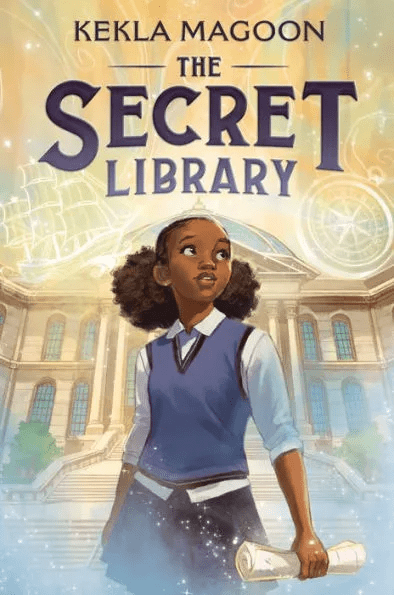
The Secret Library, by Kekla Magoon

I like to read a mix of books, so this week’s review is of a middle-grade book. As the story opens, eleven-year-old Delilah “Dally” Peteharrington has lost her beloved grandfather, whose son—her father—died some years earlier. As a result, her mother is left to manage the family’s extremely wealthy businesses. Already uptight and business-oriented, she rises to the challenge, but is determined that Dally will be trained to take over. That means tutoring in business after school, and no time for other, more interesting activities.

Dally, however, takes after her father and grandfather: two adventurers who wanted to get out and explore what life has to offer. The mysterious letter that comes to her from her grandfather leads her to the Secret Library, which is not in itself secret but rather a repository of secrets. She eludes her mother’s control to delve into her family’s past and learn the secrets hidden there.

As is Octavia Butler’s Kindred, she is actually transported into the past, resulting in wonderful adventures but also creating some problems for the author. Dally is biracial—her father Black and her mother White—so she encounters the explicit racism that up to now she’s only heard about.

Pirate ships, the Underground Railroad, Jim Crow, slavery: there’s a lot here, brought to life through her adventures. The author goes further, having her encounter same-sex relationships, trans persons, Black persons passing as White, etc. While I enjoyed the story, and in most cases felt like it was a good introduction for 8-12 year-olds to some of this history, it began to seem like a lot.

Worse, as the story went on, my credulity was strained to the breaking point. For example, I had trouble believing Dally’s mother could be so entirely cold and controlling: the worst sort of businessperson stereotype. At times, the characters perform physically impossible feats. And, unlike in Kindred, there are no consequences when Dally acts like a modern person of color around White people in pre-Civil Rights eras. There are many more examples, but I don’t want to include too many spoilers.

I love the idea of a magical library. I enjoy stories about uncovering family secrets. I even like young people wanting adventures and experiences, though I’m not fond of the anti-education slant here. I respect and admire the challenge this author has set themselves: creating a coming-of-age story mixed with fantasy and historical fiction that is based on themes of identity, racism, LGBTQ+, friendship, inheritance, and family.

I found the story engrossing, and even stayed up late to finish it. It would be fine for a twelve-year-old, but any younger than that I think I’d want to read it with the child and be ready to do a lot of explaining.

Have you read a story about a magical library?

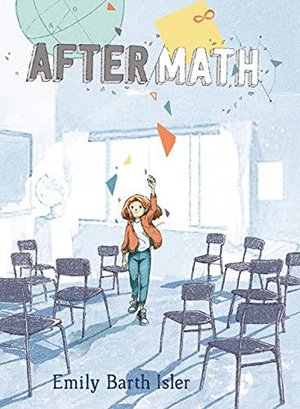
AfterMath, by Emily Barth Isler

In this middle-grade novel, twelve-year-old Lucy starts at a new school in a new town, carrying a secret burden: she’s mourning the death of her younger brother Theo from congenital heart disease and the loss of the family environment she’s known all her life. Mired in their own grief, her parents pretend all is well, yet move to another state in hopes of a fresh start.

In a misguided attempt to place Lucy in a school that will help her deal with her grief, they enroll her in a school that suffered a mass shooting four years earlier and in the very class that suffered that trauma. As the first new member of the class since the shooting, Lucy faces a solid block of young people who have made their traumatic journey together, helped by therapists and hurt by public perception.

All except one girl, Avery, who is ostracized by the entire class. At lunch on Lucy’s first day, she can’t find an empty seat, so she sits at a table that is completely empty aside from Avery. Gradually Lucy begins to learn about this withdrawn girl, particularly through an after-school mime class.

As is obvious from this summary, the story tackles themes of grief, family, friendship, and mental health, and it does so in a sensitive way. The author’s extensive research underpins the story without loading it down. Of course, the experiences of Lucy and her classmates make for heavy reading– emotionally, that is; the prose flows well and the story unfolds naturally.

I especially enjoyed Lucy as a character. She likes math, its concrete answers that are either right or wrong, though she’s troubled by the concept of infinity. Each chapter is introduced by a math joke, which is fun. Lucy finds them in her room and wonders where they come from.

What kind of angle should you never argue with?
A 90-degree angle. They’re ALWAYS right.

Some readers may find these jokes and Lucy’s way of using math to understand the world intrusive or boring. I loved them, though, both for their welcome lightness and for the way they reflect her need for structure and certainty in a world where such things can be hard to find. I also loved seeing a girl who likes math and logic: such a rarity in stories, though not in real life.

In the mime class—which may appeal to readers who are more interested in the arts than in math—Lucy and her classmates find another way to interact. Communicating without words, trying something new together, putting on a show at the end—these are all effective tools for opening emotionally to each other. Or in other words, for becoming friends. We all could use a friend.

There are a few issues with the book, such as that, after the school where the shooting had occurred had been torn down and new one built, such a class would have been split up rather than kept together in isolation. Also, the school’s lack of interest in dealing with Avery’s extreme situation seemed unlikely.

Still, I highly recommend this novel for adults and—with care—for young readers. Grownups get a chance to experience these devasting attacks and their long tail of trauma from the students’ point of view. Young people can see their fears or their own experience reflected—and not resolved so much as coped with—in a story. Which is, after all, one of the great gifts bestowed by sharing stories.

Have you read a middle-grade story that impressed you?

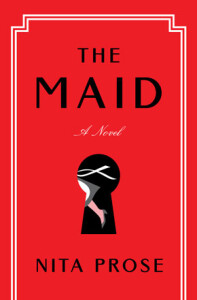
The Maid, by Nita Prose

55196813

NOTE: There may be some spoilers in this review.

My first reaction to my local book club’s choice for this month was that it was a shoddy knockoff version of the delightful Japanese bestseller Convenience Store Woman. Like that subtle, smart novel, Prose’s protagonist is a young woman apparently on the autism spectrum who works in a menial job and loves it. Unfortunately, The Maid doesn’t measure up.

Molly Gray works as a chambermaid in a five-star hotel where she enjoys restoring each room to “a state of perfection.” Less enjoyable is the disdain with which most of her colleagues treat her—referring to her a weirdo, a robot, a Roomba—though not to her face. Still, she calls on the platitudes and proverbs she learned from her gram, recently deceased, to keep her world in order. Then one day she enters a room to clean it and finds the guest staying in it dead on the bed.

Billed as a cosy mystery, the book fails to be either. True, there is a death and cups of tea, but there is no intrepid sleuth tracking down the killer. There are no clues to follow, no investigation. Instead, the story limps through a threadbare plot, every step of it embarrassingly obvious. There are a few gratuitous “twists” at the very end which come across as cheap tricks because they are not integrated with the plot at all.

Not only is the plot childishly simple, but the language is in the middle grade range (appropriate for age 8-12), often even simpler than that. And that gets to the worst aspect of the book. Since it’s quite obvious to the reader what’s going on, the plot is not the driving force in the book. Neither is the setting, which is barely sketched in. The people in the story are caricatures and stereotypes, either all good or all bad, so nothing there to keep the reader going. The only thing left is Molly herself.

Yes, the force propelling the story is the reader’s amusement as Molly constantly misinterprets what’s obvious to all of us neurotypical folks and responds with prim childish speeches. Making fun of neurodivergent people is a bizarre—and repulsive—choice for the basis of a book. I’m aghast that so many people seem to think this is just great, and that the book has won multiple awards, achieved bestseller status, and will be made into a film.

Making Molly be so childish and naïve seems like the author knows nothing about autism. We talk about cultural appropriation in literature. If a neurotypical author is going to write a first-person novel in the voice of a neurodivergent person, they ought to at least be knowledgeable about the condition. There’s also the way Juan Manuel, who works in the hotel’s kitchen, is presented as naive, unintelligent and helpless, summoning the most despicable stereotypes about immigrants and Mexicans. The police too are shown as bumbling and cruel.

In addition to the above concerns, there are gaping holes in the logic of this story, For example, Molly bounces back and forth from clueless to astute and back again. She tells us about her condition, but sometimes doesn’t show it in her behaviour. Also, no police detective arresting a young woman in her pajamas, would cart her off to jail without enabling her to get dressed. Here, Molly even has to appear in court in her jail-begrimed pajamas, like that would actually happen.

Maids do not trundle their carts through the lobbies of five-star hotels or leave them outside the door to the bar. Nefarious boyfriends are not able to clean out a person’s entire savings account at an ATM in one fell swoop; there are limits on how much you can take out at a time. Plus, how is it that criminals can be running a drug ring in a fancy hotel without anyone noticing? Where are the security people?

Most of all, how is it that no one, from Molly’s childhood teachers to her co-workers to anyone on the police force, recognises that she is neurodivergent?

I am baffled by the praise heaped on this book. As I read it, I alternated between boredom and outrage. Of course, even though it’s a first novel, the author is a longtime editor and, at the time it was published, vice president and editorial director at Simon & Schuster, so she knows a few people.

There are some cute things in the story, like the devotion of Molly and her gram to the Olive Garden and the old tv Show Columbo. But that’s not enough to make up for the story’s weaknesses.

What story have you read with a neurodivergent narrator? What did you think of it?

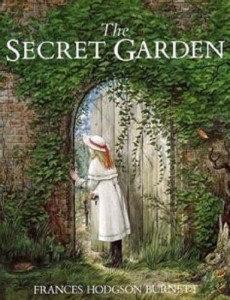
The Secret Garden, by Frances Hodgson Burnett

garden

I played hooky today, lured by the beautiful weather to work in the garden instead of writing the blog post I’d planned.

As I dug in the dirt, I was reminded, as I always am this time of year, of this wonderful children’s book. Ten-year-old Mary Lennox, orphaned by a cholera epidemic in India where she lived with her parents, is sent to Yorkshire to live with her cantankerous uncle in his gloomy house on the moors. There is a walled garden that has been locked and hidden ever since her aunt’s death.

Spoilt and headstrong Mary is miserable until she meets Dickon, 12-year-old brother of Mary’s maid. He teaches her about the wild things on the moors and gardening as well. The two search for the hidden garden by day, but at night Mary hear strange cries.

I first learned about the book when Miss Lewis, my fourth grade teacher, began reading it to us. Unfortunately, she passed away shortly into the term, and the substitute who took her place was not interested in reading us the rest of the book. I knew even then that librarians were the smartest people on earth, and sure enough, the woman at my neighborhood branch recognised my description and found the book for me.

Little did I know then that it would change everything for me, making me a gardener for life. Not only have I put in a garden everywhere I’ve lived, but my first overseas trip was to Yorkshire. Of course.

Burnett’s book is one of nine that I can point to as having made me the person I am today. Three I read as a child; three as a teenager, and three as an adult. While every book I read changes me to some extent, these books shaped my philosophy, my values, and my identity.

I hope that when a day is this gorgeous you, too, set aside your to-do lists and go outside. Listen to the birds. Dig in the dirt. Find or make your own secret garden.

What book changed your life?

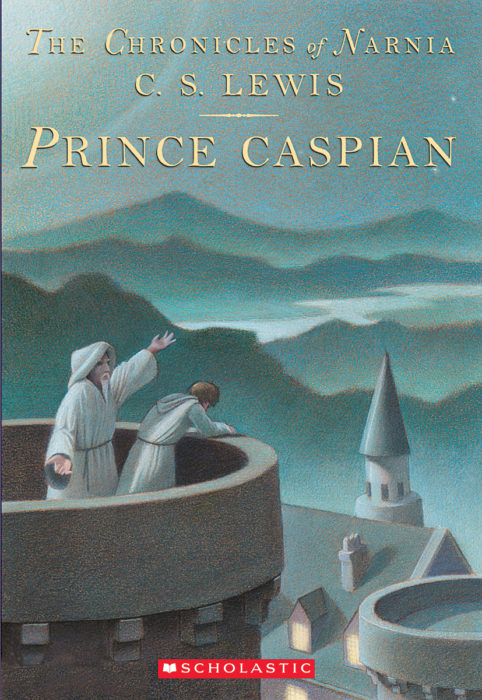
Prince Caspian, by C.S. Lewis

caspian

When I ran across Matt Mikalatos‘s blog posts on rereading C.S. Lewis’s work, I was inspired to look again at the Narnia books. In Prince Caspian, a sequel to the first book, Peter, Susan, Edmund and Lucy are about to board a train back to school when they are suddenly whisked off to the world of The Lion, the Witch and the Wardrobe, though they do not recognise it at first because over a thousand years have passed.

Narnia is now ruled by Miraz who became Lord Protector of his nephew Caspian upon the death of Caspian IX but now calls himself the king. Miraz prohibits any mention of Old Narnia: the talking animals, dwarves, the dryads and other what we would call mythological beings, and most of all Aslan himself. He dismisses Caspian’s nurse for telling the child such stories and replaces her with a tutor.

Dr. Cornelius turns out to be just as devoted to the old ways but more circumspect, and it is he who warns Caspian to escape when a son is born to Miraz and his wife, thus putting Caspian’s life in danger. Peter, Susan, Edmund and Lucy, who had become Kings and Queens in Old Narnia are dragged back to help Caspian and the remaining Old Narnians in their attempt to restore the rightful king to his throne.

I came to the Narnia books in my late teens, not as a child, but it was a time in my life when I was on the lookout for magic, spending time in the woods, studying Transcendentalism, and caught up in the 1960s whirl of possibilities. Charmed by the magical aspects of the Narnia books, I found the overtly Christian foundation a little off-putting, though tried to fit it into my then-exploration of different religions. I was also dismayed by the treatment of women and what I now know as colonialism, but recognised where these fit in the context of Lewis’s time.

On rereading the book now, I’m less struck by the religious overtones than by the similarity to today’s political climate. As Mikalatos says:

Imagine, if you will, a political climate in which truth has been completely discarded. Even the history books are full of falsehoods that advance the narrative of those ruling the nation. Stories of the past have been ignored, abused, or outlawed. In the midst of this political rule, certain classes of people have been persecuted, harmed, sent into hiding.

That is the world of Narnia during Prince Caspian.

As Hamlet says: “The time is out of joint—O cursèd spite, / That ever I was born to set it right!” Lewis himself said the book was about the “restoration of the true religion after corruption.” Leaving aside the religious aspect, the theme of a disordered world needing to be set right can’t help but resonate for me as I watch so many people who claim to follow democratic ideals betray them. At one point, after the children have been attacked by a non-talking bear, Lucy says:

“Wouldn’t it be dreadful if some day, in our own world, at home, men started going wild inside, like the animals here, and still looked like men, so that you’d never know which were which?”

Lucy’s question about talking and non-talking animals illustrates a technique that Lewis deploys throughout the book of using pairs as foils or complements. We have Prince Caspian and the four children; the separate narratives of the boys who pursue the war against Miraz and the girls who with Aslan dance and sing and awaken the Old Narnians. The latter pairing carries forward the scene early on when Dr. Cornelius takes young Caspian up to the tower to witness the conjunction of the two stars Tarva, The Lord of Victory, and Alambil, the Lady of Peace, which together indicate a great good is coming to Narnia. Note that both victory and peace are needed.

There’s also the contrast between belief and skepticism. In the first book it was Lucy who first visited Narnia and the others did not believe her. Here, she is the first to see Aslan and the others say they do not believe her, with terrible consequences. Believing in Aslan and the Golden Age of Narnia is what sets Miraz and his people apart from Caspian and his magical beings. I don’t see belief and skepticism as absolute good and evil, though understand why Lewis made them such here. To me, like victory and peace, both are needed.

Lucy’s reaction to not being believed illuminates a more important theme, that of doing the right thing even when no one around you agrees with you. Of course, the difficulty is that even they think they are doing the right thing, though as in this case a deeper look at their motives reveals more complexity. The question of what authority to follow is here handed off to religion, the old religion of Aslan. In our world and as adults this question has become more complex.

Much of my thinking about this book has been informed by Mikalatos’s posts and the ensuing discussions on them. He says of Lewis: “For him this is all about myth and fairy tales and what they signify. The stories we love are all about deeper truths.”

In my creative writing classes I often talk about tackling big ideas. As Donald Maass says in Writing the Breakout Novel:

A breakout novelist needs courage, too: the courage to say something passionately. A breakout novelist believes that what she has to say is not just worth saying, but it is something that must be said. It is a truth that the world needs to hear, an insight without which we would find ourselves diminished.

What deeper truth has a book you’ve read recently explored?

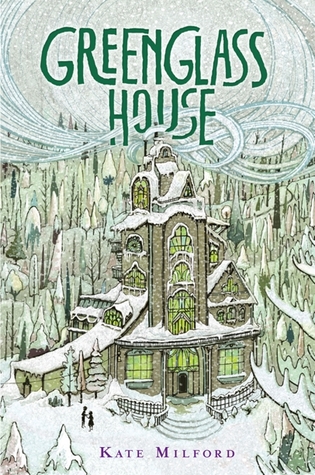
Greenglass House, by Kate Milford

greenglass

Sometimes a Middle Grade (MG) book is the right remedy for the last gloomy dregs of winter. In this first of a five-book series, twelve-year-old Milo’s glee at the start of winter vacation is dashed by the surprise arrival of a guest wanting to stay at Greenglass House, a gloriously rambling inn with many stained-glass windows, which is also the home of Milo and his adoptive parents.

Part of Milo’s dismay is that the inn, which seems to cater to an inordinate number of smugglers, is usually left to the family over the Christmas holidays. Another part is how unexpected this night-time arrival is, in the middle of a massive snowstorm which threatens to close the steep road to the house and—they thought—had frozen over the river Skidwrack, the usual approach to the house.

We quickly understand that Milo has a low tolerance for disorder and change, carefully piling his books in a certain way and always ensuring that each piece of furniture, each knick-knack is in its regular place. He’s self-conscious about how obvious it is that he is adopted, since he is Chinese, and tries to hide or at least be invisible when guests are around. His relief at being on vacation points to school being even more uncomfortable for him.

Their visitor is immediately followed by four more, each as mysterious as the last. Their cook and her oldest daughter are hastily summoned from the village, Nagaspeak, with supplies, barely making it through the storm.

None of the visitors appears to be on the up-and-up, their stated reasons for being there not ringing true. Then there’s the strange antique map Milo found, apparently dropped by one of them. His new friend Meddy, the cook’s younger daughter, introduces him to a role-playing game in which he takes on the character of Negret, through whom he discovers his own unsuspected talents. When items start being stolen, the two of them investigate.

The story takes place more or less in modern times, yet there are lovely quaint details. At one point, the Magothy is mentioned so I assume the fictional Nagspeake is set very near where I grew up on the edge of Sandy Point Park on the Chesapeake Bay in Maryland. Also, the author grew up in Annapolis, which is not far away. I especially loved the house, with its peculiar architecture, unlikely nooks and crannies, prolific attic, and mysterious history.

I read that the book started as a writing prompt—to write something about stained glass—which as a writer and writing teacher I love! Writing to prompts can take you down unusual paths, opening up new ideas and inspiring unusual stories.

While I was too immersed in the story to do much analysis while reading, I found myself afterwards looking at how the author revealed information. Like Milo, we are learning things all the time, but each new understanding raises even more questions. Thus, the suspense kept growing—with appropriate scenes of hot chocolate and companionship as a rest in between.

Some of the twists might seem a little heavy-handed to adults whose investigative skills have been honed by decades of mysteries, but are probably just right for middle-grade readers.

I loved how the characters develop through the story—Milo, of course, but also Meddy, Milo’s parents, and the guests themselves. Also adding to the richness of the story is what Tolkien called “shimmer”: the presence of a story behind the story, a detailed past hinted at, like the shadows of our past selves or our ancestors that lurk behind us.

The book in great fun and I look forward to exploring the rest of the series.

Have you read a Kate Milford book? Which one is your favorite?