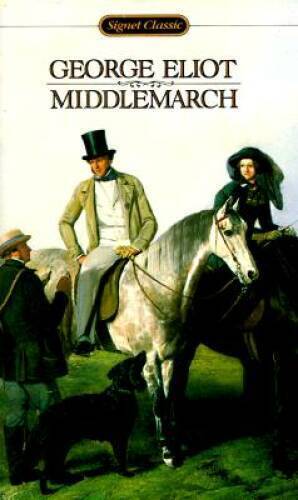
I’ve been rereading Eliot’s classic novel this month with Haley Larsen’s Closely Reading group on Substack. It’s been a few decades since I last read it, and different features of the book leaped out at me this time.
The story is about the inhabitants of the fictional town of Middlemarch in the English Midlands around 1830. Eliot does a masterful job of zooming in to a dozen or so characters while giving other townspeople plenty to space to make themselves known.
We first meet Dorothea Brooke, a wealthy and intelligent young (19) woman, who wants to do great things in service to others, starting with better housing for the tenants of her uncle and guardian Arthur Brooke, a hilariously foolish man who can talk himself out of any opinion. Dorothea is extremely religious and denies herself pleasures, such as her mother’s jewelry, in order to sacrifice herself to a greater cause.
That turns out to be marrying Rev. Edward Casaubon, prematurely elderly at 45. A dry stick of a man, who has devoted his life to creating The Key to All Mythologies, he marries her but quickly withdraws into his shell. He rejects her romantic ideas of assisting him in his work, like Milton’s daughters taking down the blind poet’s dictation (as Dorothea dreams), mostly because he fears she will mock him when she sees how little he’s accomplished.
We also meet Dr. Tertius Lydgate who hopes to modernise medicine In Middlemarch and the lovely, self-centered Rosamond Vincy who sets out to capture him. Her brother Fred loves Mary Garth, nurse to his uncle Mr. Featherstone, and she him. But she won’t marry Fred because he is feckless and a spendthrift, believing himself to be Featherstone’s heir and borrowing on the strength of that.
Mary’s parents Caleb and Susan Garth are kind and generous folks, Caleb being land agent for Featherstone. Then there’s Mr. Bulstrode, a wealthy banker. He’s a pious if hypocritical Methodist who runs much of the town and would like to do more to impose his beliefs on other residents.
A lot of characters—and there are more! However, Eliot wrangles their stories into a coherent story where we touch each person often enough that it’s not hard to keep them straight.
What stood out to me on this reading is the theme of what it means to live a good life. By that I mean a life of integrity, one we can be satisfied with when we lie on our deathbeds. In Middlemarch we have all these lives, all of these people intending to do the right thing yet derailed by temptations and compromises and the pressures of daily life. As we follow each storyline, we get to see various permutations of what a good life might look like—or not.
One aspect of a good life is being a contributing member of society, one which among other things means getting involved in politics. We hear a good bit about the Reform Bill (later the Reform Act of 1832) expanding the franchise to a larger segment of the male population, and about the coming of the railroads that threatens local farmers. There’s an interesting parallel here between the politics of the period and Eliot’s method of concentrating on a few privileged characters while including others to a lesser extent but with equal respect.
Another aspect is our personal relationships. I am fascinated by Eliot’s idea of a “home epic” which is what she calls this novel. She defines a home epic as a story about what happens after the wedding, particularly during the course of a marriage. I am often frustrated by stories that end with a wedding, as though that’s the be-all and end-all of a woman’s life, so I love that she takes marriage as the starting point instead. I’d expand the definition of Eliot’s term to include domestic stories, stories within a family, not just the married couple. And by family, I mean families of choice too. A home epic might also cover the course of a life and how we interact with others, how we live within communities.
The greatest barrier to a good relationship, whether with a spouse or a neighbour, is embodied in her subtitle “A Study of Provincial Life.” Yes, the town is geographically provincial, but there is a larger meaning to the word. As Rebecca Mead puts it in My Life in Middlemarch, “It is also concerned with the emotional repercussions of a kind of immature provincialism of the soul—a small-minded, self-centered perspective that resists the implications of a larger view.”
Over and over again, we see characters misunderstanding each other. So many conversations where people misread each other’s intentions or fail to comprehend what the other is thinking! We know this because of Eliot’s psychological insights, and her technique of using a narrator to go into each character’s thoughts. Her narrator also pulls out to give us that larger view, sometimes warning us that a character may not be as bad as they appear. The narrator can occasionally seem intrusive but is vital to Eliot’s ability to weave the story together and bring out her theme.
Therefore, to live a good life we must be able to empathise with others. We have to work to actually see things the way someone else does, to set aside our own view of the world and understand theirs. I think this is why our narrator persists in explaining these characters to us. Eliot keeps coming back to the idea that we have to grow out of our natural self-centeredness and recognise that others see the world differently.
It’s not easy. As Eliot says, “If we had a keen vision and feeling of all ordinary human life, it would be like hearing the grass grow and the squirrel’s heart beat, and we should die of that roar which lies on the other side of silence. As it is, the quickest of us walk about well wadded with stupidity.”
Yet we can try.
What does it mean to you to live a good life?