The Real Mrs. Miniver, by Ysenda Maxtone Graham

The Real Mrs. Miniver, by Ysenda Maxtone Graham

We’ve seen the movie, of course, and thought it a sentimental film about a woman who is practically perfect in every way keeping her family together and holding the home front together during the Blitz—the bombing of London during WWII. The book the film is based on, a collection of columns from the London Times, was something else altogether: an idealised portrait of an ordinary upper middle class woman’s life in pre-WWII England.

Those columns were written by Joyce Maxtone Graham (née Anstruther) using the name Jan Struther, and she modeled the family on her own husband and three children. However, as we learn from this biography by her granddaughter, the loving Miniver family was a far cry from Joyce’s own. Her marriage to Tony Maxtone Graham, initially fun-loving and amusing, had dried up as he’d been taken hostage by golf, leaving Joyce to her articles and poems many of which were published in Punch among other periodicals.

Joyce had been a tomboy as a child, loathing the ceremonial tea parties and dance lessons, preferring to run and shoot with the boys. She and Tony initially shared a comic view of the world. I loved the way they shared the silly things they noticed during their days: pebbles, as she called them, like children turning out their pockets at the end of the day. As they drew further apart, Joyce fell deeply in love with Dolf Placzek, a penniless Jewish refugee from Austria gifted with intelligence and a strong appreciation for the arts.

The Mrs. Miniver columns depict a happy, loving marriage that was a far cry from what Joyce’s had become. Yet for many, those columns embodied an England that was being destroyed by the war and a reminder of what they were fighting for. Mrs. Miniver’s upper middle class life was comfortable, with a London house and a weekend cottage in Kent, a son at Eton, and servants to do the chores. The columns contain the small things she notices during the day, some pleasurable, some not—like the pebbles she and Tony used to exchange. While Mrs. Miniver could be critical of her social circle, she was alive to its charms.

Joyce—now Jan all the time—was shocked by the surprising success of the book and the reading tours and talks that followed. She came to be haunted by Mrs. Miniver. Many fans assumed they were the same person. She struggled to finding a firm place to stand.

Of all emotions, she perhaps felt the emotion of missing most acutely. At a party, she missed solitude. Abroad, she missed home. Cut off from her children, she longed to be with them again. When she was, she longed again for solitude. The raggle-tangle gypsy in her head beckoned her to escape.

Why read biographies? In my twenties I read lots of biographies of women writers and artists, looking for inspiration during a time when women were second-class citizens when it came to the arts. I was also looking for ideas for how to write while wrangling two babies and an ex who refused to contribute. Just keeping the heat on and some kind of food on the table was a miracle. Forget about finishing a story and sending it out.

These days I still look for inspiration from brave women and men as I struggle with how to live a moral life in an increasingly compromised and chaotic world. I’m especially drawn to women living during dark times. I’m also interested in the wide range of life choices people make. One thing that is so fascinating in this book is the contrast between the life of Mrs. Miniver—a model for womanhood at the time—and that of the woman who created her.


Sometimes with a biography, it is enough to see myself in a reckless tomboy unwilling to knuckle under to social norms or an almost accidental writer. Now if only I can catch the zeitgeist the way Jan Struthers did! Perhaps it’s better I don’t. Her story is yet another cautionary tale of how too much success and celebrity can wreck a person.

It’s been difficult lately to find books that hold my interest. My reading record is full of DNFs. This one, though, fascinated me and kept my attention right through to the end. Jan reinvented herself several times over, which I find wonderful. And she changed the course of history, inadvertently perhaps and not alone, but for sure. What kind of world would we be living in today if the U.S. had refused to join the Allies fighting Hitler and Mussolini in Europe and Africa?

I take courage from her story and the stories she wrote about the ordinary people of Britain as we fight today’s fascism.

Have you read a biography that inspired you?
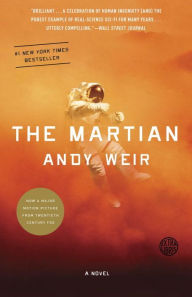
The Martian, by Andy Weir

9780553418026_p0_v4_s192x300

This novel opens with a punch as astronaut Mark Watney faces his own imminent death. Thinking him lost in a dust storm, his crewmates have taken off to return to Earth, leaving Watney stranded on Mars. In the best Robinson Crusoe tradition, he has to figure out how to survive in the harsh Martian environment until the next mission arrives—which won’t be for another four years.

One thing that lifts this story above the usual marooned-on-a-desert-island tale is Watney’s voice which we hear almost entirely through the entries he makes in his log. He’s smart and funny and never gives up. Faced with a problem, he thinks about it and comes up with a possible solution, and if that doesn’t work he comes up with another. His MacGyver-esque repurposing of the things around him is fascinating. Watney is clear about his failures and limitations; sharing a name with a famous brand of beer, he makes no bones about his status.

Actually, I was the very lowest ranked member of the crew. I would only be ‘in command’ if I were the only remaining person. What do you know? I’m in command.

As well as being a survival story, this is also a rescue thriller. Once NASA realises Watney is alive, teams of people swing into action to find a way, amongst the strictly limited options, to bring him home. As the clock ticks away, the stakes couldn’t be higher for this high-profile rescue. NASA and the U.S.’s international reputations are at risk, not to mention Watney’s life. Of almost equal concern to Watney himself is the potential loss of the precious research he’s been able to conduct while marooned on Mars.

I found the switch to NASA and a third-person point of view a bit of a wrench since it didn’t occur till well into the story. By then I was deeply focused on Watney. I never completely regained that depth of focus, but introducing people and tensions back home provided some interesting contrasts and enabled us to follow the rescue efforts in a way we wouldn’t have been able to do if the point of view had stayed solely with Watney.

One of the best things about this novel is the science. Watney’s situation is so dire and his voice so entertaining that his explanations of the science behind his creative solutions are fun to read. The part that I’m familiar with was certainly accurate and the rest plausible. I love the idea of him being saved by science. And—mystery devotee that I am—I loved that so much of the story was about solving problems. It added to the realism and the tension that not all his solutions worked. The way he picked himself up after every failure was admirable.

My one complaint was the lack of insight into Watney as a person. We learn nothing of his family or his life back on Earth, whether he has a girlfriend, likes football, or whatever. There is a vague reference at the very end to a couple on Earth worrying and awaiting news, whom I assume to be his parents, but we aren’t told. We get a little insight indirectly through his need for human contact, which recurs throughout the story. He doesn’t paint a face on a volleyball, but he does think of his crewmates as he apologetically uses their belongings.

Generally in a novel, we want interior story arc as well as an exterior story arc. However, that is actually less common for the scifi/suspense/thriller genres. Also, since what we are hearing are his work logs, he’s less likely to share his inner feelings (except by swearing now and then). Still, for me it made the book feel a bit dry sometimes, and I’d have gladly traded a few bits of science for some personal information.

One theme that comes through in this story is how much a single life matters. What is the worth of one person? Call me cynical, but I didn’t quite believe that the U.S. government would come up with billions of dollars and cripple future space programs to bring home one astronaut. I know how hard it is for NASA and other such agencies to get funding.

Still, it is a good case study for ethics classes. It is one of those wicked problems for which there is no easy answer. Like most people, my heart is moved when a child falls down a well or a hiker is lost in the wilderness. Yet I also consider the human and financial costs of rescue missions. I respect the military’s “Leave no soldier behind” ethos, but would rescuing Watney really be the best use of resources? As a former welfare mother who watched people I knew starve and suffer and die for no other reason than poverty—poor nutrition, substandard housing, lack of medical care—I can’t help thinking how many lives could be saved by those dollars. It is much easier for our hearts to be moved by the plight of one person than that of thousands of people.

The breakneck pace of this story does not allow more than a passing glance at these issues, but it is enough to conjure a larger meaning, a more significant framework that gets us thinking. It is enough to make this story more than just an action tale, more than just a thrill ride. Even if you’ve seen the film, it’s worth reading the book.

What book do you recommend reading in addition to seeing the film on which it’s based?

Note #1: Thank you to my Book Dissection Group for much of the insight included in this blog post. Opinions are my own, of course.

Note #2: Originally I included more examples of the humor, but I’ve deleted them so as not to ruin the punchlines for you. Read the book!