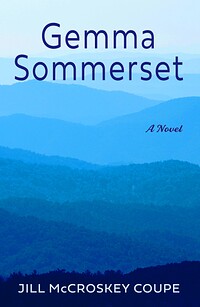
The story opens at a summer camp in the Blue Ridge mountains where fourteen-year-old Gemma undergoes a transformative experience. In 1957 girls’ roles were strictly defined, especially in the South, but away from home and facing a surprising danger, she finds a new sense of herself. The problem then becomes what to do with that when she returns home.
Gemma is part of an in-between age group: too late to be part of the WWII generation and too soon for the Sixties with its peace-and-love. This new novel from Jill Coupe explores how throughout her life she balances her desire for adventure and accomplishment with society’s restraints and expectations.
She dreams of studying French in Paris but ends up in a traditional marriage, home with a baby while her husband continues up his professional path. I’m reminded of Philip Larkin’s poem “Afternoons” where he describes young mothers watching their children at a playground, ending with: “Something is pushing them / To the side of their own lives.” Gemma’s one joy is watching the sun rise each morning, its beauty a reward, its freshness a promise.
The wonderful editor Dave King once wrote about what he called the gentle genre: “straightforward tales of ordinary people in mostly every-day, low-key situations. No psychotics, no wrenching twists, no gore, no vampires or werewolves or demons.” These stories were popular in the early part of the 20th century, from writers such as Jan Karon, Angela Thirkell, D. E. Stevenson, Elizabeth Cadell, R. F. Delderfield, and Wendell Berry.
The problem with writing such a story is how to create enough tension and suspense to propel the reader through to the end when you can’t throw in a gang war or vampire to liven things up. Dave King defines two ways to keep a gentle story going without letting it become either boring or saccharine. One is for the author to pay close and detailed attention to the characters so the reader will recognise that even small things hold deep meaning for them. The other is to set the story in a small town where you can’t avoid interactions with your neighbors, even if their opinions differ from yours.
In terms of the first method, we do get to know Gemma and the experiences that shape her and her refusal to be pushed to the side of her life. Since the story is told from her point of view, we learn about the other characters as she does. As for the second, her life revolves around her family so they, rather than the small city where she lives, become the community she defines herself within. Conflicts with her parents, husband, and daughters animate Gemma’s story as she strives to carve out a space where she can be herself while still caring for them. As Dave King says, gentle books—of which this is one—are “driven by love.”
Stories driven by love are a much-needed balm these days. Gemma Sommerset reminds me about the importance of family and community. We might disagree, but we can do so with love. So maybe Gemma’s not so far away from the Sixties generation as I thought.
What novel have you read lately that reminded you of what really matters?