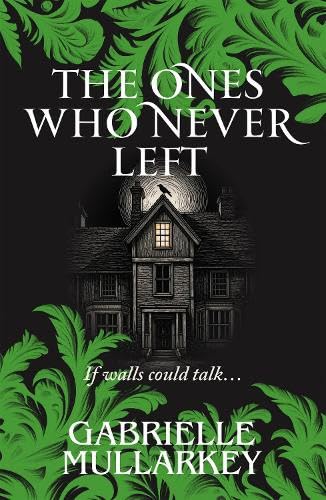
The Ones Who Never Left, by Gabrielle Mullarkey

A frustrated and stalled artist, Lucy has thrown away all her work so far because none of it was worth keeping. Now, about to turn 30, she decides to try being impulsive like Hugh. After knowing him for only seven months, she’s married Hugh and two days later is setting to meet him in rural Yorkshire where he’s signed them up as property guardians for an old manor house that’s rumored to be haunted.

In Rook House they find a study that Hugh, a struggling writer of supernatural fiction, appropriates while Lucy turns the attic into a studio. They mostly spend the rest of their time in the kitchen because the dining room is empty and the living room features an unnerving portrait of the original owner of the house, a painting that seems to have a mind of its own.

These two babes in the wood know nothing about living the country. Lucy’s just bought her first car, a bit of a wreck, while Hugh doesn’t even know how to drive. They rely on the occasional housekeeper, Mrs. Bird, to teach them how to use the Rayburn so they’ll have heat and hot water. They hear peculiar noises and debate whether it’s safe to walk in the woods.

As they learn more about the history of the house, the family who owned it, and the ghosts who supposedly haunt it, the two young people encounter strange happenings. The bedroom they use, the only one furnished, is papered with a design of birds stealing strawberries. Not too strange so far.

Next, they explored the remaining six bedrooms, all uncurtained and empty of furniture . . . The smallest bedroom had an open fireplace and bird-free wallpaper—also William Morris—featuring old-gold and pale-green leaves in snake-like coils. “Acanthus leaves,” Lucy identified.

Glancing at the faded paper, she had the strange sensation, just for a second, that the curling leaves were flowing and reforming into Rorschach ink blots, as if the pattern—maybe even the wall itself—was writhing with dark, silent life.

But Lucy is subject to migraines, so perhaps that is what’s happening to her. As the incidents come faster and go from alarming to frightening, it’s unclear what’s causing them: maybe ghosts, a Bertha in the attic, or simply their imaginations? To make things worse, Hugh’s impulsiveness begins to look more like the self-centered recklessness of a spoiled child, and Lucy finds it harder and harder to connect with him.

Although the plot accelerates nicely, Lucy and Hugh’s relationship becomes less interesting as it devolves into squabbling and secrets. They are both only children and perhaps lack the emotional tools for a relationship. Orphaned Lucy loathes her stepmother, while Hugh courts disapproval from his cold, wealthy parents even as he accepts their money.

Still, I cannot resist a story about a haunted manor on the edge of a Yorkshire moor, reminding me as it does of my introduction to gothic fiction when I was fifteen. I’ll never forget that November dusk when I curled up on a windowseat in the living room and opened Jane Eyre for the first time.

The plot in Mullarkey’s novel kept me turning the pages. There are plenty of shivers and surprises. What makes the scary parts so effective, besides being well-placed in the story, is how they call on fears that many of us experience. These days in particular, we know in our hearts and bones what it’s like to be misunderstood, to be in danger, to feel powerless.

I love the title which came, Mullarkey says in her note, from her wondering if the former inhabitants of the houses we occupy ever truly leave. Now there’s a thought. Many of us experience strong vibrations in the houses we enter. I thought perhaps the strong emotions within may have seeped into wood and stone and become subtle exhalations. But after this book, I’m considering the places I’ve lived and wondering what part of me might linger there. I think, too, of those who lived in them before me, the ones I know of anyway. This is where the gothic space begins to open: that uncanny disorientation that suggests maybe we don’t know so much after all.

What novel have you read recently that unsettled you?

Disclosure of Material Connection: I received a copy of this book free from the publisher. I was not required to write a positive review. The opinions I have expressed are my own.
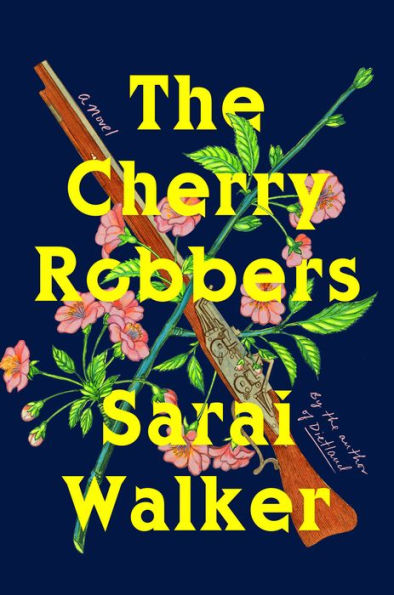
The Cherry Robbers, by Sarai Walker

Reclusive Sylvia Wren is a famous artist, now in her eighties, living in New Mexico and painting flowers that resemble women’s private parts. Her peaceful life is upended when a journalist discovers her long-buried secret: She is actually Iris Chapel, an heiress who has been missing for sixty years. Concerned that her story might be distorted or sensationalised, she begins to write it herself.

With that, we leave the frame story and plunge in the life of Iris Chapel, the fifth of the six Chapel sisters, born in the 1930s and all named after flowers. Their strict father is a gun baron, owner of Chapel Firearms, while their mother is a distant woman, obsessed by her own fears and her belief that the victims of those guns are haunting her. Alternating between screams and silence, Belinda also believes that the women of her family are cursed, and tries to keep her daughters from marrying

However, as the sisters begin to come of age in the 1950s, marriage seems to be the only way to get out of their restrictive home. Some of them long to live “normal” lives and head for that escape hatch, certain that the curse is just part of their mother’s madness. Iris comments:

It’s easier to say that women like my mother are crazy. Then you don’t have to listen to them. And so maybe in a way she became crazy. Maybe she could communicate only by screaming.

This novel was recommended to me when I was reading ghost stories around the solstice last month. I love the way Walker handles the spooky side of the story. People are haunted for sure, and sometimes ghosts are mentioned, but the story remains in a liminal space where the reader can believe in the ghosts or not. What is unmistakable is the underlying unease, a sense that something is dangerously wrong, and the way that unease intensifies as the story unfolds.

Iris alone believes her mother and tries to help her sisters. I loved the depiction of the communal life of the sisters, with their quarrels and tenderness, their jealousies and generosity. Like the plucky heroine beloved of gothic novels, Iris tries to be the compliant, self-sacrificing young woman her society demands, but says:

When you live in defiance of yourself, you can adapt to your circumstances, but remnants of who you are at your core remain. A bit of wildness that can’t be tamed.

With Iris as an engaging narrator, the first part of the story absorbed me. I found the  characters strong; the setting atmospheric, and the pacing excellent. However, the story went on too long and became repetitious. Also, coming back to the frame story at the end felt a little flat and predictable.

The use of Georgia O’Keeffe’s life and work to characterise Sylvia Wren disturbed me. Walker did acknowledge the artist in her note at the end, and she has a right to imitate O’Keeffe this way, since the artist is considered a public figure. If O’Keeffe were still alive would she object to this imitation? I don’t know, but somehow feel that this depiction is as jarring as commercials of Fred Astaire dancing with a vacuum cleaner. Similarly, using Sarah Winchester’s supposed fears as the centerpiece for Iris’s mother earned a raised eyebrow. I’m reminded of Milan Kundera’s Immortality where he delves into the morality of manipulating a person’s image and reputation after they are dead and cannot protest.

The title comes from D. H. Lawrence’s poem with its sensuality, blood and tears. While the metaphor of the cherry seems almost too direct, the poem brings more context to the uneasiness summoned by the image of a robber. I ended up liking the title and glad I read this book.

What do you look for in a ghost story?

Wakenhyrst, by Michelle Paver

For the winter solstice I wanted to return to East Anglia and the fens, a time and a place when the veil between our world and another seems to thin. Paver’s novel fit my mood perfectly with its luminous and sometimes eerie descriptions of life in fen country.

Many Gothic novels use a frame story, usually told by an ordinary person, someone the reader can identify with. Then the inner story plunges into the darker twists and turns of human nature before ending with a return to the realistic world, reassuring perhaps, yet still haunted by a suspicion of unease.

Here the frame story takes place in 1966, starting with a magazine article. The first paragraph lands us right in the story.

Like a witch’s lair in a fairytale the ancient manor house crouches in its tangled garden. I can’t take my eyes off the ivy-choked window above the front door. It was from that window in 1913 that 16-year old Maud Sterne watched her father set off down the steps with an ice-pick, a geological hammer—and murder in his heart.

The article’s author describes a visit to the now elderly Maud, alone in her crumbling manor, Wake’s End, in Suffolk. He suggests that Edmund Sterne might have been innocent, adding, “We only have Maud’s word that he did it.” Then comes an exchange of letters between Maud and an academic culminating in her inviting him to Wake’s End.

From there we go into the larger story, beginning in 1906 with young Maud as our guide. The house is situated by Guthlaf’s Fen, one of the few fens that hasn’t been drained to create more farmland. Her father Edmund hates it and won’t allow any of the windows on that side of the house to be opened, but Maud loves it.

To her the fen was a forbidden realm of magical creatures and she longed for it with a hopeless passion. In summer the scent of meadowsweet drifted across the Lode and the reeds rang with the eep-eep of frogs. In winter Maud could hear the ice cracking on the Mere and the skies were alive with vast skeins of geese. One afternoon they’d flown right over the garden, and the beat of their winds had lifted Maud as if she were flying.

The sense of dread grows as Maud’s mother suffers multiple unsuccessful pregnancies. “ ‘Perhaps not every night,’ ” the doctor advises, but Edmund brushes him aside. Maud finds her father’s private journal where she learns of the foggy afternoon when Edmund walked by the church in the nearby hamlet of Wakenhyrst. “The church loomed, deep black against the charcoal sky. It seemed not a place of sanctuary, but the menacing relic  of a savage and haunted past.”

Then he tripped over the planks he’d ordered stripped from the chancel arch as part of the renovations. Seeing an eye peering up at him from the grass, he felt a strange sense of guilt and caught “a strong marshy whiff from the fen.”

It turns out that the planks hold a medieval painting that had been whitewashed by the Puritans, a Doom that depicts the Last Judgment, dominated by the gleeful devils torturing the damned. It is restored and mounted in a separate room in the church, yet the painting clings to his imagination until he begins to see devils everywhere.

With the unearthing of the Doom, he comes to believe that “Something has been let loose…” The old superstitions still have a hold, not only on the church-going residents of Wakenhyrst, but also on the manor house where servants tell Maud stories of the fens, and now they gradually take hold of Edmund himself.

Maud finds, though, that her father won’t give up his autocratic grip on the household and is frustrated in her attempts to educate herself. The sense of intrigue grows as she begins to unearth other secrets even as the claustrophobic atmosphere tightens around her.

What I liked about this story was its slow burn. It moves within that liminal space between the ancient mysteries and the modern world without completely spilling over into either horror or rational explanation. I found plenty of tension and suspense, but they are curiously muted by the proximity of reality; somehow that intensifies them.

Framed narratives like this one, with their multiple narrative voices, do increase suspense and also create a sense of unease through the blurring of reality and fiction. There are some daring moves on the author’s part, such as revealing so much in the first paragraph and then staying within that liminal space between the natural and supernatural worlds. I thought she succeeded and look forward to reading more of her work.

Can you recommend a good Gothic novel or perhaps a literary novel with some Gothic attributes?

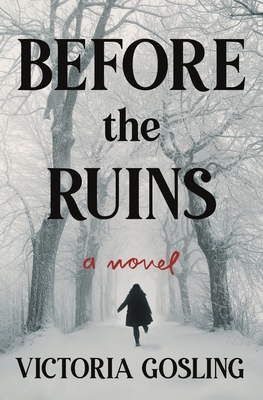
Before the Ruins, by Victoria Gosling

“The year Peter went missing was the year of the floods.” Thus begins this tale from Andrea (Andy) set in the present-day but reaching back twenty years to the summer of 1996 when she and her friends have finished their final exams. A bored teenager with few prospects, Andy enriches her life by coming up with games to play with her three best friends: Peter, Marcus and Em. The guardrails come off when Andy’s alcoholic mother predicts the apocalypse is about to occur—if the world is ending, their actions have no consequences—and the four friends take over an empty manor house near Marlborough in Wiltshire.


Learning that a valuable diamond necklace had been stolen at the manor fifty years earlier and never recovered, they embark on a new game of playing detective. Em acquires a cheap copy of the necklace—a tourist item in town—and they take turns hiding it, a game that has the added relish of perhaps actually finding the real necklace and changing their lives. Another teen, the suspiciously charismatic David, turns up one day, claiming to be a friend of the absent owners and quickly becomes a part of the group.  


Yet there’s an ominous push-pull within the group as they practice deceiving one another. Relationships fray; secrets and lies erode trust; betrayals lurk in the shadows. The story builds gradually, moving between the search for Peter in the present and unpacking the events of the past, turning them this way and that, looking at them anew.

Memory is a house, a castle with many rooms. Some of the rooms are deeper inside, honeycombed away. Each has a thousand keys – an image, a smell, a sound. Behind each door are a thousand other doors.

I was drawn to this novel because I like the narrator of the audiobook, Kristin Atherton, and because a reviewer compared it to Tana French’s work. My favorite is The Likeness of which I said, “French captures so well the fun of being part of a tight group of friends, when you’re young, and it’s all happening for the first time, and everything seems unbearably sweet.” Gosling’s story comes at youthful friendship from another angle, capturing its mystery and beauty, but also its fragility and fear.


To sleep on? Or to wake? This was the question facing me. To sleep, or to wake and face the reckoning, to find out what had been lost.

I thought Before the Ruins would be another in a long line of gothic mysteries about a narrator revisiting formative events in the past, secrets that come to light, etc. However, I underestimated the book. It rewards deeper investigation, from the pun in the title (before) to the use of diamonds as a MacGuffin to the sly use of imagery (floods, treasure, playing games, losing your nerve at the prospect of a leap).


Caught up in the story I noticed little else, but on reflection I wish we could have gotten to know the characters other than Andy a bit better. The way they are presented makes sense since we are getting the story through her point of view which comes with her own blinders; only near the end do their actions indicate more complexity. I would also have welcomed more description of the manor itself.


As a writer, several things in this book impressed me: the complexity of the narrative with multiple storylines and reveal after reveal; Gosling’s willingness to let the slow burn unfold in sentence after delicious sentence; and the way she hits the reader flat out near the end, signaling that whatever you thought the theme was, it’s so much more. No spoilers here, but be prepared to discover layers upon unexpected layers of this story.


Have you read a novel that turned out to be much more than you expected?


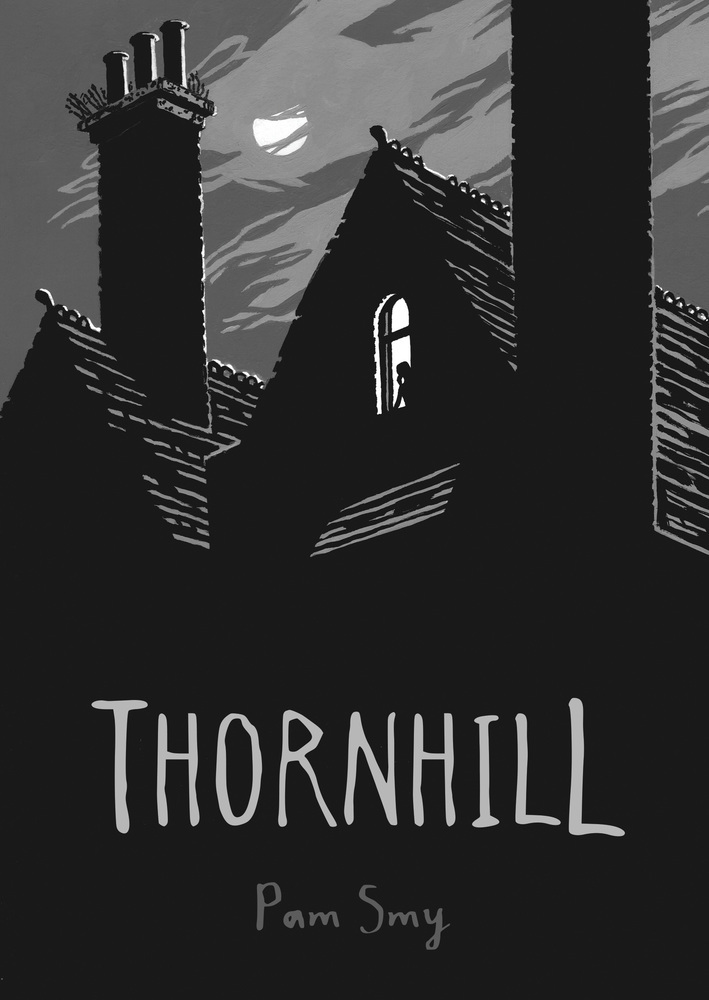
Thornhill, by Pam Smy

This unusual Young Adult (YA) novel is perfect end-of-October reading: stark, a little sad and a lot spooky. Part graphic novel and part journal, it’s a stunning portrayal of what many people experience, especially those on the tender, unpredictable cusp of adolescence.

Lonely Ella has just moved to town, her modern-day story told in striking black-and-white graphics, the only words being those occasionally written on items in the scene. We see an upstairs room, packing boxes, a window—and through that window a strange gothic ruin of a house buried in an overgrown garden.

The Thornhill Institute for Children, a boarding school for abandoned and orphaned children, closed in 1982. Mary is one of the last to leave, and it is her journal that runs parallel to the silent pictures depicting Ella’s life. Mary writes of terrible goings-on at Thornhill, especially the bullying directed at her. She takes refuge in her attic room, locking the door against the nightly bangings of her chief persecutor. There she makes puppets and dolls—creating her own friends—and reading.

Ella’s mother has apparently died, and her busy father seems to have little time for her. Sometimes we see through a crow’s eyes; is it the crow or Ella who first sees a shadow in an attic window of the dilapidated Thornhill? Ella finds a way into the property and begins exploring.

The book made me consider what we see and what we don’t see. The adults at Thornhill don’t see Mary’s suffering, nor does Ella’s father see her loneliness and her grief for the loss of her mother. Mary’s diary reveals her uncertainty about whether to trust what she sees, such as overtures of friendship from her persecutor. It also shows her hiding from view in her room, more and more as the story continues.

We readers see only Mary’s words and the pictures of Ella’s life. I found this distancing  effective because it made me create their stories myself. That happens with the best traditional novels, of course, but I felt newly challenged here. I was reminded of what writer/teacher/agent Donald Maass has said about creating emotion in our stories. Just describing the emotion doesn’t make the reader feel it. Instead, we have to set up a situation that invites the reader to remember feeling that emotion themselves; their own memories then supply the emotional heft.

I certainly found that to be true here. I was flooded with memories of that awkward, in-between time. Mostly I remember glorious days, enchanted moments, etc. but I was reminded that there were some bullying and loneliness; there was the need for a friend.

Another part of my thinking about what we see and how we see it was remembering a show of Andrew Wyeth’s paintings at the National Gallery entitled “Looking Out, Looking In.” His paintings of windows and doors made up the exhibition and sent me down a path considering point of view in a way that had nothing to do with first or third person but everything to do with where we are standing, whether we are inside or outside.

In Thornhill, we have windows and doors, walls and secret gardens, mysteries and ghosts. It’s a quick read, but the story may stay with you a long time.

What are some of your favorite spooky reads for October?

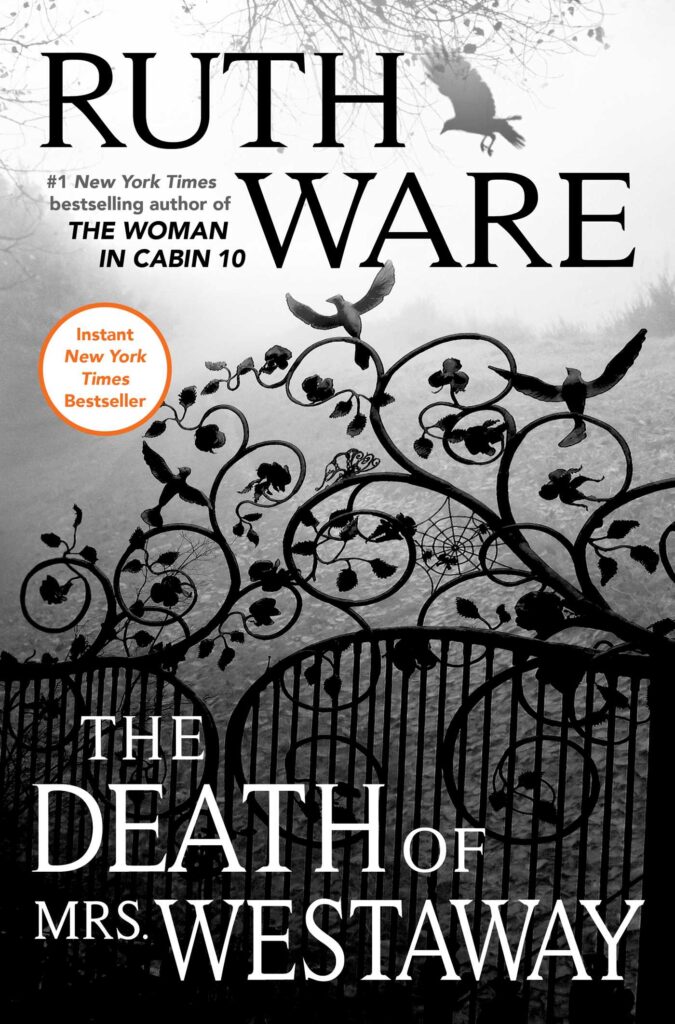
The Death of Mrs. Westaway, by Ruth Ware

On a damp, chilly night, Harriet “Hal” Westaway finally makes it home to her dismal flat. At 21, she’s been scraping out a living doing tarot readings in a kiosk on Brighton Pier she inherited from her mother. In her mail, mixed in with the past-due notices are two letters: a threat from a loan shark demanding immediate payment and one from a lawyer in Cornwall.

The lawyer’s letter informs her of the death of her maternal grandmother and invites her, as a beneficiary, to a reading of the will. Hal knows her mother’s mother died years ago, so this must be a case of mistaken identity. She’s alone in the world, her mother killed in a hit-and-run three years earlier and her father dead when she was too young to remember him.

Still, the promise of a sizeable bequest and the increasing violence of the loan shark’s threats combine to overcome her scruples at deceiving this mourning family. After all, she reasons, they are obviously rich enough to spare a few thousand pounds. In crafting her tarot readings, she’s become superbly skilled at reading people, so she just might be able to pull it off.

She barely manages the one-way fare to Cornwall, where she’s met and taken in the pouring rain to Mrs. Westaway’s funeral at a church outside Penzance, where she meets her “uncles” and is taken back to Trepassen House, a gloomy mansion complete with hostile housekeeper who shows her to a tiny room set off from the rest of the house with a small iron bed and bars on the window.

There was a lock on the door. Two, in fact. They were long, thick bolts, top and bottom.

But they were on the outside.

I generally avoid thrillers—the world is producing a more than sufficient supply of anxiety these days, thank you very much—but I keep gravitating to Ware’s books anyway. This is the first one I’ve managed to read through, entranced by the echoes of Daphne Du Maurier’s Rebecca and the brilliant use of tarot cards.

Hal and her mother never believed in the cards; they were a means of making a living.

The cards tell you nothing you don’t already know. It was her mother’s voice, steady in her ear. They have no power, remember that. They can’t reveal any secrets or dictate the future. All they can do is show you what you already know.

Yet the author tantalises us with one card or another, turned up in a reading demanded by her new “relatives” or left conspicuously out, its meaning exerting power over the other characters and perhaps holding a clue to the mystery.

I’m also not a fan of the glut of woman-in-danger stories, but here the gothic atmosphere combined with the fascinating house and its grounds made for a captivating read. And Hal is an interesting heroine. I liked her integrity and how it is put to the test, not just once but over and over. At times I wished she were more strong-minded, but I could also see how the tragedies in her life could have left her afraid and uncertain.

As an author I was intrigued by the pacing and the reveals: when information is revealed, questions answered or new questions raised. Some things I did see coming, so I especially liked the times (no spoilers!) when I expected something to happen and was all set to condemn it as predictable—and it didn’t. Or it happened in a different way. Nice.

A contemporary gothic mystery with a mysterious mansion in Cornwall and plenty of family secrets to unearth: who could ask for anything more?

What mystery have you read that is set in Cornwall?