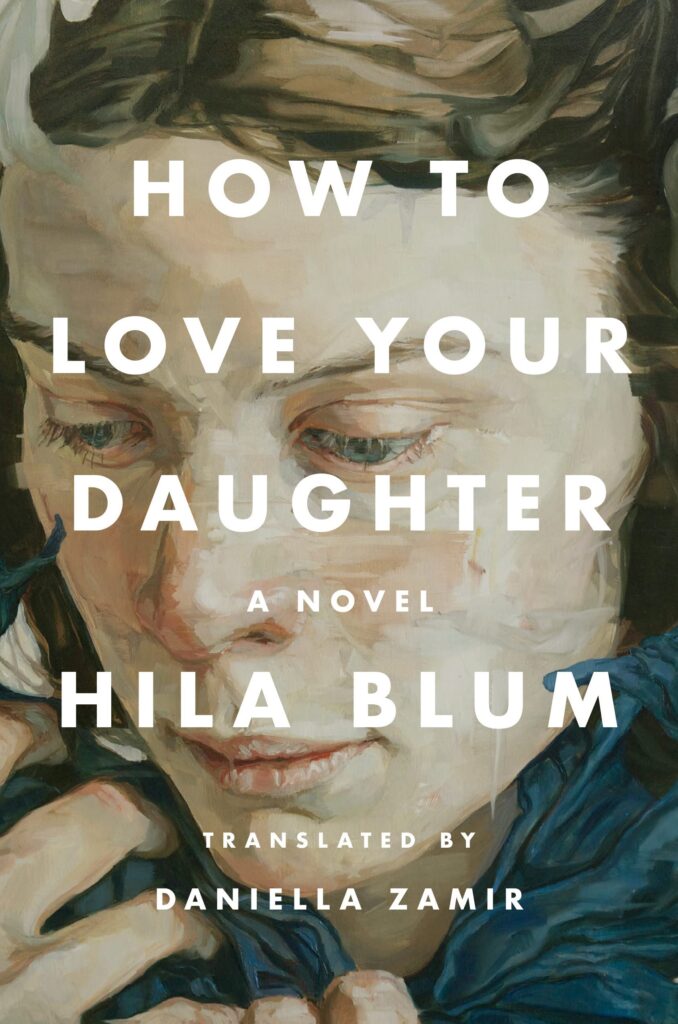
How to Love Your Daughter, by Mila Blum

Translated from Hebrew by Daniella Zamir

As this short introspective novel opens, Yoella has come from Israel to Groningen in the Netherlands to stand outside her daughter Leah’s home. She does not approach the door. Instead she looks in at a window to see Leah with her husband and two children. It has been ten years since she has seen her beloved daughter, during which men would occasionally call her to say her daughter was safe but hiking in Nepal or some such place without phone connectivity. She has only just learned that it was all a lie. Leah, now 28, has been here all this time.

And because I was watching my daughter and her family without their knowledge, I was vulnerable to witnessing what wasn’t mine to witness.

Such a rift begins to seem impossible as Yoella describes her immense love for baby Leah. We are entirely in her mind, absorbing her memories and insights, with only a rare piece of dialogue or gesture recounted to indicate what Leah and Meir’s perspectives might be.

My love for my baby daughter came easily. Her father was also in love with her; we talked about her every night after she fell asleep, thanked each other for the gift that was our girl. Everything that I had been denied I gave to her, and then some. And she loved me too.
 

In a quiet, mesmerizing voice, Yoella moves back and forth in time, describing Leah’s perfect childhood—a star at school and in her ballet classes—and the tight bond between the two of them. Yoella’s husband Meir is older and busy with his work, yet he, too, adores the child. The two of them seem to have a special understanding.

The fractures appear as she begins to reveal tidbits from her own troubled childhood and the silences in her relationship with Meir. Woven into her thoughts are brief insights about mothers and daughters from the stories she’s reading by authors such as Anne Enright, Margaret Atwood, and Alice Munro.

I think we are supposed to be in suspense about the cause of their rift until near the end of the book. However, the suffocating nature of this woman’s all-consuming love for her daughter, made me want to run away from her almost from the beginning, and I’m not even related to her. She’s the kind of mother who follows her daughter everywhere, kisses her on the lips even as she’s leaving home at 18, and prefers to cuddle close and sleep in her daughter’s bed rather than her husband’s. She makes me appreciate my own mother’s distance.

The writing is lovely and the chapters very short; Yoella doesn’t linger in any fragment of memory for long. It becomes an interesting psychological portrait, as she reveals—perhaps without meaning to—the way she manipulates Leah, and the lies and evasions she uses to paper over the cracks in her life.

The mother-daughter relationship is an endless source of interesting variations. That this one came to feel to me like a horror story probably says more about me than the book. It certainly made me reflect on my life with my own mother and with my children. There are so many ways we can go wrong, so many ways we can inadvertently injure these vulnerable beings we are responsible for. Yoella says we are all “… survivors, everyone was given either too much or too little, life is always a long journey of healing from childhood.”

What story about mothers and daughters has moved you?
Hush Hush, by Laura Lippman

I was thrilled when this twelfth book in Lippman’s Tess Monaghan series came out in 2015. I decided to save it for a moment when I really needed it, a moment that came this week. Hush Hush is everything I hoped it would be and more. Lippman is in top form, digging into the darkness of family life—and its joys too.

After the death of her baby, Melisandre Harris Dawes was found not guilty of murder by reason of insanity (postpartum psychosis). She spent some time in rehab and then moved to South Africa and then England. Her husband Stephen had full custody of the two older girls, Alanna and Ruby. Now, twelve years later, Melisandre has returned to Baltimore to reclaim her daughters—now teenagers—and her reputation.

A stunning woman, imbued with the glamour and confidence of old-style Baltimore wealth, Melisandre expects to impose her will on everyone around her. She has hired a filmmaker to create a documentary about her trial, supposedly to expand public understanding of the verdict. Interviews for this documentary crop up between chapters, adding new insights for the reader. Mindful of her notoriety, she has contacted her old flame, lawyer Tyner Gray, for help.

Through Tyner—Tess’s friend, mentor and husband of her beloved aunt—Tess has been hired by Melisandre to look into her security. It’s not work Tess and her new partner, ex-policeman Sandy Sanchez usually do, but Tess is feeling the financial pinch of being a parent. The interweaving of the investigation with Tess’s home life—deepening relationship with Crow, adoration of their three-year-old daughter Carla Scout, and the inevitable complicated scheduling of their work and day care—furnish an extra level of depth to the story.

The theme of mothers and daughters is one of those universal themes that always draws my attention. The subtheme of questioning what constitutes good parenting adds complexity and further deepens my interest. Both Tess and Melisandre receive anonymous notes criticising their parenting, though most parents (me included) don’t need outside critics in order to question themselves. I’ve been faced with more than one toddler meltdown in a busy grocery store and could thoroughly identify with Tess’s reaction. Carla Scout is not the first three-year-old with Big Feelings whom I’ve encountered.

The mystery itself is satisfyingly twisty. Alanna’s rebellion against, well, everything and Ruby’s tendency to search out secrets and hold them close complicate the story, as does their young stepmother’s struggle to care for her own new baby. Sandy Sanchez adds a gravitas to the story and another point of view. Lippman does a good job of showing how his strengths align with Tess’s. As events escalate, each character adds to the richness of the story.

The story felt especially poignant for me because I left Baltimore a few years ago after a lifetime there. On the trail with Tess, crisscrossing the city, even visiting some of my formerly regular spots left me a little homesick.

I’ve read and enjoyed Lippman’s standalone novels since Hush Hush came out. If you search my blog you’ll find seven other Lippman novels I’ve reviewed. I am still hoping for another Tess story.

What’s your favorite Laura Lippman book? Do you have a favorite spot in Baltimore?

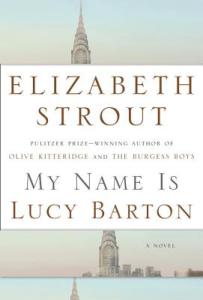
My Name Is Lucy Barton, by Elizabeth Strout

lucybarton

My library puts a slip of paper in books where people who’ve checked out the book can rate it. When I took out this book, I saw that three gave it top marks and one hated it. Me, I loved it.

Obviously, this quiet story is not for everyone. Lucy herself is the narrator, telling us about a time in the 1980s when she was in the hospital for nine weeks and her mother came to stay with her for five days. From the start we wonder what is wrong with her that she must be in the hospital for so long and why this is the first time Lucy has seen her mother in years, since Lucy and William’s marriage in fact.

Over the course of the five days, Lucy’s mother relates gossip from home, mostly of marriages that did not end well. Lucy’s thoughts wander over the years, touching on her brutal childhood when the family’s poverty was so great that they lived in an unheated garage with no running water and she was locked in her father’s truck while her parents were at work. She tells us about her life in New York City with her husband and daughters, though not—she insists—about her marriage.

It’s Lucy’s voice that made me fall in love with this book. Like her mother, whose voice Lucy describes as “shy, but urgent”, Lucy tells us of these things calmly, leaving us to infer the desperation underneath. Telling details—a memory of her father’s hand on the back of her head, hiding a magazine from the doctor for fear it makes her seem “trashy”, her near-envy of people with AIDS because they seem part of a community—reveal what lies beneath her surface calm.

Even the title reflects Lucy’s calm, matter-of-fact tone.

Lucy tells us how happy she is to see her mother and reassures us that she loves her mother, but the two of them shy away from anything too personal. Their relationship is at the core of the book. As in Jeannette Walls’s The Glass Castle, Lucy’s love for her mother and apparent lack of self-pity make the book glow. She recognises that their love for each is an “imperfect love”, as Sarah Payne says. Payne is an author who, in occasional encounters, gives Lucy advice on writing that become life lessons.

In addition to the voice, what I admire most as a writer is the way Strout releases information. Among the themes of imperfect love and family is the theme of reticence. There is so much that Lucy does not say. Sarah Payne, too, is criticised as a writer who shies away from telling everything, from digging too deeply.

The story seems to ramble haphazardly, but when I went back and looked more closely, I could see how well crafted it is. The seeming randomness actually follows traditional narrative structure.

Also, things are mentioned without explanation, such as Lucy’s fear of snakes or her friend telling her to be ruthless. Then, later, we learn a bit more, and then perhaps another bit. We are never told everything, but we are told enough. As one person in my book club said, every single thing in this book has to be there.

Recently, I was thinking that I had lived in my most recent home for 17 years—which seemed like no time at all—when I was surprised to realise that 17 years was the length of my childhood. When I left for college at 17, I shook off my family and began to create my life, just as Lucy did when she married and left home. Yet those few childhood years exert a power as great as that of all the decades that followed.

In the end, though, what I treasure most in this story is the perception that it’s not so much a matter of forgiving parents, but rather a recognition that the love is there, an imperfect love, but love nonetheless.

Have you read a quiet book that turned out to be unexpectedly powerful?