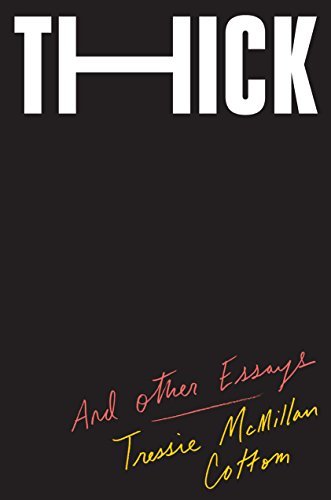
Reading this collection of essays has been like sitting down with a friend and asking, So tell me—what do you really think? Cottom draws on her academic training and her lived experience to create pieces that blur the line between sociology and personal essay. One editor said she was “too readable to be academic, too deep to be popular, too country black to be literary, and too naïve to show the rigor of my thinking in the complexity of my prose.”
If in her academic life she is chided for her popular success on social media and for using herself as a subject, she responds that “The personal essay had become the way that black women writers claim legitimacy in a public discourse that defines itself, in part, by how well it excludes black women.” Writing about your personal experience is a way in because your authority about your own self cannot be denied. Also, by its very form the personal essay invites empathy from readers.
I was, like many young women, expected to be small so that boys could expand and white girls could shine. When I would not or could not shrink, people made sure that I knew I had erred….[I was] thick where I should have been thin, more when I should have been less.
She writes about black women’s (and girl’s) problems, ones that are too often dismissed by others, in lucid prose that invites you into the conversation. But don’t be fooled by the casual tone. Yes she can be snarky and funny, but she can also pull out the statistics to support her statements and references to the work of other academics and deep thinkers. I often found myself setting the book aside between essays to follow the links in the endnotes for more detail.
I especially appreciate that she keeps probing at an issue. For example, in “Dying to Be Competent” she starts from our common desire to be able to manage our own lives, despite the fact that much of what happens to us is unpredictable and outside of our control. She goes on to tell a heart-wrenching story of trying to navigate the healthcare system, and the shock that despite her academic credentials and middle-class status markers, she has to fight for treatment and medication because the staff assume that she is incompetent and ignorant and thus can be ignored.
All this is presented in a cool tone and then buttressed by study after study about the high mortality rate of black women giving birth in the U.S., as well as by the example of what even celebrity tennis superstar Serena Williams had to go through to get a needed treatment, one that likely saved her life.
But Cottom doesn’t stop there. “Sociologists try to figure out how ideologies like race and gender and class are so sticky . . . The easiest answer is that racism and sexism and class warfare are resilient and necessary for global capitalism.” A further analysis takes us to Patricia Hill Collins’s idea of “controlling images, those stereotypes that are so powerful they flatten all empirical status differences among a group of people to reduce them to the most docile, incompetent subjects in a social structure.” Such reduction is needed because “This moment of global inequality demands incompetent subjects.”
This is just one example from one essay. If I’ve made it sound like heavy going, believe me when I say that it is not. I read most of the essays twice, just for the sheer delight of following her argument. This is a book that has given me much to think about.
What book or podcast or blog has given you new insight into our culture?