Pattern of Lies, by Charles Todd

pattern

Bess Crawford, a nursing sister on the frontlines in France near the end of the Great War, returns on leave to England to find a different kind of war being waged. Stuck in Canterbury when the London train is cancelled and all the hotels full, she runs into a former patient, Maj. Mark Ashton, who invites her to stay with him and his parents at their home in nearby Cranbourne.

What she finds is that the tiny village has turned against the Ashtons, particularly John’s father Philip. The Ashton Powder Mill, once the largest employer around and a place where workers were treated particularly well, had blown up two years previously, an explosion followed by a devastating fire, killing over a hundred men.

The Army investigated, fearing sabotage, but declared it an unfortunate accident. Due to the war, the need for gunpowder was overwhelming, and the mill had been commandeered by the Army. Despite Philip’s warnings, the new masters had the mill working flat out to meet the demand, with extra shifts and new workers brought in.

Now the villagers have become convinced that Philip Ashton is responsible for the disaster. Bess is shocked by the retaliatory actions they have taken: tearing down walls, releasing animals, spitting at anyone associated with the Ashtons, even setting fire to their house.

Given the suddenness of the accusation and its wide spread, Bess comes to believe that someone is behind the rumors, someone angry with Philip Ashton or the Ashton family. Unfortunately, the only witness to the fire is a local man now serving at the front in France who refuses to request leave to come back and make a statement.

There is almost nothing more terrifying to me than this kind of hysteria. We see it today with the firehose of misinformation. We have seen it before: Lillian Hellman described it chillingly in The Children’s Hour and Arthur Miller in The Crucible. It is almost impossible to defend oneself as rumors spread.

This mystery, seventh in the Bess Crawford series, though the first one I’ve read, is absorbing. There are plenty of twists and turns, and plenty of clues. Best of all, we get Bess’s impressions of England and France during wartime. Her duties vary from working at the front itself, escorting patients to hospital in the backlines in an ambulance under fire, and caring for patients as they are shipped back to England.

The latter gives her plenty of opportunity to visit the Ashtons, as she must pass through Canterbury, and pursue her own investigation while offering support to the family. The other characters are memorable due to the nuance with which they are rendered. I especially liked that the authors (Charles Todd is the pseudonym for mother and son Caroline and Charles Todd) avoids the standard romantic subplot.

The time period increased my enjoyment of this book. I’ve long been fascinated by the Great War, aka WWI, which changed everything for the Western world. Empires ended, colonies gained freedom, global power shifted, and the irresponsible slaughter not only decimated populations and economies but destroyed the ideal that it was glorious to die for your country. As Wilfred Owen put it: If you could have experienced what he did in the trenches

My friend, you would not tell with such high zest
To children ardent for some desperate glory,
The old Lie: Dulce et decorum est
Pro patria mori.

Do you read historical fiction? Do you have a favorite time period?
Shrines of Gaiety, by Kate Atkinson

shrines-of-gaiety-3

The story opens with the infamous Nellie Coker, owner of a string of nightclubs in 1926 London, being released from Holloway Prison at dawn. Many of the toffs and high-ranking politicians who revel at her clubs and who conspired with her in evading police scrutiny are present, a bit bedraggled by their long night dancing and drinking, to celebrate Nellie’s release, along with “the usual riffraff and rubberneckers.”

Nellie immediately has to buckle down and defend her empire from several threats.

Meanwhile Detective Chief Inspector John Frobisher, on loan to Bow Street to “root out corruption,” is one of those threats, though he is hampered by the distrust of his new colleagues, the distraction of a string of drownings of young girls, and his own ineffectual nature. He is unhappily married to a mentally ill woman; he’s not really sure why he married her except that he prevented her from jumping off a bridge.

With characteristic humor, Atkinson vividly depicts the London club scene of the time. The aftermath of the Great War is everywhere in this story, from wartime reminiscences of the doorman to the difference between men who had gone to war and those who had not. Even the reckless abandon of 1920s London is blamed on a reaction to the war.

The criminal elements are mostly played for laughs. This bumbling cast of villains reinforces Hannah Arendt’s idea of the banality of evil. Writers don’t come off much better. Frobisher’s articles requested by John Bull are never published because they are not sensational enough. Ramsey Coker wants to be a best-selling author, but is too lazy to actually write.

Atkinson has done her research on this period. However, this novel illustrates the danger of too much research. I found it an unsatisfying story of uninteresting characters.

It also illustrates the danger of using real people and their lives for a story. Real people the author only knows from reading about them don’t necessarily make for interesting characters. There’s too little detail, nothing that makes them stand out. Frobisher, “influenced” by real-life Superintendent Robert Fabian and Nellie Coker, based on the real “queen of Soho’s clubland” Kate Meyrick, never quite come to life in this story.

Nellie’s obnoxious brood seem like empty caricatures put in place for plot purposes. The two 14-year-old girls who run away to London are stock characters. There’s a prostitute with a heart of gold, two policemen on the take, a strict battleax running a hotel for women, and so on.

Only the third protagonist, fictional Gwendolen Kelling, a former librarian who has come to London in search of the two lost girls, steps off the page, displaying real emotion and unexpected competencies. A nurse during the war, she is more than equal to London’s recklessness.

The other danger of using real lives is that they rarely fit into the kind of narrative arc readers expect. Here, plot threads are abandoned without being resolved; story questions are not answered; important events are random happenings rather than growing organically out of the characters and the plot. True, a couple of threads and questions are dispatched, but too much is left unresolved for there to be a satisfactory ending.

I had to wonder why I should care about these characters and their lives when the author seemed to care so little that she would just abruptly abandon them.

Just like real life, you might say. True. And it is somewhat interesting as an experiment. Atkinson is not alone among authors questioning whether standard story structures adequately represent our lives in this world. I appreciate her willingness to tinker with the balance between reality and story. Still, it was too insubstantial a story to satisfy me.

Have you read an historical novel that includes real people as characters? What did you think of it?

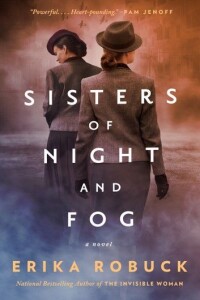
Sisters of Night and Fog, by Erika Robuck

7bbe5b77543d58f522f43ee9063ae898-2374309684

This absorbing historical novel follows two real women who became French Resistance fighters during World War II. Violette Szabo and Virginia d’Albert-Lake both have a history with France. Violette was born there of a French mother and English father and grew up in England to become a strong-willed Cockney. Virginia is an American who, like Violette, falls in love with and marries a Frenchman.

From the start, we are caught up in the rumors of war, brought to life through the eyes of these two women. With the stunning invasion of France, a pregnant Violette in London immediately starts campaigning to do some kind of war work, despite her father’s discouragement, a campaign that takes fire when her husband in killed in North Africa. Meanwhile, Virginia elects to remain in France with her beloved husband, invalided out early in the war.

Alternate chapters follow the two women as they find their way forward, Violette doing various kinds of war work before joining the Special Operations Executive (SOE), a secret UK intelligence agency, in the hopes of being sent to France, Virginia and her husband sheltering and helping downed pilots and escaped POWs.

Beautifully written, full of stunning scenes that we discover in the historical note at the end actually happened, this is one of those books that you simply cannot stop reading. It’s a fantastic addition to our understanding of what was happening beyond the battlefields during this showdown with fascism.

You might think that I would have had enough of women Resistance fighters after reading nonfiction books about Virginia Hall, one of the first British spies in France where she organised Resistance units and provided critical intelligence to the Allies, and Marie-Madeleine Fourcade, who also ran a Resistance operation in France, supplying critical information to MI6, the UK’s Special Intelligence Service. I thought so too until I read reviews of this book by Robuck, whom I know slightly.

Why read yet another book about World War II? One: because this is a story of real people based on Roebuck’s extensive research. Two: because many people don’t realise the role that women played in the war effort, particularly in the Resistance. Three: because it is important to remember the actual horrors of Hitler’s fascist state and the weakness of those who supported and contributed to it. Remembering the heart-breaking realities of fascism is especially critical today when the radical right, funded by amoral one-percenters, are waving swastikas and trying to persuade people in this country to do away with democracy and embrace fascism in order to fulfill their white supremacist dreams and fantasies of a nation with no freedom of religion.

In her Author’s Note, Robuck tells us how Virginia and Violette’s stories came together, “showing the different ways that women, in particular, are called to serve, how each of us has a vocation, and we cannot have peace until we become who we are meant to be. Also, ultimately, they show us that none of us can operate alone. We are all called into a community of people working together for good.”

Virginia and Violette—their courage and integrity—are an inspiration for us all.

Have you read a history—fictionalised or nonfiction—that has inspired you?

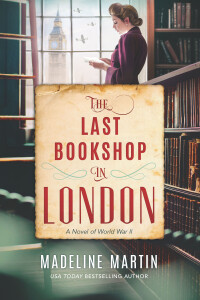
The Last Bookshop in London, by Madeline Martin

the-last-bookshop-in-london-cover-final-2157477167

When Grace Bennett lost her mother, she lost almost everything. Her sole relative, an uncle, not only takes over her house but also dismisses her from her job at his store without a reference. She and her more adventurous friend Viv have always dreamed of going to London, so they set off, buoyed by the offer of lodgings with a friend of Grace’s mother.

It’s August, 1939.

Viv gets her dream job at Harrods, but timid Grace has no luck because she has no references. Finally, the fond, if bossy, Mrs. Weatherford bullies the owner of a struggling bookshop into hiring Grace for six months so she can get the necessary reference.

Primrose Hill is barely staying afloat because it is far away from Paternoster Row, home of most of London’s bookstores, and its owner Mr. Evans is not much of a businessman. Grace is nervous: she’s not a reader, so how can she recommend books to customers?

However, her retail experience helps her make the shop more organized and attractive, and she finds the kindness lurking under Mr. Evans’s gruff exterior. She also enjoys the customers, especially George whose encouragement finally gets her to start reading.

Then war comes, with blackout curtains and the Blitz. Amid loss and constant fear, Grace volunteers as an ARP (Air Raid Precautions) warden, coincidentally paired with the grumpiest of the store’s customers, sending her out on the dark nights during the worst of the bombing. She takes refuge in her new passion: reading. On the nights she’s not on duty, when she and Mrs. Weatherfield sleep in the subway tunnels, she’s persuaded to read aloud to help others pass the time and distract them from their fears.

This second in a string of bookshop books for me starts out as a light read, but quickly turns serious with the start of World War II. The story eloquently depicts the home front: the women and old men left behind, the first attempt to find your way home in the blackout, the fear at the sound of the doorbell because it could be someone delivering a telegram, the sounds and smells of sleeping in the tube station turned air raid shelter, the attempt to extinguish incendiaries, the shock—first physical and then emotional—of a bomb blast.

What I most admire in this story is the way Martin integrates the larger story of the war with Grace’s particular journey. The grim accuracy of life in London during the Blitz, and all the losses—loved ones, homes, security—keep this from being a frothy romance or coming-of-age story. The war is not just pasted on to add drama; it informs everything in Grace’s story, from large events to the smallest detail.

What novel have you read that incorporates events current to the story?

A Registry of My Passage upon the Earth, by Daniel Mason

a-registry-of-my-passage-upon-the-earth-daniel-mason-9781529038491-2881892114

Having found Mason’s novel The Winter Soldier a rich experience, I picked up this collection of short stories. I was surprised to find that I had already read one of them in The Atlantic and thought it brilliant.

“For the Union Dead” begins with the narrator being asked to sort through the belongings of his recently deceased uncle, a nan he didn’t know well. “He was a quiet figure, my father’s only brother, and overshadowed by my mother’s sprawling clan of six siblings.” The narrator does know that Teddy was peculiar: an unmarried man who wore suspenders, drank borscht every morning, and kept the tv tuned to pro wrestling. We learn more about Teddy’s background, his growing interest in Civil War reenactment, and the strange way he chose to participate in it. All add up to an unforgettable portrait of man and the weight of history.

The other stories are about equally peculiar people. Set in earlier ages, each delves into a person who is, well, different. From naturalist Alfred Russel Wallace collecting new species in the Malay Archipelago to a female aéronaute piloting a balloon into eternity, their voices invite us to share their experience as they launch themselves outside society’s straitjacket.

I particularly liked “The Line Agent Pascal” which begins “Every morning Hippolyte Pascal, agent of the Line at Urupá, woke to the sun and the sound of parrots, rose from his hammock, dressed, set a battered kettle on the fire, and crossed his tiny station to check the signal.”

Writers are often advised to leave out routine actions for fear of boring the reader. Yet this first sentence not only grounds the reader in time and place, but also conveys his solitude. It is a time when the telegraph was necessary to connect the town and the distant mines, when the technology was primitive enough to require signal boosters at intervals along the line. But it is his solitude that is the core of the story, the eternal balancing act between solitude and society.

The title story takes us into one of the farthest of society’s outliers: Arthur Bispo de Rosário who calls himself a sailor and “a collector of lives.” What today we would call an outsider artist, he speaks to us from the Brazilian psychiatric institution, his home for fifty years, where a doctor draws details of his life from him. Interspersed in the narrative are Arthur’s descriptions of his elaborate embroideries, part of his “divine mission.“ Mason draws on his own work as a psychiatrist to take us into the mind of this actual person, diagnosed with schizophrenia, whose name now adorns Rio de Janeiro’s Contemporary Art Museum.

The real question in these stories is: What does it feel like to be inside this person’s head? How do they perceive and interpret the world?

And this is the great gift of fiction: to be able to see the world through the eyes of another.

Yes, like many readers, I sometimes dive into a novel to escape from our humdrum or terrifying present into a pleasant dream of a world. Even in the most lightweight novels, though, we are asked to experience the events along with the protagonist. Every time we do that, we increase our capacity for empathy.

Some stories stay with us for years. What is one that has stayed with you?

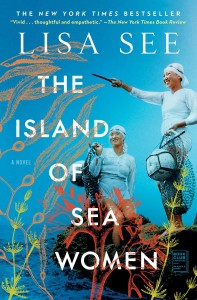
The Island of Sea Women, by Lisa See

the-island-of-sea-women-9781501154867_hr-2984931108

The island is Jeju, off the South Korean coast. The sea women are the Haenyos, women who don’t use breathing equipment but rather hold their breath to dive to the sea floor to harvest seafood.

The story opens with Young-sook, an elderly retired Haenyo who hates being treated as a tourist attraction. She is especially peeved by the persistence of an American woman and her daughter who claim to be descended from Young-sook’s best friend Mi-ja. They show Young-sook a photograph which she pretends not to recognise.

We are then transported back to 1938. As the daughter of the chief of a Haenyo collective, Young-sook trains from a young age, both to learn the breathing technique called “Sumbisori” and to be in top physical condition. Since the women are the ones who earn money, men on the island stay home to care for the children. Meanwhile, the island is suffering under Japanese rule.

We follow Young-sook as she meets and befriends Mi-ja, who is an outcast because her parents collaborated the Japanese. The girls eventually begin training to become Haenyos, starting out as “baby divers” and gradually becoming more proficient. They work as a team farming the wet fields (the sea) and the dry fields (the vegetable garden). Much as Young-sook loves being in the sea, she can never forget the danger involved, repeating the mantra “Every woman who enters the sea carries a coffin on her back. In this world, the undersea world, we tow the burdens of a hard life.”

The situation worsens during World War II, as the Japanese impress young men from the island into their army and send refugees to the island, where there is already too little food. The end of the war brings a new nightmare, as the Americans install a dictator in South Korea and help his forces further tyrannize the island. The carnages on top of the great poverty on the island makes for difficult reading at some points.

The two girls find themselves at odds as they enter arranged marriages. The progress and zig-zags of their friendship are one of the best things in the story, beautifully rendered. The story occasionally flashes forward to 2008, when the Americans continue to pester the elderly Young-sook, wanting to tell her about Mi-ja’s fate.

The details of the culture on the island, the history of the people there, and most of all the immersive experience of diving with the Haenyos are what make the story memorable. Meticulously researched, with additional information on the author’s website, we are privileged to learn about a way of life that has now almost disappeared.

Perhaps the hardest task for a novelist is inserting a trail of breadcrumbs such that the ending comes as a surprise, yet perfectly obvious looking back over the story. What makes it hard is the range of readers: I know from my book clubs that some people catch on right away, while others may still need an explanation even after finishing a book.

For me, with this book, I saw the answers to the story questions too early and wondered through much of the book why the characters were not able to see them as well. Still, though the story of the friendship sagged a little, for me at least, the story of the sea women and their island did not. I strongly recommend this book.

Have you ever heard of the Haenyos?

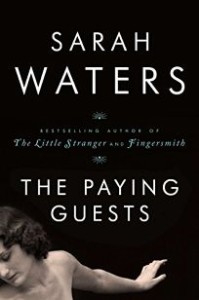
The Paying Guests, by Sarah Waters

Waters

After the carnage of the Great War, many women in England found themselves condemned to spinsterhood. That’s not why in 1922 Frances Wray remains unmarried and living with her mother in South London, where their lives are circumscribed by the endless domestic chores, church on Sundays, and occasional visits with a few friends.

Frances does the domestic work, her mother being elderly and still grieving for the loss of her sons in the war. They once had a servant, but after the death of Frances’s father, the two women discovered that he had left them nothing but debts. By the time of the story, they have decided that their only recourse is to take in lodgers, dressing up the idea by calling them paying guests.

Enter Lillian and Leonard Barber. Members of the “clerk class,” they take up residence in the newly created apartment on the second floor and quickly change the atmosphere of the house, with their lively music and visits from Lillian’s rambunctious, working class family. Still the Wray women are more puzzled than distressed. What upsets the applecart is Frances’s growing attraction to Lillian.

The author brilliantly captures the peculiar intimacy of families sharing a wall, something I’m familiar with from living in rowhouses, triple-deckers, and a duplex (aka semi-detached). You try not to listen, but nonetheless find yourself having an unwelcome familiarity with their routines. Sometimes you even speculate about what’s going on over there.

Vividly captured as well is the domestic life of the period. The author gives us enough of Frances’s routine to understand what a burden housework was before the “labor-saving” devices we are accustomed to, without letting those passages become boring. She does this by exquisite detail, carefully chosen, and sometimes by making them part of action scenes.

I was surprised and impressed by the author’s handling of the class differences between the three families. Though never coming out and saying something like They are not our sort, Mrs. Wray remains aloof from the Barbers and Lillian’s family. However, Frances begins to enter the lives of both and seems to be free of that sort of class consciousness.

In fact, the psychological portrayal of Frances is what helped me stick with this overlong book. A fascinating character to start with, Frances changes with exposure to new information or outlooks, each transformation believable within the story.

The other thing that kept me going was the narrator Juliet Stevenson, one of my favorite actors. Having her voice in my ear is always a pleasure.

Who are your favorite audiobook narrators?

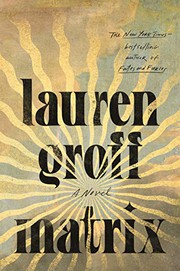
Matrix, by Lauren Groff

matrix

In 1148, Marie de France at 17 has been running her family’s estates since the death of her parents and trying to avoid coming to the attention of Eleanor of Aquitaine, with whom she has a familial connection. When Eleanor does notice her, she declares the tall, sturdy girl with a rural accent too gauche for marriage or life at court, and sends her to England to be prioress of a run-down abbey.

Initially homesick and shocked by the poverty and near-starvation of the nuns, Marie summons the strength of her predecessors: a long line of women warriors and crusaders.

Fine then, she thinks with bitterness. She will stay in this wretched place and make the best of the life given her. She will do all that she can do to exalt herself on this worldly plane. She will make those who cast her out sorry for what they’ve done. One day they will see the majesty she holds within herself and feel awe.

She sets herself to rebuilding the abbey’s prosperity, its fields and sheepfolds, its income-producing business of copying illuminated manuscripts, and its body of nuns. These new sisters—some prickly older women, some giggling girls, some laborers—support her as she finds their hidden talents and sets them to work that best uses their strengths. Later she begins to have visions, which call on her to create an “island of women” protected from men and the corrupt world by a massive labyrinth: Marie hiding once again from a misogynistic world, this time with her sisters.

Fueled by Groff’s energetic prose, the book traces Marie’s entire life at the abbey, her many successes and rare failures. The world of the abbey comes alive, the texture of its life, the cold of early-morning prayers, the taste of a rare treat, the ways of healing. The handful of nuns we get to know are presented as memorable individuals with their own strengths and flaws.

In this fictional Marie, Groff combines two historical characters: Marie de France, a 12th century French poetess who wrote a collection of lais about courtly romance, and Marie d’Anjou, Abbess of Shaftesbury. There is a theory that they might be the same person, but it is unproven. I would have liked to hear more about Marie the poetess, but accept that is not this book.

Here Groff instead gives us a model of a powerful, indomitable woman, canny and visionary, much like Eleanor of Aquitaine but with a Christian moral code. While I love seeing a strong woman succeed, Marie’s accomplishments strain my credulity. Building the maze that protects the abbey like Briar Rose’s castle is one thing, but going on to design and build new machines, roads, dams, and fortifications with military precision?

Where the book started to lose steam for me was when challenge after challenge is met and defeated by Marie immediately. I love her bent for management, her practicality. I love her foresight and the political acumen that leads her to create an international network of spies (often women) and protectors. I appreciate the narrow path she walks between power and pride.

Yet, after a while, the stakes begin to seem very low once we know that Marie’s superpowers will resolve every issue within a few pages. I found it particularly hard to believe that an incipient cult among the young nuns and, later, a revolt about Marie’s going against the church’s teachings would both simply evaporate.

Still, the powerful writing carries the book. As a utopian vision, it reminds me of Groff’s Arcadia which I read recently, about a commune. That book dealt closely with the interpersonal tensions and rivalries that warred with the communal ideals of the families. I expected more of that here, more of the interactions between the sisters, the inevitable conflicts that arise among a group of people living together, but Marie’s iron hand seems to preclude them.

In the end, I’m glad I read this story of a powerful woman. Marie will stay with me for a long time.

Have you read anything by Lauren Groff? What did you think of it?

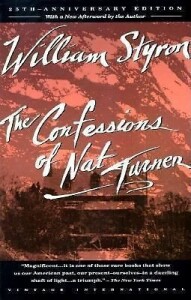
The Confessions of Nat Turner, by William Styron

Confessions of Nat Turner

As the title suggests, this 1967 novel about the slave revolt of 1831 is told in the first person by Nat Turner, leader of the revolt. It starts with Nat in jail, chained hand, foot and neck. In meetings with his White lawyer, Nat dictates his confession, and we learn something of what sent him on this mission to kill as many White people as possible. But we need his whole life to get past the surface and truly feel what motivated him.

Nat’s life, brilliantly written, is a litany of injustice and often cruelty. Some of his owners treated him well, some viciously. He has joys and pleasures too: his friendships with some of the other slaves, his study of the Bible, his deep satisfaction in his carpentry work.

While reading, I was fully immersed in Nat’s consciousness, yet at the same time swept by my own horror and grief and shame. None of it was a surprise—I’ve seen, heard, read too much for that—but the effects of continual trauma brought to life like this affected me deeply.

Having grown up in the Tidewater area of Virginia during the Jim Crow years, Styron had been interested in the story of Nat Turner since childhood and “haunted by the idea of slavery.” His good friend James Baldwin encouraged him to write this story and to do it by taking on the persona of the protagonist.

Nat Turner has usually been presented as a fanatical madman, and apparently he truly did fast obsessively, see visions, and believe that he had been divinely appointed to this mission. Styron’s great achievement is to give us a credible and relatable individual within the confines of those facts. Two other recorded facts gave him some clues: Of the fifty-five White people killed in the revolt, Nat Turner himself only killed one, near the end, and the revolt “ran out of speed” after that.

Those facts indicate a moral consciousness at war with Nat’s mission. Throughout the book wee are in his head, thinking his thoughts, and he is always presented as rational and intelligent. By letting the reader merge into his life, taking each step with him, the author makes Nat’s actions seem reasonable, almost inevitable. Also, Nat’s thoughts are sprinkled with verses from the Bible which is his only reading material, verses which reinforce his decisions.

A third way this feat of characterisation is accomplished is by finding common ground between our experiences and his. Often Nat’s thoughts reflect insights that seem familiar to me, such as this one:

Does it seem a hopeless paradox that the less toilsome became the circumstances of my life the more I ached to escape it? That the more tolerable and human white people became in their dealings with me the keener was my passion to destroy them?

It took Styron five years to research and write the book. With little hard information to go on—the actual 7,000-word document produced by that lawyer being the only meaningful record of Nat’s life and thoughts—the author had to imagine himself into the mind and soul of a slave in antebellum Virginia. His intentions were good: he wanted to “fashion . . . an imagined microcosm of the baleful institution has persisted into this century and become the nation’s central obsession.” The book quickly became a bestseller and a Book-of-the-Month pick.

Yet only a few years later it was denounced as racist by a group of Black writers. I’ve not read their book yet and am not qualified to say one way or the other. What I do know is that it is no surprise that a book about the experience of slavery by a prominent White author would be considered proof of the privilege awarded to White voices by the publishing world.

Having already read many books about slavery, Jim Crow, and today’s injustices by Black authors, having grown up myself in a racially segregated time and place, I’m grateful to have this story too. It deepens my understanding of the early 1960s, when it seemed to me that things would never change. In some ways, sadly, they haven’t.

One thing I didn’t know before reading this book and the author’s Afterword is that in 1831 Virginia was poised to abolish slavery in the state, but Nat Turner’s revolt put an end to that. As Styron says, “the impact on the future (especially in terms of the possible avoidance of events leading to the Civil War) is awesome to contemplate.”

At this moment in time, when our democracy seems at a tipping point into destruction, largely because of deeply engrained racism, it’s daunting to consider how much can turn on a single event.

What novel have you read that gave you new insight into an historical event?

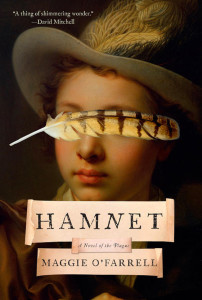
Hamnet, by Maggie O’Farrell

hamnet-cover-revised-knopf-620

The year is 1596. Hamnet carefully, quietly descends the stairs, searching for an adult, anyone other than his abusive and often drunk grandfather. The child needs help because his twin sister Judith has fallen suddenly and disastrously ill. He doesn’t realise that his mother is off tending her swarming bees.

O’Farrell’s tour de force focuses on Agnes, Hamnet’s mother, Shakespeare’s wife, and in so doing immerses us in the day-to-day experience of raising children and managing a household in Elizabethan England. Agnes herself is an outlier in her society: the first thing we learn about her is that she keeps a falcon, unheard-of for a peasant much less a woman. Independent, strong-minded, more at home in the woods than anywhere else, she is an herbalist and a healer. She also has a mysterious ability, presumably from her long-dead mother, to read people’s fates.

What makes this novel so stunning is the author’s evocation of the details of each scene. Instead of tearing through a scene to keep the reader hopping, the author takes the time to richly imagine the sights and sounds, the minutest actions, staying with the scene until we are there, and stays there before moving on.

Suspense comes from our foreknowledge about Hamnet’s fate—perversely denied to his mother—and from the dual timelines: one being the year of Hamnet’s death, and the other the 1580s when Agnes and William begin a life together. A lengthy middle section describing how the plague made its way from a glass-blower in Italy to Judith in Stratford-upon-Avon may at first seem unnecessary, but it serves to increase the suspense as we long to return to that house on Henley Street.

That middle section also adds to our immersion in the period, envisioning how and why goods are packaged and transported, and what the costs are. I couldn’t help but be struck by the many people felled by the plague during its journey, people whom we don’t have time to mourn as we mourn for Judith and Hamnet.

What we know about Shakespeare comes mostly from his work. What we know about his son Hamnet is simply that he died at the age of 11, four years before Hamlet was written. What we know about Shakespeare’s wife is only a name, which is probably wrong.

The way the author uses names, starting with the title, gives us the frame for this book. The epigraph, a quote from Stephen Greenblatt, tells us that Hamnet and Hamlet were used interchangeably at the time. Similarly, his mother, who was called Agnes in her father’s will, is the woman we know as Anne Hathaway. Shakespeare himself is never named in this novel, instead called the glover’s son, the Latin tutor, her husband. My book club debated why, deciding that the book was not meant to be about him. One person astutely suggested that the author didn’t want us to think about Shakespeare the bard, but Shakespeare the man.

Our name is tied to our identity, so by introducing this uncertainty, the author reminds us how little we can know of each other, whether that other is in the past or our present. Members of my book club could not help but be struck by how many of the playwright’s works deal with misunderstandings and misinterpretations, switched and mistaken identities.

Every reference I’ve seen to Anne Hathaway depicts her as an older woman preying upon young Will, forcing marriage on him by getting pregnant. In truth, though, we know almost nothing about this woman—basically just the mentions of her in her father’s will and her husband’s—as we know nothing about the many women who loved, married, and bore children in obscurity.

Thus, though I am usually wary of fictional representations of real people who are not alive to defend themselves—per Milan Kundera’s masterful Immortality—here I welcome this reimagining of a woman and her passionate relationship with her husband.

In his review of Carole Angiers’ Speak, Silence: In Search of W.G. Sebald in the London Review of Books, Michael Wood writes:

Sebald’s deep preoccupation is with what his character Jacques Austerlitz calls ‘the marks of pain’, psychological and physical, in human and other animals. These marks are indelible, and for some people unforgettable.

Similarly, O’Farrell writes:

Every life has its kernel, its hub, its epicenter, from which everything flows out, to which everything returns. This moment is the absent mother’s: the boy, the empty house, the deserted yard, the unheard cry . . . It will lie at her very core, for the rest of her life.

Speaking from experience, I can say that the wrenching pages after Hamnet’s death truly capture a mother’s grief: the stunned emptiness, the guilt (contrary to all logic), the obsessive replaying of the child’s suffering, the eventual return to being able to function though changed, profoundly changed, forever.

As I am changed by this story. I was afraid to read it, despite the glowing reviews and recommendations, because I feared the pain. I’m grateful to my book club for giving me the impetus to gather my courage and begin. As Agnes discovered, art can help heal our heart’s wounds. So I say to you, go ahead. Give yourself over to this extraordinary book.

What book have you put off reading?