Mrs. Dalloway, by Virginia Woolf

Reading this classic novel now, more than fifty years since I first encountered it as an undergrad, is quite a different experience. Back then I was confused and thrilled by Woolf’s modernist, experimental style that expanded forever my idea of what a novel could be.

Now I see it as a story of midlife, in several senses of the word. The story unfolds as a day in the lives of a handful of people in London going about their ordinary business, and we get thrown right into the middle of things. Clarissa Dalloway is preparing to give a party. Newly returned from India, Peter Walsh sets out to recapture the past by exploring London and visiting Clarissa, his first love. Richard Dalloway is off to lunch with old friend Hugh Whitbread at Lady Bruton’s. Septimus Smith, a damaged veteran of the Great War, and his wife Rezia are walking through the park, on their way to an appointment with a doctor.

Since Clarissa, Peter and others are in their early fifties, we have another sense of midlife. It’s a time of life when we look back nostalgically, but also when we measure ourselves—and others—assessing how we have changed with age, and calculating what we have made of our years. Have we measured up to our early promise?

Time comes up frequently, not just in the characters’ reflections on how they and each other have aged, their memories of the past, and the bustling busy lives of their present; but also in the more linear sense of the clocks sounding the hours of the day. Time in this novel is both infinite and finite.

Another sense of midlife underpins the story: the Bible’s “Media vita in morte sumus”—“In the midst of life we are in death.” Death comes up frequently, whether it’s Septimus thinking of suicide or Clarissa hearing old Mrs Hilbery at the party say “how it is certain we must die.” Clarissa herself has recently been ill which has turned her hair white and left a concern still about her heart.

In my youth the book’s theme that struck me most strongly centered on solitude versus society. Plunging into this novel, we have opportunities to see most of the characters alone—really see them; right into their jumbled, chaotic thoughts, sublime ideas, and snarky digs. We see Peter like his namesake in Kensington Gardens never having fully grown up, and Clarissa awash in memories of a golden childhood and gloriously loving her present life—until she’s brought low by self-doubt or sensing criticism from others.

We also see them with others, whether through intimate conversations or Clarissa’s crowded party. In some instances simply exchanging a look with someone else—a young woman in the park or an elderly woman in a window across the street—becomes a vital communication.

Clarissa believes that her strength is that she knows what other people are feeling. In fact, all the characters think they do, but they are mistaken. Richard is certain that Clarissa will know he loves her without his saying so. Peter thinks he and Clarissa read each other’s minds. The worst offenders are the two doctors to whom Septimus goes for treatment; they burst with confidence that they know what is wrong with him, but their pompous, one-size-fits-all solutions are worse than useless.

There’s a reason why so many books and essays and dissertations have been written about this novel. It is so rich—so full of life. You can look at it through the lens of class or gender; you can hold it up to Woolf’s own life; or consider the fragility of a world that is on the cusp of change—the book came out in 1925, so this year is its centennial.

For me in this reading it is the sense of time that demands my attention. Like these characters I strain to reckon the long years behind me: the golden times that I weave into stories for my grandchildren and the bitter griefs and regrets that I keep to myself. I consider what I will do with the few years that remain, knowing how much I value being alone and how much I enjoy being with others.

We are all born and we all die. That is what we have in common. What comes in between is our own unique story. By slicing one day out of the lives of this small group of people, Woolf gives us a glimpse of the extraordinary richness of the lives humming all around us.

If you’ve read Mrs. Dalloway, what did you think about it? If you’ve reread it, did your opinion change?

Note: My thanks to Tash for her discussion of the novel on her Woolfish! Substack and to all the commenters there as well for expanding my understanding of the novel.
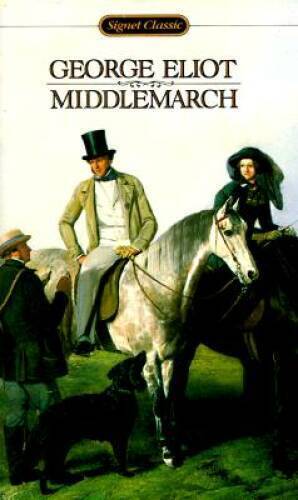

Middlemarch, by George Eliot

I’ve been rereading Eliot’s classic novel this month with Haley Larsen’s Closely Reading group on Substack. It’s been a few decades since I last read it, and different features of the book leaped out at me this time.

The story is about the inhabitants of the fictional town of Middlemarch in the English Midlands around 1830. Eliot does a masterful job of zooming in to a dozen or so characters while giving other townspeople plenty to space to make themselves known.

We first meet Dorothea Brooke, a wealthy and intelligent young (19) woman, who wants to do great things in service to others, starting with better housing for the tenants of her uncle and guardian Arthur Brooke, a hilariously foolish man who can talk himself out of any opinion. Dorothea is extremely religious and denies herself pleasures, such as her mother’s jewelry, in order to sacrifice herself to a greater cause.

That turns out to be marrying Rev. Edward Casaubon, prematurely elderly at 45. A dry stick of a man, who has devoted his life to creating The Key to All Mythologies, he marries her but quickly withdraws into his shell. He rejects her romantic ideas of assisting him in his work, like Milton’s daughters taking down the blind poet’s dictation (as Dorothea dreams), mostly because he fears she will mock him when she sees how little he’s accomplished.  

We also meet Dr. Tertius Lydgate who hopes to modernise medicine In Middlemarch and the lovely, self-centered Rosamond Vincy who sets out to capture him. Her brother Fred loves Mary Garth, nurse to his uncle Mr. Featherstone, and she him. But she won’t marry Fred because he is feckless and a spendthrift, believing himself to be Featherstone’s heir and borrowing on the strength of that.

Mary’s parents Caleb and Susan Garth are kind and generous folks, Caleb being land agent for Featherstone. Then there’s Mr. Bulstrode, a wealthy banker. He’s a pious if hypocritical Methodist who runs much of the town and would like to do more to impose his beliefs on other residents.

A lot of characters—and there are more! However, Eliot wrangles their stories into a coherent story where we touch each person often enough that it’s not hard to keep them straight.

What stood out to me on this reading is the theme of what it means to live a good life. By that I mean a life of integrity, one we can be satisfied with when we lie on our deathbeds. In Middlemarch we have all these lives, all of these people intending to do the right thing yet derailed by temptations and compromises and the pressures of daily life. As we follow each storyline, we get to see various permutations of what a good life might look like—or not.

One aspect of a good life is being a contributing member of society, one which among other things means getting involved in politics. We hear a good bit about the Reform Bill (later the Reform Act of 1832) expanding the franchise to a larger segment of the male population, and about the coming of the railroads that threatens local farmers. There’s an interesting parallel here between the politics of the period and Eliot’s method of concentrating on a few privileged characters while including others to a lesser extent but with equal respect.

Another aspect is our personal relationships. I am fascinated by Eliot’s idea of a “home epic” which is what she calls this novel. She defines a home epic as a story about what happens after the wedding, particularly during the course of a marriage. I am often frustrated by stories that end with a wedding, as though that’s the be-all and end-all of a woman’s life, so I love that she takes marriage as  the starting point instead. I’d expand the definition of Eliot’s term to include domestic stories, stories within a family, not just the married couple. And by family, I mean families of choice too. A home epic might also cover the course of a life and how we interact with others, how we live within communities.

The greatest barrier to a good relationship, whether with a spouse or a neighbour, is embodied in her subtitle “A Study of Provincial Life.” Yes, the town is geographically provincial, but there is a larger meaning to the word. As Rebecca Mead puts it in My Life in Middlemarch, “It is also concerned with the emotional repercussions of a kind of immature provincialism of the soul—a small-minded, self-centered perspective that resists the implications of a larger view.”

Over and over again, we see characters misunderstanding each other. So many conversations where people misread each other’s intentions or fail to comprehend what the other is thinking! We know this because of Eliot’s psychological insights, and her technique of using a narrator to go into each character’s thoughts. Her narrator also pulls out to give us that larger view, sometimes warning us that a character may not be as bad as they appear. The narrator can occasionally seem intrusive but is vital to Eliot’s ability to weave the story together and bring out her theme.

Therefore, to live a good life we must be able to empathise with others. We have to work to actually see things the way someone else does, to set aside our own view of the world and understand theirs. I think this is why our narrator persists in explaining these characters to us. Eliot keeps coming back to the idea that we have to grow out of our natural self-centeredness and recognise that others see the world differently.

It’s not easy. As Eliot says, “If we had a keen vision and feeling of all ordinary human life, it would be like hearing the grass grow and the squirrel’s heart beat, and we should die of that roar which lies on the other side of silence. As it is, the quickest of us walk about well wadded with stupidity.”

Yet we can try.

What does it mean to you to live a good life?

Go Tell It on the Mountain, by James Baldwin

baldwin

In this debut novel, described as semi-autobiographical, we meet John Grimes on the morning of his fourteenth birthday. It’s a Saturday, but he is consumed by thoughts of the family’s Sunday routines, dominated by attendance at the storefront church founded by his stepfather. We sense the tension in the family as he wonders if anyone will remember it is his birthday.

Although everyone has always expected John to become a preacher too, his stern stepfather Gabriel constantly demeans John and favors his own son, John’s younger brother. But Roy is wild, running the streets of Harlem with his gang and uninterested in the church. Over the course of the next 24 hours, John wrestles with the conflicting expectations laid upon him and with his newfound sexuality.

In doing so, he has to sort out for himself what is holy and what is good, and whether they are the same thing. Gabriel’s strict Pentecostal religion demands that members forgo worldly pleasures, forcing John to decide where he stands, as he considers the people he knows at church and his friends at school.

The second of three parts consists of extended flashbacks where we learn about the early lives of John’s aunt (Gabriel’s sister), Gabriel himself, and John’s mother Elizabeth. This unconventional structure not only gives us needed background, but also heightens the suspense as we wait to find out what the long night will bring for John.

My book club agreed that this book was hard to read. The overwhelming context of harsh Pentecostal Christian teachings, preached by Gabriel at church and at home, and Biblical references made for heavy reading. Outside of the religious doctrine, though, Baldwin’s language is stunning.

He was ill with doubt and searching. He longed for a light that would teach him, forever and forever, and beyond all question, the way to go; for a power that would bind him, forever and forever, and beyond all crying, to the love of God. Or else he wished to stand up now, and leave this tabernacle and never see these people any more. Fury and anguish filled him, unbearable, unanswerable; his mind was stretched to breaking. For it was time that filled his mind, time that was violent with the mysterious love of God. And his mind could not contain the terrible stretch of time that united twelve men fishing by the shores of Galilee, and black men weeping on their knees tonight, and he, a witness.

My soul is a witness for my Lord. There was an awful silence at the bottom of John’s mind, a dreadful weight, a dreadful speculation. And not even a speculation, but a deep, deep turning, as of something huge, black, shapeless, for ages dead on the ocean floor, that now felt its rest disturbed by a faint far wind, which bid it: “Arise.“ And this weight began to move at the bottom of John’s mind, in a silence like the silence of the void before creation, and he began to feel a terror he had never felt before.

Even more than the preaching, it is the anguish that makes the book so hard to read. A controlling parent, emotional and physical abuse, being the one child out of several who is hated by a parent: these are experiences we know about, though the knowing doesn’t make them any less heart-breaking.

One person noted the outsized anger that consumes many of the characters. That reminded me of our last book, Isabel Wilkerson’s The Warmth of Other Suns, where she talked about how those who were part of the Great Migration found themselves crammed into overflowing segregated areas. Also, there was the disappointment of thinking they would escape racism by going north, only to find a different kind of racism. No wonder there is anger.

Like others in my book club, I found much of the preaching tedious. However, I was interested in Baldwin’s use of music in his prose. Here it is the music of hymns and the King James Bible, the one that I grew up on. In his later work he uses jazz rhythms but, as one person pointed out, we can see the influence of jazz even here in his riffs and solos.

We also appreciated his experimental structure, perhaps influenced by the modernism and post-modernism of the time. One person noted the similarity to the structure of Virginia Woolf’s Mrs. Dalloway.

Most of all we were struck by the honesty of the book, its brutal honesty, as one person put it. Baldwin doesn’t sugarcoat anything or anyone, even his own avatar.

Have you read this classic? What did you think of it?

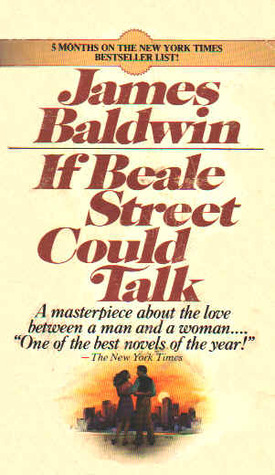
If Beale Street Could Talk, by James Baldwin

beale

This is a story of young love up against a society determined to keep them apart, yet it’s a story like none you’ve heard before. Tish, 19 years old, and Fonny, 21, have known each other most of their lives, friends first, then lovers, and now pledged to marry. However, in 1970s New York, like today, it can be a crime to be black. Fonny has been jailed for raping a Puerto Rican woman, framed by a white policeman who was still smarting from an earlier encounter with Fonny.

It’s also a story of family, the strength of black families despite the stereotypes that tell you otherwise. Tish’s family not only supports her in her pregnancy but love Fonny as a son, and all—mother, father and sister—join forces to find a way to get him out of jail. Fonny’s family is dominated by his self-righteous mother who believes her religion puts her above others.

It was like there was nothing, nothing, nothing you could ever hope to say to her unless you wanted to pass through the hands of the living God: and He would check it out with her before He answered you.

Fonny’s sisters follow their mother’s lead and there are wonderful snarky scenes between them and Tish’s sister. However, Fonny’s father Frank defies his womenfolk and puts himself on the line to help his son.

“It’s a miracle to realize that somebody loves you.” This is Tish talking about her beloved, but it is also true of the gift of familial love. You can’t take it for granted. One of my friends is concerned about the lack of stories—books, movies, television, news articles—about the strong bonds of love within black families like her own. Something to set against the flood of stories of gangsters and drug dealers, the abused and the abusers. Here is one such story.

I guess it can’t be too often that two people can laugh and make love, too, make love because they are laughing, laugh because they’re making love. The love and the laughter come from the same place: but not many people go there.

Tish’s voice conveys love in a fresh, unsentimental way. It reflects her hard-won understanding of how the world works: when to speak up against injustice, when to just keep going; how to hold onto dreams without getting lost in them. In giving us Tish’s inner thoughts, Baldwin expertly navigates the steady heartbeat of being black in America, almost never shouting, letting the events speak for themselves.

This is also a story about prison and what it does to a man, not just Fonny unjustly locked up, but also his childhood friend Daniel. Only recently released from prison on a charge of which he was innocent, though guilty of holding weed, Daniel is a shadow of his former self. Unfortunately, as Fonny’s alibi, he is also the target of the white policeman determined to make sure Fonny goes down.

The structure of the story reflects another of Baldwin’s themes. While the main storyline follows Tish from when she is three months pregnant to when she gives birth, we constantly dip into the past. Ranging from scenes of their childhood to their attempts to find a loft to rent to the events that led to Fonny’s arrest, Baldwin’s shifts in time are expertly handled, reflecting the rhythms of jazz and blues that he’s known for. More significantly, they summon thoughts about time itself.

Time, the word tolled like the bells of a church. Fonny was doing: time. In six months’ time, our baby would be here. Somewhere, in time, Fonny and I had met; somewhere, in time, we had loved; somewhere, no longer in time, but, now, totally, at time’s mercy, we loved.

The contrast of being in time and being at time’s mercy reflect the long, slow path to equality for the black people brought against their will to this country. I am reminded of the early days of the Civil Rights movement when whites and blacks (though mostly whites) told the protestors to be patient, to set aside their songs and marches, that things were getting better, but slowly.

Things are better than they were in the early 1960s, mostly due to those protesters, but not enough.

This subtle book, full of love, unsettled by the dark currents of racism, is as relevant today as it was when it came out in 1974.

Have you read this book or one of Baldwin’s other novels? What are your thoughts about it?