The Cherry Robbers, by Sarai Walker

Reclusive Sylvia Wren is a famous artist, now in her eighties, living in New Mexico and painting flowers that resemble women’s private parts. Her peaceful life is upended when a journalist discovers her long-buried secret: She is actually Iris Chapel, an heiress who has been missing for sixty years. Concerned that her story might be distorted or sensationalised, she begins to write it herself.

With that, we leave the frame story and plunge in the life of Iris Chapel, the fifth of the six Chapel sisters, born in the 1930s and all named after flowers. Their strict father is a gun baron, owner of Chapel Firearms, while their mother is a distant woman, obsessed by her own fears and her belief that the victims of those guns are haunting her. Alternating between screams and silence, Belinda also believes that the women of her family are cursed, and tries to keep her daughters from marrying

However, as the sisters begin to come of age in the 1950s, marriage seems to be the only way to get out of their restrictive home. Some of them long to live “normal” lives and head for that escape hatch, certain that the curse is just part of their mother’s madness. Iris comments:

It’s easier to say that women like my mother are crazy. Then you don’t have to listen to them. And so maybe in a way she became crazy. Maybe she could communicate only by screaming.

This novel was recommended to me when I was reading ghost stories around the solstice last month. I love the way Walker handles the spooky side of the story. People are haunted for sure, and sometimes ghosts are mentioned, but the story remains in a liminal space where the reader can believe in the ghosts or not. What is unmistakable is the underlying unease, a sense that something is dangerously wrong, and the way that unease intensifies as the story unfolds.

Iris alone believes her mother and tries to help her sisters. I loved the depiction of the communal life of the sisters, with their quarrels and tenderness, their jealousies and generosity. Like the plucky heroine beloved of gothic novels, Iris tries to be the compliant, self-sacrificing young woman her society demands, but says:

When you live in defiance of yourself, you can adapt to your circumstances, but remnants of who you are at your core remain. A bit of wildness that can’t be tamed.

With Iris as an engaging narrator, the first part of the story absorbed me. I found the  characters strong; the setting atmospheric, and the pacing excellent. However, the story went on too long and became repetitious. Also, coming back to the frame story at the end felt a little flat and predictable.

The use of Georgia O’Keeffe’s life and work to characterise Sylvia Wren disturbed me. Walker did acknowledge the artist in her note at the end, and she has a right to imitate O’Keeffe this way, since the artist is considered a public figure. If O’Keeffe were still alive would she object to this imitation? I don’t know, but somehow feel that this depiction is as jarring as commercials of Fred Astaire dancing with a vacuum cleaner. Similarly, using Sarah Winchester’s supposed fears as the centerpiece for Iris’s mother earned a raised eyebrow. I’m reminded of Milan Kundera’s Immortality where he delves into the morality of manipulating a person’s image and reputation after they are dead and cannot protest.

The title comes from D. H. Lawrence’s poem with its sensuality, blood and tears. While the metaphor of the cherry seems almost too direct, the poem brings more context to the uneasiness summoned by the image of a robber. I ended up liking the title and glad I read this book.

What do you look for in a ghost story?

The Strand Magazine, Issue LXXV 2025

A new story by Graham Greene? And a new one from Ian Fleming, too? Wow! I had to send for this issue.

Greene’s story is a departure from his usual explorations of moral ambiguity in the worlds of diplomats and spies, which he knew from having been recruited by MI6, as well as the Catholic faith and imperialism. “Reading at Night” is an entertainment indeed: a ghost” story, reminiscent of classic British ghost stories such as those described in Ghostland, by Edward Parnell.

A man who is traveling on the Côte d’Azur stays in a borrowed house has a nervous disposition, traumatised by a boyhood reading of Dracula. He picks up an anthology of stories to read himself to sleep, but unfortunately the one he lights on . . . Well, Greene shares the story with us and it’s disturbing and mysterious. When our man becomes too terrified to read any more, he puts the book aside and turns out the light. Then . . .

I found myself going back to look for what Donald Maass calls promise words: words that tell you what to expect in the story. I found plenty that helped create the ominous atmosphere, the sense of being outside of the natural world, and the suspense.

Ian Fleming’s “The Shameful Dream” is not about James Bond, but rather a story of psychological suspense as a successful literary editor, Caffrey Bone, drives toward the home of the Chief. Lord Ower has invited Bone for the evening at The Towers and to spend the night. Gradually, though, we learn the reasons why he wishes the invitation had been sent to someone—anyone—other than himself. Plenty of promise words in this sentence alone:

Bone stared moodily ahead at the rain and the dripping hedgerows and at the shaft of the headlights probing the wet tarmac of the secondary road which would bring him in due course to The Towers.

I had heard of The Strand Magazine in its British incarnation. From 1891-1950 it published short fiction and general interest articles and was perhaps best known for being the first in the U.K. to publish Arthur Conan Doyle’s Sherlock Holmes stories and some of Agatha Christie’s. I somehow missed that it was revived in 1998 in the U.S. The magazine features stories from emerging crime and mystery writers in addition to stories by established writers. These are genres that I often turn to, and I thoroughly enjoyed this entire issue.

Aside from the stories by Greene and Fleming, there are two by writers I’m familiar with—Denise Mina and C.J. Box—and two by authors new to me—Mike Adamson and John M. Floyd. All are excellent. What a box of wonders! To top it off there’s a fascinating talk with Amor Towles, author of A Gentleman in Moscow and The Lincoln Highway, and pages of reviews of additional mysteries and thrillers.

Sometimes it seems as though there are too many magazines and too little time, but The Strand is one I now intend to make time for.

Have you read a magazine full of short stories lately? Tell me about it.

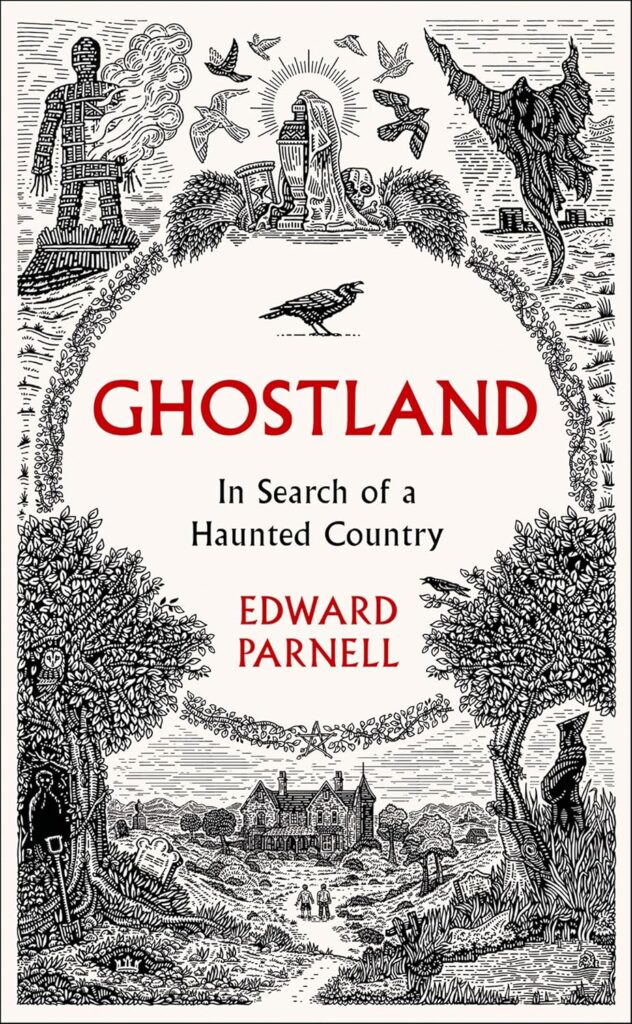
Ghostland, by Edward Parnell

Subtitled In Search of a Haunted Country, this unusual book combines travelogue, literary review, and memoir. England is that country, home to nearly all of the ghost stories I grew up on and to the legends that fired my imagination as a child. Parnell sets out to revisit the ghost stories that have been meaningful to him throughout his life, and actually go to the places where they are set or were written.

I felt as though I were making this journey with him. As he takes us to these places, he shares not only their sometimes beautiful, sometimes eerie atmosphere, but also his own memories of visiting them as a child with his family or later on birding expeditions with his brother Chris. He introduces us to the writer associated with the place and one or two of their stories. This is no dry, academic tome, but rather a genial, engaging story, as though we were in a pub somewhere listening to a fascinating storyteller.

Hard as it was to put down, I spent most of December reading this book because I kept stopping to find and read stories and books that Parnell discusses. Many of the authors, stories and places are old friends of mine. Some were new to me, all or in part. For example, I didn’t know that Rudyard Kipling had written ghost stories. I loved being introduced to The Children of Green Knowe, and returning to old haunts in the fen country and Arthurian-haunted Cornwall and Dorset.

Most of all, I enjoyed revisiting W.G. Sebald’s Rings of Saturn, a formative book for me, and similar in some ways to this book, being also a combination travelogue, memoir and collection of curious information. Parnell refers to a particular scene which

. . . cuts to the heart of Sebald’s work and his exploration of how we, both individually and collectively, come to forget (or at least suppress) the losses we have suffered, the memories of people and events that once came to us to us with such clarity, and the atrocities to which we are in some part complicit.

With this book, though, we are doing just the opposite: exploring the memories that haunt us. I was most moved by a story new to me: “Pirates,” by E. F. Benson, in which a fifty-six-year-old, successful business man comes across his childhood home, now abandoned and beginning to decay. The man becomes obsessed with buying and restoring it, recreating the happy home of his youth, returning even the furniture and other items now in his London home. The story gave me a jolt of recognition for I often dream that I’ve discovered my own beloved childhood home, miraculously not destroyed after all, and that I can buy it and, indeed, return these items from my current home to their rightful places. Then I wake up.

There is something about this time of year that makes me turn to ghost stories. Of course, traditionally the solstice and Christmas Eve are moments when the veil between the living and the dead thins, and perhaps disappears. And there’s something about ghost stories and England. Parnell mentions the Happisburgh footprints discovered in 2013 in Norfolk, England. Dating to the end of the Early Pleistocene, they are the oldest known hominid footprints discovered outside of Africa.

Although only in his late thirties, Parnell has suffered great losses: the deaths of both parents and Chris, his only sibling, leaving him—as one of my friends said of herself—the Last of the Mohicans. He talks about the period during and after the Great War, with its huge loss of life, when those desperate to see again their lost loved ones embraced Spiritualism. One of the themes that lends power to this story is the question of how best to heal from grief. Can we really sense something of them lingering around us? Do we hold onto our dead or let them go?

And of course there are the attendant themes around memory: what we hold onto and what we suppress, why these particular memories stay with us, even though at the time the incidents may have seemed inconsequential. As the year dies, I think about death and welcome my ghosts. I believe this is a book I will return to every December.

Who or what haunts you?