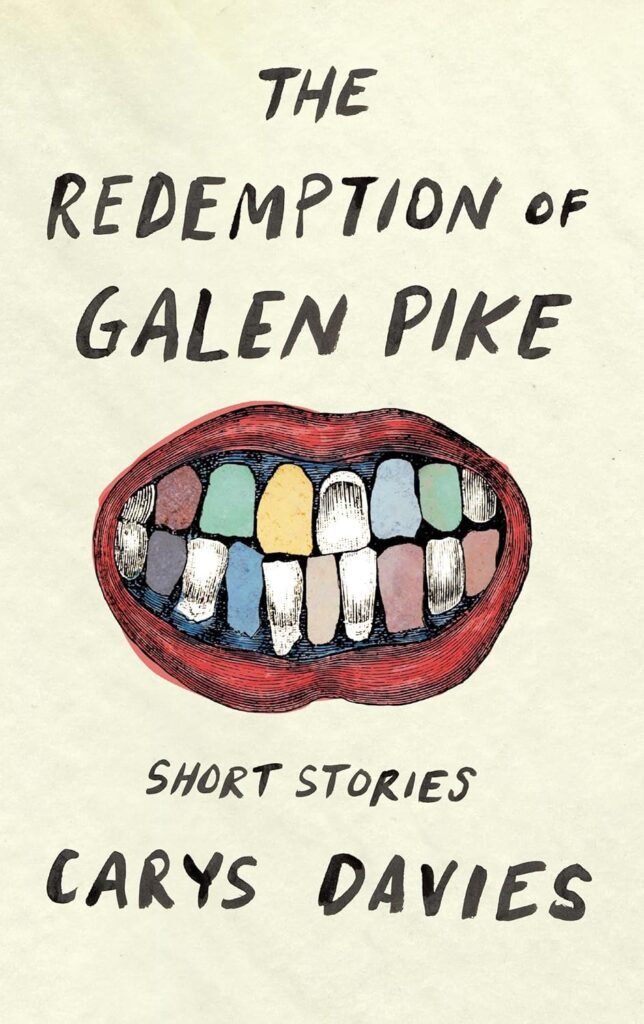
After enjoying her novel Clear, I picked up Davies’s second short story collection. Each of the 17 stories here, most of them very short indeed, is a gem.
We writers are told to write what we know. The stories here range through time and space: a woman isolated in the outback reluctantly entertaining her rough neighbor, an alderman in a small English town hosting a “bored and miserable and alone” Queen Victoria, a Caribbean immigrant working as a nursemaid in New York.
It may seem risky for a woman from Wales to write stories set in such wildly varied locales—others include Siberia, Africa and Oklahoma—but she pulls it off. Davies brings such a deep knowledge of people and emotions that our shared humanity shines through each story, however distant the place or unusual the plot.
Everything about her made Lenny think of a string pulled tight and about to be plucked, a figure balanced on the crumbling lip of a cliff and ready to jump; a brief electric calm before a storm.
Many of the stories convey a vulnerability or loneliness and consequent attempts to connect, all without naming those emotions but instead building them organically. Evangelina, whose husband disappeared more than a year earlier, is:
. . . the only person who didn’t believe that the emptiness out in the bay, the mist, and the water creeping soundlessly back and forth beneath the moon, in and out over the sands, were the silence of a man who was doing his best to disappear.
Sometimes I shy away from short stories because it can take me a little while to get into a book, and that seems like a lot of effort to go through for something that will soon be over. Not a problem here! I was instantly transported into each story and satisfied when it ended no matter how many or few pages later.
Davies often starts a story with some statement that gives us a person and at the same time raises a question (or three). Here are a few examples:
“His name was Henry Fowler and she hated it when he came.”
“Standing at her shoulder, no longer caring much about his future, Arthur Pruitt began to speak.”
“From the moment I arrived, they loved me.”
These deceptively simple sentences unsettle us because they assume that we know what’s going on; there are no long explanations, no backstory. And they hook us because we want to know more.
Once you’re in the story, what makes it so stunning is the deft way she uses the turn—what Steven James calls the pivot and poets call the volta. In a moment the story changes, and you see everything that came before differently. And that change is both unexpected and inevitable; looking back you can see the little details she has planted along the way, and the assumptions that led you astray.
Sometimes a turn comes through a change in point of view. Sometimes it’s a reveal of some new information, or an event that calls up a memory shedding new light on what’s happening. It’s less a plot twist than an addition of something that makes everything slide into place—and not the place you expected.
Sadly, the front cover is the ugliest one I’ve ever seen. The back cover is better and says the stories are ”written with prickly wit and punch.” True, and the punch comes from the turn. Some stories have cascading turns where your understanding of what’s happening flips not once, but two, three or more times. Brilliant!
Davies’s use of long sentences, sometimes without commas or other punctuation, captures the swiftness of thought.
I kept looking at Annie. I knew what she was thinking because I was thinking it too—that we could both of us let go of his hands and feet and leave him there till the tide turned and let him ride back out on it like a Viking and be dragged down by the current; the sea would take him and Bella would never know.
Short stories are notoriously difficult to write. The author has very little real estate in which to place the reader in time and space, introduce characters, and play out a plot. I’m so impressed by the variety and dexterity of Davies’s stories. I’ll be studying them for a long time.
What’s your favorite short story?