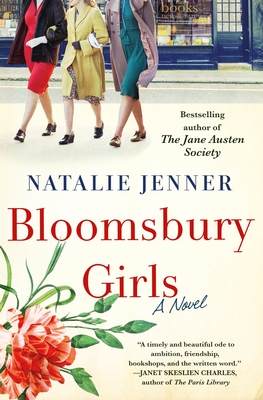
In 1950s London, Bloomsbury Books is a relic of an earlier age. Offering new and rare books, the store has resisted change for a hundred years, and its stodgy general manager, Herbert Dutton, with his 51 unbreakable rules is determined to keep it that way. However, the three women who work there have other ideas.
Vivien staffs the Fiction department and loathes her one-time lover Alec who heads the department. She wants to introduce more female authors while Alec refuses all but the usual classics like Jane Austen and George Eliot. Ambitious and clever, Vivien provides much of the humor in the book. I especially love the way she comes up with witty and daring names for the people and places in the bookshop, like the Tyrant and the Via Dolorosa.
As Mr. Dutton’s secretary, Grace is the unacknowledged angel of the house. She helps Mr. Dutton manage his workload and tries to keep things on an even keel. She’s an anomaly for the time: a wife and mother who decided to take a job to avoid her abusive, unemployed husband. She cannot leave him because she doesn’t make enough to support herself and the children and fears she’d lose custody of them.
Despite a brilliant career in Cambridge, a member of the first class of women awarded degrees by the university, Evie’s academic plans are crushed when she is passed over for a less accomplished man who takes credit for her work. At the bookstore she is in charge of cataloging the jumbled collection of rare books on the top floor, but she has an ulterior motive for working at Bloomsbury Books.
All tea-making is done by the three women, in obedience to Rule No. 17: ‘Tea shall be served promptly four times a day.’ Each of the four departments is run by a man, and they, of course, cannot be expected to make their own tea. The exception is Ash, head of the Science Department, who makes his own chai. As an immigrant from India, Ash’s presence brings portents of change and adds another dimension of discrimination.
I selected this story when looking for a light but engaging audiobook for a trip. Not only does it check those boxes, but it also features a few of my favorite things: a bookstore, London, one of my favorite actors as narrator—Juliet Stevenson—and the post-WWII time period. It also offers something I look for and rarely find: people, especially women, functioning in the workplace. Yes, raising children and running a household is work, and there are many stories about that, but little is written about the rewards and difficulties of working in an office (literal or figurative).
Jenner’s story abounds with the kind of rivalries and shifting alliances, the kindnesses and restrictions recognisable to anyone who has worked in an office. They keep the plot roiling and force the characters to show what they are made of. Other characters come and go, including real people of the time, such as Peggy Guggenheim, Daphne du Maurier, and Samuel Beckett.
Of course I hate the use of “girls” in the title applied to women, but it is true to the time period. I was a child then, but I see my parents in these characters. Many of those who survived the worldwide depression and WWII treasured security and stability, like Mr. Dutton and his 51 rules. And after the war many women like my mother had to give up jobs they found rewarding and confine their ambitions to home and family. Thus, I found Grace’s journey and her impulsive decision to work at the bookstore particularly touching.
If you’re looking for a cosy read with a bit of a bite, check this one out. You don’t need to have read Jenner’s previous book The Jane Austen Society which includes some of these characters. In writing this book, she was inspired by rereading 84, Charing Cross Road. She describes Bloomsbury Girls as “Mad Men meets You’ve Got Mail” which is pretty accurate. Of note, Jenner once owned an independent bookshop in Oakville, Ontario, where she lives now.
Can you recommend a story set in a bookshop?