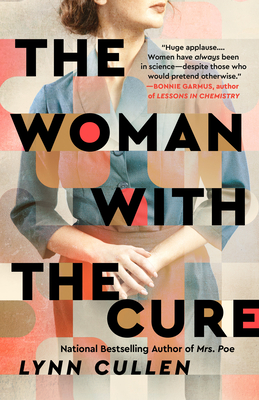
Meet Dr. Dorothy Horstmann who worked tirelessly and in the face of persistent gender discrimination to stop the polio pandemic. Now mostly forgotten, polio epidemics between 1948 and 1955 paralyzed or killed hundreds of thousands of people, mostly children, around the world. President Franklin Roosevelt is the patient with whom most people are familiar.
Cullen brings this time period to life with searing portraits of wards filled with children in iron lungs and scientists competing against each other to be the first to find a cure. Dorothy doesn’t care about fame; fighting polio is her only concern. She freely shares what she learns with the two leading competitors—Jonas Salk and Albert Sabin—as well as with others working to end the scourge.
I love that biographers and historical fiction writers are bringing to light women whose essential contributions have been downplayed and forgotten while only the “great men” are credited and remembered. It’s worth noting that polio research was one of the first uses of HeLa cells which I first learned about in Rebecca Skloot’s The Immortal Life of Henrietta Lacks. How much we owe to Ms. Lacks! Check out the book if you’re ever looking for an example of how one person can—even unwittingly—change the world.
Rejected for a residency because of her gender, Dorothy applies again as D. M. Horstmann and is accepted. The first to suspect that polio travels from the gut to the blood, she is refused support needed to investigate and conduct trials. She finally gets funding years later after a male scientist proposes the same thing; meanwhile thousands of children continued to be paralyzed or died each year. Nominated for a Nobel Prize for her work, she is passed over for two men.
With no time for bitterness, Dorothy pushes forward. The first woman to become a full professor at the Yale School of Medicine, she travels around the world to participate in polio conferences and to study polio outbreaks, thus contributing valuable data. She is also instrumental in the Russian study that validated Albert Sabin’s successful polio vaccine, enabling it to be approved.
Cullen takes us behind the scenes as scientists race the clock and each other. I felt Dorothy’s despair at setbacks and her thrills at successes. The delays caused by infighting I found frustrating, thinking of the children around the world left to suffer while male scientists kept their secrets. One of the holdups was danger of human trials with children.
We learn that the first round of Salk’s initial vaccine (which was greeted with cheers of relief) left 164 people paralyzed and 10 dead, due to one of the suppliers cutting corners, so that their vaccines actually gave people polio. The resulting distrust of vaccines lingers to this day.
I’m old enough to remember those awful years, with terrified parents keeping children apart and swimming pools closed. Some of the children in my school stumped around in their leg braces, while other children never got to attend because schools couldn’t accommodate wheelchairs.
I vividly remember the day at school when we lined up to get our first sugar cube with the vaccine and my mother crying. Since then I’ve been a confirmed advocate of vaccinations and nothing that drug-addled creep currently in charge of the U.S. Department of Health and Human Services—who has made millions of dollars off of anti-vax activities—can say will convince me otherwise.
For me, the most moving scene in the book occurs in Detroit, Michigan in 1953 when Dorothy tours the Henry Ford Hospital’s polio unit with its rows of “groaning and wheezing iron lungs out from which heads stuck.” Dorothy herself had tried out one of them early on so that she’d better understand her patients and had immediately panicked.
On the tour, Dorothy is distracted by a little girl in a wheelchair. “With her physician’s eye, she noted that the muscles of both the child’s legs had atrophied from the hips down and were thus likely to remain permanently paralyzed.” The child is playing a board game with a grown woman in an iron lung, Mrs. Konkle, who cheerfully announces that all the children beat her at the game, even her own children when they come to visit.
The game is Candy Land which we played incessantly when I was little. I never knew that it was invented by a schoolteacher in California while she was in the hospital with polio. Mrs. Konkle had her husband buy it and spent her days cheering up the children in the ward with her by letting them win. Such courage!
Occasionally the ins and outs of such a complex, multifaceted effort became a bit tedious, and perhaps some of the side stories could have been eliminated, but it is worth pushing through to get the full story of the dedication and sacrifice, not only Dorothy’s but that of others as well, which finally brought about a cure. Of course, Dorothy—the daughter of immigrants by the way—didn’t stop there but went on to work on the rubella vaccine still used today to protect children.
Did you ever play Candy Land? Were you aware of its history?
Candy Land—hours of boredom, but our child loved it. Also insisted on falling into the swamp—was it a molasses swamp—even though that was supposed to be a bad thing! But did you actually know children with polio? I never did, though I was of course cautioned about swimming pools and ice cream—there was a belief that ice cream could carry the disease.