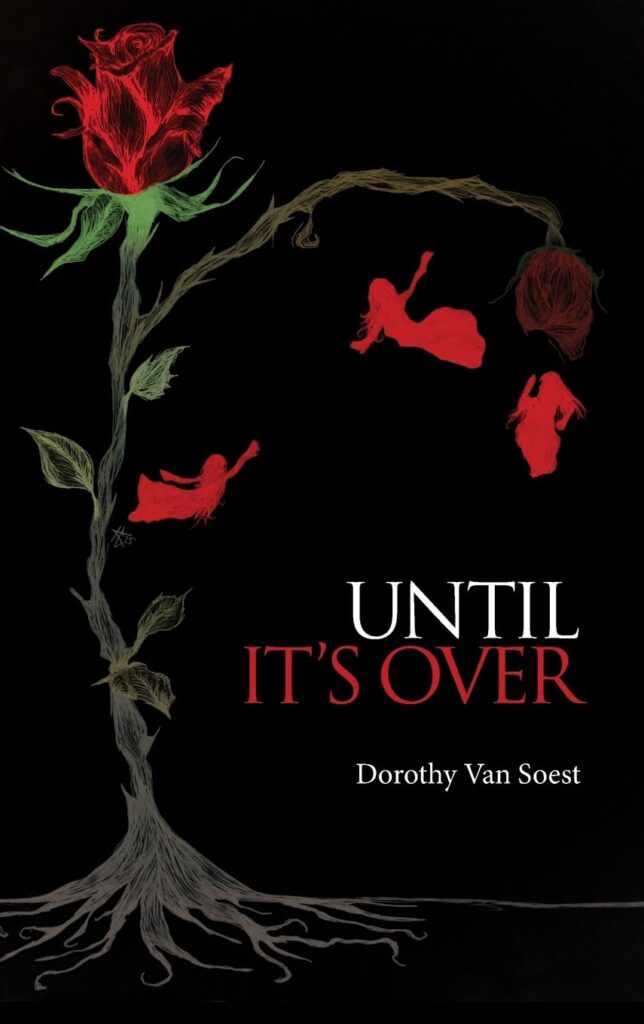
When retired social worker Sylvia Jensen refuses to be silenced by a politician with dark secrets, her investigation takes her deep into the past, to the secret springs of guilt, regret, fear and trauma. The story opens with a protest in the state capitol rotunda against a mining company’s plan to open a uranium mine on Indian land.
Readers of Van Soest’s earlier three novels featuring Sylvia know her courage and willingness to fight for her clients’ rights and well-being, as well as for the betterment of all. Now in her eighties, Sylvia attends the protest with her young journalist friend J.B. to support Peter Minter, the frail Ojibwe elder who had been arrested at the mining company’s office.
Peter immediately turns the microphone over to the leading candidate for the Senate, Anthony Jordane, a White man who smoothly promises to protect Indian rights. Then Sylvia, who’s been growing increasingly agitated, lunges toward Jordane screaming that he is a liar before collapsing to the ground unconscious.
This is J.B.’s story as much as it is Sylvia’s. A victim of the U.S.’s unjust and inhumane policies towards the Native Americans whose land they stole, J.B. was forcibly removed from his family as a baby and given to a middle-class White family. Then at age seven he was again forcibly removed from the only family he remembered and returned to his birth family. Eventually he ran away and took refuge with his foster grandparents.
Now he is an investigative journalist with the New York Times who has worked with Sylvia before on some of her cases and also knew her as a social worker who actually cared about what was best for him. However, his unresolved issues about his past, his ethnicity, and his identity make it hard for him to decide the right course of action while Sylvia is sidelined in the hospital.
Per his training, he must first investigate the truth of Sylvia’s claims about Jordane, which means going to the small rural town where she and Jordane grew up and attended high school together. There he must pry open the lid of silence the townspeople have slammed down over the events of that fateful year, the one that made Sylvia leave town swearing never to return.
What I admired most in the story is the subtle way Van Soest weaves the theme of silence versus speaking truth to power through the actions each of the major and minor characters. Sylvia and J.B’s stories were especially moving as the main characters, but I also found myself caring deeply about the minor characters.
This exciting tale, full of compassion and psychological insight, gives voice to the victims of injustice. It speaks to today’s headlines and reminded me of The Great Gatsby where Fitzgerald characterizes the Buchanans as “careless people.” That is of course what we’re seeing today, so I’m grateful to Van Soest for demonstrating how we all, including writers and artists, can resist injustice.
What stories of resistance have inspired you?
Disclosure of Material Connection: I received a copy of this book free from the author. I was not required to write a positive review. The opinions I have expressed are my own.