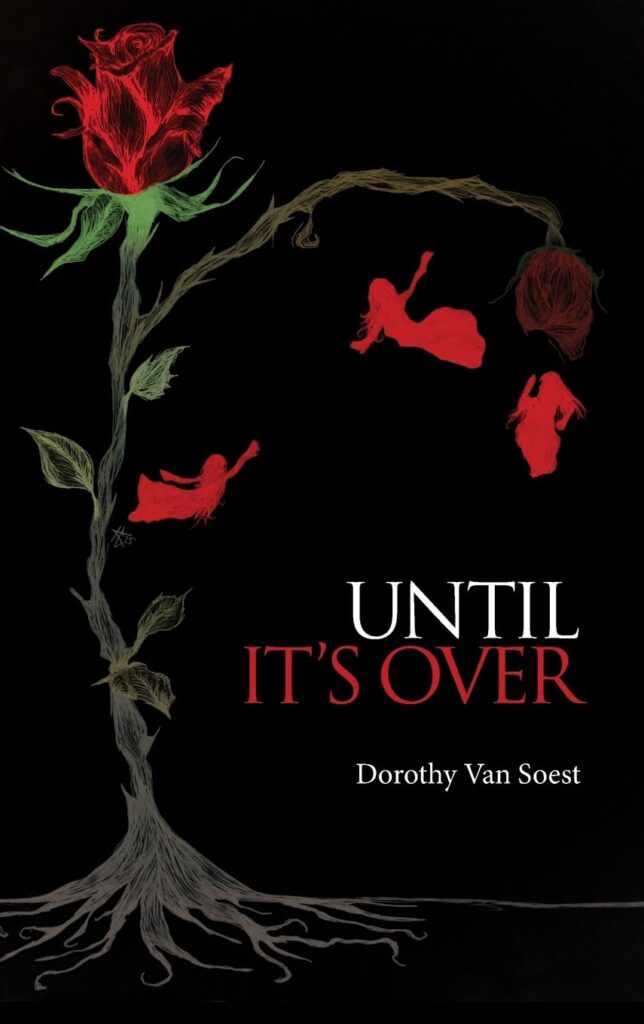
Until It’s Over, by Dorothy Van Soest

When retired social worker Sylvia Jensen refuses to be silenced by a politician with dark secrets, her investigation takes her deep into the past, to the secret springs of guilt, regret, fear and trauma. The story opens with a protest in the state capitol rotunda against a mining company’s plan to open a uranium mine on Indian land.

Readers of Van Soest’s earlier three novels featuring Sylvia know her courage and willingness to fight for her clients’ rights and well-being, as well as for the betterment of all. Now in her eighties, Sylvia attends the protest with her young journalist friend J.B. to support Peter Minter, the frail Ojibwe elder who had been arrested at the mining company’s office.

Peter immediately turns the microphone over to the leading candidate for the Senate, Anthony Jordane, a White man who smoothly promises to protect Indian rights. Then Sylvia, who’s been growing increasingly agitated, lunges toward Jordane screaming that he is a liar before collapsing to the ground unconscious.

This is J.B.’s story as much as it is Sylvia’s. A victim of the U.S.’s unjust and inhumane policies towards the Native Americans whose land they stole, J.B. was forcibly removed from his family as a baby and given to a middle-class White family. Then at age seven he was again forcibly removed from the only family he remembered and returned to his birth family. Eventually he ran away and took refuge with his foster grandparents.

Now he is an investigative journalist with the New York Times who has worked with Sylvia before on some of her cases and also knew her as a social worker who actually cared about what was best for him. However, his unresolved issues about his past, his ethnicity, and his identity make it hard for him to decide the right course of action while Sylvia is sidelined in the hospital.

Per his training, he must first investigate the truth of Sylvia’s claims about Jordane, which means going to the small rural town where she and Jordane grew up and attended high school together. There he must pry open the lid of silence the townspeople have slammed down over the events of that fateful year, the one that made Sylvia leave town swearing never to return.

What I admired most in the story is the subtle way Van Soest weaves the theme of silence versus speaking truth to power through the actions each of the major and minor characters. Sylvia and J.B’s stories were especially moving as the main characters, but I also found myself caring deeply about the minor characters.

This exciting tale, full of compassion and psychological insight, gives voice to the victims of injustice. It speaks to today’s headlines and reminded me of The Great Gatsby where Fitzgerald characterizes the Buchanans as “careless people.” That is of course what we’re seeing today, so I’m grateful to Van Soest for demonstrating how we all, including writers and artists, can resist injustice.

What stories of resistance have inspired you?

Disclosure of Material Connection: I received a copy of this book free from the author. I was not required to write a positive review. The opinions I have expressed are my own.
Horizon, by Barry Lopez

Horizon

In this profound and generous book, Lopez looks back over some of the travels that have shaped his understanding and philosophy. We go from Oregon to Antarctica, from Nunavut to Tasmania, from Eastern Equatorial Africa to Xi’an in China.

Many of these expeditions are scientific endeavors, where he has joined a team of archeologists to excavate the site of a long-gone indigenous peoples or scientists measuring boreal (ocean bottom) life or another team measuring glacier movement. Sometimes he ventures out for other reasons, such as revisiting the Galápagos Islands or tracing the route of Shackleton’s open-boat journey to Elephant Island.

He weaves in stories of explorers and adventurers, the well-known such as Cook, Darwin, Scott, and the lesser-known such as Ranald MacDonald, Edward Wilson, Lt. Adolphus Greeley. He taps poets, writers, and philosophers for insights and connections.

I’ve taken my time reading this book. It’s so rich! I’ve gone back and reread sections, or paused for a few days to consider what I’ve just read. More than once I’ve picked it up to find him addressing something that was on my mind, as in this paragraph from the section in Antarctica. I had been thinking about various lifespans, and in particular that of rocks.

I turned one rock after another over in my gloved hands, to get its measure, to take it in more completely. In the absence of any other kind of life, these rocks seemed alive to me, living at a pace of unimaginable slowness, but revealing by their striations and cleavage, by their color, inclusions, and crystalline gleam, evidence of the path each had followed from primordial birth to this moment of human acquaintance.

The science is easy to follow, the descriptions gorgeous. Lopez depicts not only the natural world, but the human cultures that have come and gone upon it. What stands out for me is the unhurried accumulation of insights building one upon another, like a coral reef, to create an ethical framework, a structure that can hold the eager quest for knowledge of scientists, the adventurousness of explorers, the communities that care for each other and also the atrocities visited upon innocent people, cultures deliberately or accidentally wiped out, chemical waste dumped in cities and towns.

What are we to make of our current societies, where the drive for profit pushes technology without regard for consequences, where science is undermined by for-profit businesses and their government lackeys? There was much that was wrong in earlier centuries, earlier societies, but can we draw any lessons that could help us today? What is being lost as human cultures and species are obliterated, as glaciers melt into the sea?

And then we set that against the generosity of those who have sought to advance our knowledge, those who have labored to save the remnants of the past, those who have devoted themselves to conserving this world that we have so damaged, of Oates walking out into the night, of Shackleton’s determination to save every one of his crew.

Lopez’s accounts embody the respect for other cultures that many people today strive for. The cultures he explores—especially the lost indigenous cultures like the Thule of the Arctic, the Kaweskar of southern Chile—remind me of the long arc of human history, the coming and going of peoples. One insight I found particularly helpful was about communicating with “members of a culture that had experienced the brutal force of colonial intrusion. I knew the only right gift to offer people in these situations is to listen, to be attentive.”

The horizon he explores is physically and metaphorically the line where our known world gives way to air, to the space we still know almost nothing about. That liminal space is where exciting things can happen. The quest for knowledge and understanding—along with compassion—are what I value most in human beings. I will be reading and rereading this book for years to come.

Have you read a book that increased your knowledge of the natural world and challenged your philosophies?