Spell Freedom, by Elaine Weiss

Many people contributed to the success—partial as it was—of the Civil Rights Movement of the 1960s. We’ve all heard the names of the famous leaders, their words and deeds. In this book, subtitled “The Underground Schools That Built the Civil Rights Movement,” Elaine Weiss tells the story of some of those we haven’t heard of, courageous people who came before the famous speeches and laid the foundations for success by creating the citizen schools that prepared Black Americans in the Jim Crow South to register to vote.

These unsung heroes had to start the school in secret, sometimes in the back room of beauty parlor, and create their own materials, adapted to the needs of an illiterate or barely literate adult population. Weiss doesn’t shy away from the difficulties, the terrible repercussions they all risked from a South wedded to White Supremacy.

Participants in the schools learned not just how to read and write, but also how to decipher the voter registration literacy tests intended to keep them from voting. They also learned what their rights were and gained the confidence to exercise them. By the time the Voting Rights Act passed in 1965, these secret schools had spread across the South, helping thousands of people register to vote.

I came to this book reluctantly when it was selected by my book club for this month. I figured I already knew about the Civil Rights Movement. I couldn’t miss it, growing up in Baltimore in the 1950s and 1960s. And then there are all the books, articles and discussions I’ve absorbed since. Yet once I started reading, I was hooked. And as it turns out, most of the book was new to me.

Weiss begins with the 1954 Brown v. Topeka Board of Education ruling that said racial segregation of public schools was unconstitutional. She shows how that news was received by Septima Clark, a 56-year-old teacher from South Carolina; Esau Jenkins, a Sea Island aspiring businessman and bus driver; and Bernice Robinson, a beautician from Charleston. The three of them understood that doing away with segregation would take work, dangerous yet necessary work.

Septima Clark came to the Highlander Folk School in rural Tennessee, a training ground for labor organizing created by Myles and Zilphia Horton that was pivoting to support civil-rights activism. Initially mistrustful of the fully integrated school, Mrs. Clark was shocked to share a room with a White person and sit at a table with White people for the first time. Yet the vision of White and Black people working together day after day to come up with practical plans for challenging segregation is one that would stay with her and encourage her for the rest of her life.

She brought Mr. Jenkins and Mrs. Robinson to Highlander. The compelling portraits of these three unlikely leaders fuel the story: ordinary people doing extraordinary things. The writing is clear and compelling; Weiss transforms her extensive research into riveting stories. We do meet the famous leaders in these pages but usually in the context of these unsung heroes.

Weiss also doesn’t shy away from the movement’s internal struggles and the sexism of its leaders. Most of all she brings home to the reader the terrible dangers faced by these teachers and organizers, as well as by everyone sitting in at a store counter or trying to register to vote. They are fired from jobs, kicked out of their homes, beaten and shot.

We need their stories today. We need to remember how hard they had to fight for the right to vote—now in danger once again—and that they did win again and again. We have much to learn from Mrs. Clark, Mr. Johnson, and Mrs. Robinson: the way they organised within their communities, found creative ways to help people, and got up each time they were knocked down.

Elaine Weiss kindly came to our book club meeting and proved to be a fascinating speaker with a sure command of her material. She said that her interest in this story began when she heard of the March 2019 firebombing of the current Highlander Center, complete with White Nationalist symbols. She wondered what this place could be doing that it should still be such a powerful symbol. 

Then she was curious about people like Septima Clark, whom most people haven’t heard of. She found a brief autobiography, Ready from Within, that Mrs. Clark wrote of her early life and an academic biography, Freedom’s Teacher, that focuses on her teaching techniques. In her research, Weiss was shocked by the systematic oppression and the economic punishment for attempting to vote. She reminded us that Septima Clark was financially insecure for the rest of her life; her friends had to get together to pay for her grave marker.

I hope many people will read this book. There is so much that will fire your imagination and strengthen your resolve in these dark times. Elaine Weiss said that in tough moments she often thinks What would Septima do? From now on I will, too.

Where are you finding courage these days?

The Real Mrs. Miniver, by Ysenda Maxtone Graham

The Real Mrs. Miniver, by Ysenda Maxtone Graham

We’ve seen the movie, of course, and thought it a sentimental film about a woman who is practically perfect in every way keeping her family together and holding the home front together during the Blitz—the bombing of London during WWII. The book the film is based on, a collection of columns from the London Times, was something else altogether: an idealised portrait of an ordinary upper middle class woman’s life in pre-WWII England.

Those columns were written by Joyce Maxtone Graham (née Anstruther) using the name Jan Struther, and she modeled the family on her own husband and three children. However, as we learn from this biography by her granddaughter, the loving Miniver family was a far cry from Joyce’s own. Her marriage to Tony Maxtone Graham, initially fun-loving and amusing, had dried up as he’d been taken hostage by golf, leaving Joyce to her articles and poems many of which were published in Punch among other periodicals.

Joyce had been a tomboy as a child, loathing the ceremonial tea parties and dance lessons, preferring to run and shoot with the boys. She and Tony initially shared a comic view of the world. I loved the way they shared the silly things they noticed during their days: pebbles, as she called them, like children turning out their pockets at the end of the day. As they drew further apart, Joyce fell deeply in love with Dolf Placzek, a penniless Jewish refugee from Austria gifted with intelligence and a strong appreciation for the arts.

The Mrs. Miniver columns depict a happy, loving marriage that was a far cry from what Joyce’s had become. Yet for many, those columns embodied an England that was being destroyed by the war and a reminder of what they were fighting for. Mrs. Miniver’s upper middle class life was comfortable, with a London house and a weekend cottage in Kent, a son at Eton, and servants to do the chores. The columns contain the small things she notices during the day, some pleasurable, some not—like the pebbles she and Tony used to exchange. While Mrs. Miniver could be critical of her social circle, she was alive to its charms.

Joyce—now Jan all the time—was shocked by the surprising success of the book and the reading tours and talks that followed. She came to be haunted by Mrs. Miniver. Many fans assumed they were the same person. She struggled to finding a firm place to stand.

Of all emotions, she perhaps felt the emotion of missing most acutely. At a party, she missed solitude. Abroad, she missed home. Cut off from her children, she longed to be with them again. When she was, she longed again for solitude. The raggle-tangle gypsy in her head beckoned her to escape.

Why read biographies? In my twenties I read lots of biographies of women writers and artists, looking for inspiration during a time when women were second-class citizens when it came to the arts. I was also looking for ideas for how to write while wrangling two babies and an ex who refused to contribute. Just keeping the heat on and some kind of food on the table was a miracle. Forget about finishing a story and sending it out.

These days I still look for inspiration from brave women and men as I struggle with how to live a moral life in an increasingly compromised and chaotic world. I’m especially drawn to women living during dark times. I’m also interested in the wide range of life choices people make. One thing that is so fascinating in this book is the contrast between the life of Mrs. Miniver—a model for womanhood at the time—and that of the woman who created her.


Sometimes with a biography, it is enough to see myself in a reckless tomboy unwilling to knuckle under to social norms or an almost accidental writer. Now if only I can catch the zeitgeist the way Jan Struthers did! Perhaps it’s better I don’t. Her story is yet another cautionary tale of how too much success and celebrity can wreck a person.

It’s been difficult lately to find books that hold my interest. My reading record is full of DNFs. This one, though, fascinated me and kept my attention right through to the end. Jan reinvented herself several times over, which I find wonderful. And she changed the course of history, inadvertently perhaps and not alone, but for sure. What kind of world would we be living in today if the U.S. had refused to join the Allies fighting Hitler and Mussolini in Europe and Africa?

I take courage from her story and the stories she wrote about the ordinary people of Britain as we fight today’s fascism.

Have you read a biography that inspired you?

Best Books I Read in 2024

As a writer, I learn something from every book I read. In no particular order, these are ten of the best books I read in 2024. Please check the links to the blog archive for a fuller discussion of those I’ve reviewed.

Note: I did not include poetry here, though I read the work of some amazing poets, such as Richard Wilbur, Sam Schmidt, Linda Pastan, Ellen Bryant Voight, and Mahmoud Darwish. If you’re interested in reading a wider range of poets, consider joining in on the monthly Poetry Discussion Group I host. Free, no experience necessary, and copies of the poems are provided. Details on my website.

Fiction

  1. Our Missing Hearts, by Celeste Ng

Twelve-year-old Noah Gardner receives a letter from his mother, who disappeared several years earlier. It has been opened by the authorities of course, and is covered with drawings of cats. Noah and his father, formerly a linguistics professor but now demoted to a janitor, live in a U.S. that shows what our current country could easily become. Noah decides to find out once and for all what happened to his mother, a famous Chinese-American artist. A powerful story that puts our current social and political tensions into a (so far) fictional authoritarian world.

  1. The Cartographers, by Peng Shepherd

Nell Young loves maps and once dreamed of working with her brilliant father in the Map Room of the New York Public Library. Her even more brilliant cartographer mother died when Nell was a toddler. When Nell gets an emergency call from the New York Public Library, she embarks on a quest to identify the monster behind a string of thefts and murder. The delightfully complicated plot uses maps in surprising and satisfying ways.

  1. The American Queen, by Vanessa Miller

This fascinating novel is based on the true story of twenty-four-year-old Louella Bobo who in 1865 leads a group of her fellow former slaves to build a community in the Carolinas. The part I enjoyed most was the building of the Happy Land: how Louella managed to negotiate what they needed, the ways they found to make the money they needed, and the success of their communal sharing of all resources.

  1. Small Mercies, by Dennis Lehane

Mary Pat Fennessy just wants to find her daughter. It’s 1974, and life is hard in the grinding poverty of South Boston’s housing projects. She’s buried both her first husband and her son, who fought in Vietnam but came home to Southie to overdose on heroin. Her beloved second husband left her, and now her remaining child, Jules, has not come home from a night out with friends. In this complex story, Lehane shows how difficult it is to go against your tribe. It is a cracking good read, and accurate in its depiction of the time and place, at least according to my memories.

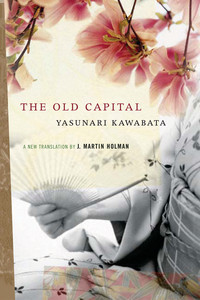
  1. The Old Capital, by Yasunari Kawabata

Chieko lives with her parents in the same building that houses their shop in Kyoto. This gentle story of a few months in her life begins with three images that embody themes central to Japanese literary tradition while later, more modern themes emerge. The microcosm of Chieko and her family holds a much larger story about how we handle the past—what we keep and what we discard—not only traditions but also our memories and our own identities.  This beautifully written story is one that will haunt me.

Nonfiction

  1. Vesper Flights, by Helen MacDonald

The author of the exquisite and deeply moving memoir H Is for Hawk returns with this collection of essays. She compares them to the objects you might find in an 18th-century cabinet of curiosities. As MacDonald opens the doors on these wonders of the natural world, she encourages us to see nature as something other than a reflection of ourselves. I read and reread these essays, loving the way she communicates the “qualitative texture of the world.”

  1. Burning Questions, by Margaret Atwood

Subtitled Essays and Occasional Pieces, 2004 to 2021, this is Atwood’s third collection of essays, speeches, book introductions, and reviews. What astonished me was how readable this heterogeneous collection is. Of course, we have Atwood’s voice throughout: intelligent, calm, learned, self-deprecating, and witty. For a more global understanding of the issues facing us, their interconnectedness, and how we can move forward, this book cannot be beat.

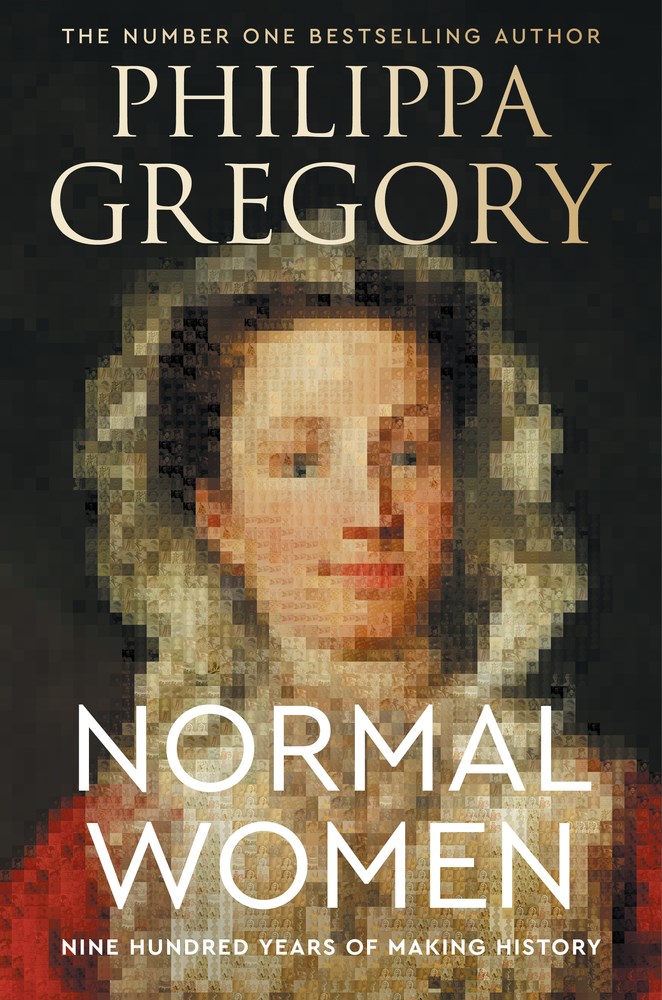
  1. Normal Women, by Phillipa Gregory

This astonishing book should be required reading everywhere in the Western world. This history of women in England for the last 900 years is fascinating and infuriating. Women have suffered ever since William the Conqueror brought his patriarchal ideas about the superiority of men over women to England in 1066, obliterating the more equitable society he found there. In this book, every assertion is backed up by example after example drawn from primary sources, starting with the Norman laws that dictated the so-called natural inferiority of women, morally, mentally, and physically. As the book progresses through the centuries, we get stories of many extraordinary women and their struggles.

  1. The Equivalents, by Maggie Doherty

Subtitled A Story of Art, Female Friendship, and Liberation in the 1960s, Doherty’s fascinating new book tells of the Radcliffe Institute for Independent Study, created in 1960 to provide a stipend, office space, and a like-minded community to help women advance their careers as scholars and artists while also caring for a family. Doherty concentrates on a few of the first fellows: poets Anne Sexton and Maxine Kumin, writer Tillie Olsen, sculptor Marianna Pineda and painter Barbara Swan. The book provides fascinating insight into the creative life and what can inspire or hinder it. It’s also a wonderful portrait of that era and of these remarkable women.

  1. Proust’s Duchess, by Caroline Weber

Even those who don’t care who inspired Proust’s Duchess of Guermantes may enjoy this biography of three fascinating women in fin-de-siécle Paris. At a time and in a society where women had no power, these three embarked upon “a conscious strategy of self-promotion.” Like so many today, they became famous for being famous. However, Weber goes beyond that easy judgment and delves into their lives, showing us that in striving to be celebrities, they wanted to be noticed. They wanted to assert some agency over their lives.


What are the best books you read in 2024?

Normal Women, by Phillipa Gregory

If you’re going to read the history of women in England for the last 900 years, then you can’t be surprised that it is a huge book. Long? Yes. Also, fascinating and infuriating.

Women have suffered ever since William the Conqueror brought his patriarchal ideas about the superiority of men over women to England in 1066, obliterating the more equitable society he found there. Sound like a generalisation? Read this book, where each assertion is backed up by example after example drawn from primary sources, starting with the Norman laws that dictated the so-called natural inferiority of women, morally, mentally, and physically.

Gregory’s extensive research yields statistic after statistic, example—by name—after example of women doing the work of society while having no power. She divides the book by eras and, within each presents a cogent description of areas such as the status of women’s health, marriage rights, widows, work (paid and unpaid), female soldiers, sexuality, slavery, rape, and prostitution.

Bottom line? Every time things start to look better for women, every time they are given a modicum of power, the immediate reaction by terrified men shoves them backwards. Think it’s all in the past? Look at how the percentage of rapes of women that are investigated by British police—already appalling low—have declined in recent years. If I remember correctly, the most recent figure in the book is from about ten years ago and is shockingly only two percent. Two percent!

Century after century, women are excluded from profitable work, from unions and guilds, from being able even to train for better work. All this while they are the ones feeding the family, more often than not. Elite women cheerfully throw their lower class fellow females under the wheels of their chariots.

A lot of this I already knew, but the tsunami of detail, of individual stories, really brought the horror of this persistent imbalance of power home to me. One area I hadn’t realised is that women were the true force behind the great resistance movements in England, the ones that pushed back against enclosure of common lands, automation, and other power grabs by the wealthy that left everyone else to starve. The Peasants’ Revolt of 1381 was sparked by two women from Kent, Joan Hampcok and Agnes Jekyn protesting a poll tax, not Wat Tyler, as the history books would have it.

If you think that 500+ pages of this would be boring, think again. There are surprises everywhere. Did you know that boxing was primarily a women’s sport in the early 18th century? Gregory writes with a cool attention to story, grabbing the reader’s attention and not releasing it. You cannot even turn away from her ten pages listing names of women murdered in Britain in 2019, nearly all dying from domestic violence. She tells us of the broken ribs and deformed bodies of women laced into too-tight corsets, of women colliers dragging coal out of mines like pit ponies.

She reminds us of how men of every period attempted to define women—quoting their very words—in ways that demeaned them and reinforced male dominion. All these unscientific theories of women’s nature spoke of her weakness of body, mind, and morals.

We are introduced to so many extraordinary women in these pages, but the author reminds us to look around us. “The history of women is a struggle over identity and inclusion: we are all ‘normal’ women even when we have been described as exceptional or deviant or inadequate, even when our vanity prompts us to stand apart, or our ambition to compete with each other.”

Yes, it’s a long book. You may want to pace yourself, though I confess that I tore through it. This is the book that I’m recommending to everyone this year.

Have you read any part of this remarkable book? What did you think about it?

Negative Space, by Luljeta Lleshanaku

Negative Space

The title of this collection of poems by Albanian poet Lleshanaku intrigued me. The title poem, itself long and complex, about her childhood and the Cultural Revolution of 1968, a result of Communist Prime Minister Hoxha’s anti-religious policy of Enver Hoxha, Albania’s leader from the end of WWII until his death in 1985.

But I found a different perspective in the poem “Menelaus” where she writes using as a persona the Spartan leader who fought in the Trojan War under his brother Agamemnon and eventually married Helen after the sack of Troy. In Lleshanaku’s telling, not only is his ship becalmed on the voyage home, but actually never arrives in Sparta:

I continued to wander on open seas, forgotten,
on history’s waters . . .

Patris now doesn’t exist.
Not because of a curse from the gods,
but because with revenge
everything ends. The curtain falls.
And peace is never a motif.

“Patris” is the Greek word for homeland and of course also reminds us of Paris who started the war by stealing Helen. What I see here, though, is the enduring legacy of Albania’s civil wars, dictatorships, occupations, massacres, followed by four decades of communism and the empiness left after its defeat. How do you write about the traumas that shaped your life when they are over? In “The Deal” she talks about going home and all that has changed:

“I’ve come to write,” I explain.
“Is that so? And what do you speak of in your writing?”
asks my uncle, skeptically . . .

Only my eyes haven’t aged, the eyes of witness,
useless now that peace has been dealt.

What’s left in that negative space are the small, human things of life, beautifully rendered in other poems here, with a turn that lifts them out of the ordinary. For example, in “Small-Town Stations” she pulls us in with the first line: “Trains approach them like ghosts.” Then come the details, rousing our own memories of train journeys and what we see looking out at these stations. She ends, though, with a twist that makes us rethink the entire poem and the person narrating it.

This book is Ani Gjika’s 2018 translation of Lleshanaku’s 2012 and 2015 collections. As always, I wish I could hear the poems read in the original as well, since I’m curious about the musicality of the author’s poetic voice and am never sure how well it translates.

Regardless, I’m grateful for these translations that have given me access to these poems with their images upon images. They’ve stirred me into, not only remembering my own moments and reviewing what I know of Albania’s history, but also making me think further about the long-term effects of trauma, whether it’s systemic racism or the wars and dictators who are driving the many people deciding to try the difficult journey to another country.

What do you know about Albania? Have you read Lleshanaku’s poetry?

Best Books I Read in 2022

As a writer, I learn something from every book I read. In no particular order, these are the ten best books I read in 2022. Please check the links to the blog archive for a fuller discussion of those I’ve reviewed.

1. The Wall, by Marlen Haushofer
The narrator wakes from a nap to find herself alone. She’s visiting family members at their hunting lodge on the edge of the Alps, and they have gone into town, leaving her with their dog Lynx. She walks down the road to meet them, but both she and the dog run into an invisible wall that separates them from the rest of the world. This journal of her solitary life in the years that follow is stunning.

2. Hamnet, by Maggie O’Farrell
O’Farrell’s tour de force focuses on Agnes, Hamnet’s mother, Shakespeare’s wife, and in so doing immerses us in the day-to-day experience of raising children and managing a household in Elizabethan England. What makes this novel so stunning is the author’s evocation of the details of each scene. It is a powerful reading experience that gives us insight into Shakespeare’s work, but even more into the lives of the many women who loved, married, and bore children in obscurity.

3. Generations: A Memoir, by Lucille Clifton
Lucille Clifton is one of my favorite poets and a huge influence on my writing. In this memoir, originally published in 1976 and now a new edition from New York Review Books, she brings a poet’s sensibility to crafting her story. The chapters, while prose, in their brevity exhibit the conciseness of poetry; anything not absolutely necessary is pared away, leaving the kernel. And you, the reader, bring your own understanding and experience to fill in the spaces.

4. Memorial Drive, by Natasha Trethewey
Trethewey is another of my favorite poets, so I looked forward to reading her memoir. Not needing to know anything more than the author’s name, I plunged in, only to emerge finally, astonished and awed. With a poet’s concision and musicality, she conjures her rural Southern childhood. Trethewey’s voice is quiet—quiet as Black women’s voices have had to be. Yet with all that, her voice carries the emotions held in check by her composure, a tribute to the author’s exquisite use of language. She has created a moving exploration of memory and of how we manage, or fail to manage, our painful past.

5. Migrations, by Charlotte McConaghy
Arriving in Greenland with only her research gear, Franny Stone is determined to study the last of the Arctic terns. She says that even though her expedition has been canceled, she intends to follow the terns on what will be their final migration to Antarctica. The book is set in the near future when climate change has wiped out most birds, fish, and animals. Although disapointing at times, this profound story is worth your attention.

6. The Tradition, by Jericho Brown
I am astonished by these poems, the power and sheer artistry of them. They are personal and political, specific and universal. Brown deploys the tools of poetry—enjambment, white space, personification—boldly. Some of the poems take up hardly any space, lines only two or three words long. Yet even with that limitation they are remarkable, the fragmentation creating a rhythm in counterpoint to and with the rhythm of the words. He also creates his own tools, complex forms that defy gravity.

7. The Crane Wife, by CJ Hauser
This book of essays, anchored by the superb title essay, is about the stories we tell ourselves about our lives and about who we are. Hauser balances personal stories with those of others, sometimes her friends, sometimes writers or their characters, sometimes the natural world.

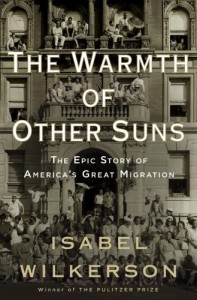
8. The Warmth of Other Suns, by Isabel Wilkerson
From 1915 to 1970 almost six million Black citizens left the south for northern and western cities looking for better lives. For the first time Wilkerson’s monumental book gives us a history of the Great Migration. The book is long but eminently readable, due to Wilkerson’s approach. By closely following stories of three individuals, she captures the reader’s attention and sympathy and keeps us turning pages.

9. Parable of the Sower, by Octavia E. Butler
This 1993 novel begins in the then-distant future of 2024, which startled me at first. Due to her mother’s drug abuse while pregnant, teenager Lauren Olamina actually feels all the sensations she witnesses in others. She calls it “sharing” and finds it a liability in her world, a dreadful world that is only too likely how things will turn out here, given the trends already present in the 1990s and only worse today. A brilliant story of one woman’s journey.

10. Miss Benson’s Beetle, by Rachel Joyce
London in 1950 is still recovering from World War II, with food rationed, ruined buildings being cleared, another generation of men wiped out, and women chucked out of their wartime jobs. Middle-aged spinster Margery Benson finally cracks and quits her job teaching domestic science in an elementary school with out-of-control children. She decides to set out on the adventure of a lifetime: an expedition to New Caledonia to find a mythical golden beetle. So much fun!

What were the best books you read in 2022?

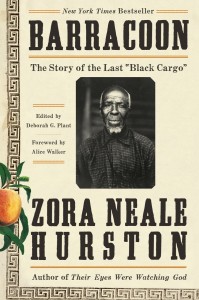
Barracoon, by Zora Neale Hurston

barrac

After reading The Confessions of Nat Turner, a fictional account of the leader of the 1831 slave uprising, I wanted to read a first person account from someone who had been a slave. This slim book, subtitled The Story of the Last “Black Cargo,” fits the bill.

I was already familiar with Hurston from her novels, such as Their Eyes Were Watching God, and knew she had studied with the pioneering anthropologist Franz Boas. Here, she combines her anthropologist and storyteller skills to give us the story of Cudjo Lewis in his own words.

Born in the town of Banté in West Africa, Kossola, as he was known then, was captured by the Dahomey when they destroyed his town, taking the teenager and others to sell as slaves. At the time Hurston interviewed him in 1927, he was thought to be the only person still alive who had made the gruesome Middle Passage from Africa to the United States. His was the last group of slaves to make that journey.

A storyteller in the griot tradition, Kossola describes what life was like in his town, including marriage customs, how murderers are punished, and his own training to be a man. He tells of the Dahomey raid—“ ‘I see de people gittee kill so fast! De old ones dey try run ‘way from de house but dey dead by de door, and de women soldiers got dey head’”—and the long march to Dahomey where they are kept in the barracoon, or barracks, until the White slave traders come.

Hurston captures his voice by representing his dialect. Although I usually tire easily when trying to read dialect, I had no trouble here, easily falling into Kossola’s voice. The dialect adds authenticity to his story.

Dey takee de chain off us and placee us in de boats . . . When we ready to leave de Kroo boat and go in de ship, de Many-costs [a derisive term for the Kroos, an African tribe that works for the white men, called that because many of them can be hired for the cost of a good worker] snatch our country cloth off us. We try save our clothes, we ain’ used to be without no clothes on. But dey snatch all off us. Dey say, ‘You get plenty clothes where you goin’.’ Oh Lor’, I so shame! We come in de ‘Merica soil naked and de people say we naked savages. Dey say we doan wear no clothes. Dey doan know de Many-costs snatch our clothes ‘way from us.

He goes on to describe his life as a slave, which lasted a little over five years, and after abolition, when he and the other slaves who had been brought on the Clotilda, those who hadn’t been sold elsewhere, built a town for themselves that they called African Town, today a community known as Africatown or Plateau, Alabama.

Religion is important to him and he is active in his church. He doesn’t see a disconnect between the faith of his childhood and the Christianity he learned in Alabama. He says that they worshiped the same god back in Africa, though they called him Alahua. Because they couldn’t read the Bible, they didn’t know he had a son.

This is not a traditional slave narrative, the story of an enslaved person escaping, trying to survive in the wilderness as they struggle to reach a place where they will be free. Instead, it starts with a free man, captured at 19 by fellow Africans and sold to White slavers—a fact that startled Hurston who had not realised that Black people were as responsible for the slave trade as White.

Hurston gives us a man who, despite the trauma and tragedies of his past, is someone much like us: retired, working in his garden, enjoying a good peach. We feel his love for his wife and their grief over the loss of two of their three children. His words touch us, especially his heartsick knowledge that he will now never see Africa again. He hopes that someday someone will carry his words back to that town in Africa where people will recognise his name and welcome him home.

This is a remarkable primary source for a time before any of us were born. Hurston completed the book in 1931, but it was rejected by publishers, partly because of the dialect. It was not published until 2018.

Do you ever pair two books that you’re reading, so that one complements the other?

The Warmth of Other Suns, by Isabel Wilkerson

Warmth

In 1937 Ida Mae Gladney left Mississippi for Chicago. In 1945 George Starling left Florida for New York City. In 1953 Robert Pershing Foster left Louisiana for Los Angeles.

They were part of the Great Migration. From 1915 to 1970 almost six million Black citizens left the south for northern and western cities looking for better lives. For the first time Wilkerson’s monumental book gives us a history of this remarkable movement.

The book is long but eminently readable, due to Wilkerson’s approach. By closely following stories of three individuals, she captures the reader’s attention and sympathy and keeps us turning pages. There are historical sections complete with supporting statistics, but these are kept to a minimum and related to the stories we’re following. The author brings all the tools of fiction to keep us interested in this meticulously researched history.

World War I is usually considered to precipitating cause of the Great Migration. Black soldiers serving in the military and in Europe discovered that it was possible to escape Jim Crow. At the same time, factories and businesses in the north and west were desperate for workers since the flow of immigrants had basically halted and the military claimed many of the remaining men.

The scope of the Great Migration was not recognised for a long time. The effects were felt locally, in cities such as Baltimore, Chicago, Detroit, New York, but it wasn’t until southern businesses found they could no longer hire enough Black workers—whose wages had been kept artificially low by Jim Crow laws and local corruption—that the outcry began.

The last part of the book, almost one hundred pages, includes Wilkerson’s notes on her methodology, acknowledgments, endnotes and index, attesting to the solid underpinning of research. She says:

This book is essentially three projects in one. The first was a collection of oral histories from around the country. The second was the distillation of those oral histories into a narrative of three protagonists . . . The third was an examination of newspaper accounts and scholarly and literary works of the era and more recent analysis of the Migration to recount the motivations, circumstances, and perceptions of the Migration as it was in progress and to put the subjects’ actions into historical context.

It is that historical context that is the takeaway I most value from this book. Much of the information here was not new to me. Yet what stands out is how I now have a framework for all the pieces that I was already familiar with. I felt them slotting into place as I read.

One area I wish Wilkerson had covered in more depth, though obviously there wasn’t room for it, is the Black communities that flourished during segregation and then dissipated, partly through “urban renewal” demolitions and partly through integration. Wilkerson mentions it briefly in a few places, such as speaking of Harlem’s rise and fall. Robert Foster’s story, too, shows it in microcosm: as he aged, he left his prosperous private practice, where he was popular among his mostly Black patients, to join the staff of a Veterans’ Hospital. He missed being in charge and disliked having to answer to higher-ups who he believed discriminated against him, eventually forcing him out.

I will remember Robert’s story as well as those of Ida Mae and George for a long time. They brought to life the indignities of the Jim Crow South they fled and the different kinds of injustice and prejudice they found in their sanctuary cities, far worse than the discrimination that immigrants from other countries faced. Through these individuals, I have a better understanding of the people around me.

What nonfiction have you been reading?

In the Memory House, by Howard Mansfield

memory

What we remember and how we remember it continue to puzzle me. Sometimes a random, quite trivial moment remains vivid decades later while critical events are somehow lost. And then, as a memoir writer, the accuracy of my memories matters to me.

Oliver Sacks said:

We now know that memories are not fixed or frozen, like Proust’s jars of preserves in a larder, but are transformed, disassembled, reassembled, and recategorized with every act of recollection.

I find this idea exciting and horrifying. My writing is sometimes like an archeological dig: unearthing memories followed by research to verify them as much as possible. Sometimes it is more like a circus clown’s act: pulling a handkerchief from my sleeve only to find it attached to another one, which when pulled out is attached to yet another, and so on.

But if every time I pull out a memory it is somehow changed, then I have to factor that in. Yet it is exhilarating to consider what those changes say about me and the person I’ve become, or rather, am becoming.

In this series of essays, Mansfield uses the recollections of individuals to compose a portrait of what we as a society remember, or more accurately, what we forget. From there, he considers the effects of that loss of cultural memory.

He visits small museums around New England, usually run by the local historical society, and ponders the objects donated to them: rock collections, strange antique tools, and in one a bottle of barley. Why would someone bottle up some grains of barley and present it to the historical society? Was it a particularly good harvest?

Mansfield says, “What is saved and what is discarded, who is remembered and why—all that is significant.” The who is important. In another essay he says, “In history, unlike heredity, we choose our ancestors. We choose with monuments, markers and history books. We choose also with bulldozers, by what we remove.”

One essay describes the loss of Boston’s West End neighborhood in the late 1950s. In the name of urban renewal, the city assumed ownership of all the houses and demolished them to make way for luxury high-rises, giving the lie to their promises of mixed housing. Reimbursement, if it came, was minimal, leaving homeowners and landlords with mortgages they still had to pay. The layering of voices, remembering, summons a vision of what life must have been like before the wrecking balls came. Who decides what is destroyed?

Mansfield describes the tall trees that covered New England before the Europeans arrived. “Sailing to America, the early settlers could begin to smell pine trees 180 nautical miles from landfall.” In his brilliant book, Reading the Forested Landscape, Tom Wessel described how the Native Americans had managed these forests to enhance hunting game and harvesting fruit and nuts. But the settlers feared the woods and cleared them for fields and, later, to send timber back to Europe. They also brought diseases that further decimated the woodlands. When trees were planted in towns in the 19th century, streets of elms and oaks and maples, another set of diseases came to wipe them out.

What enlivens these essays are the individual stories: the tale of the Cooke Elm in Keene, New Hampshire; Frederic Tudor who invented a machine to harvest ice from Walden Pond; the memories of West Enders like Joe Caruso, Richard Lourie, Barbara LoVuolo. Joseph LoPiccolo describes his grandfather, “known as the ‘mayor’ of Brighton Street” sitting outside with his cat Martha all day, greeting everyone who went by.

We have—each of us—in our lifetimes seen great changes in our culture. From our parents and grandparents, from the books we read and the songs we sing, we have memories of even older ways of life. Questioning the accuracy of those memories, which often seem transformed by nostalgia into a past that never was, may not be as important as asking why we want to remember the past that way, what our revisions say about our dreams and ideals.

What do you remember about the road you grew up on—perhaps what it looked like or an odd character who lived there or some game that you used to play?

All the Devils Are Here, by David Seabrook

seabrook

This is a strange book. Seabrook creates a portrait of Kent, though not the popular “Garden of England” image and not the sort of portrait you’d expect. It is a form sometimes called a psycho-geography or an odd sort of travel memoir, where we are drawn into his mind, the odd things that interest him, the associations they carry with them. It’s like listening to a chatty passenger in the seat next to you whose inescapable monologue takes you to unexpected places, places you perhaps would never go, sometimes leaving you floundering as you try to figure out how he got from here to there.

Seabrook explores a number of coastal towns, down on their luck now that the boom for such seaside resorts has passed. Margate became England’s first bathing resort in the early eighteenth century with other fishing villages following suit. That time is over now, and Seabrook is drawn to the seamier side of what remains.

Margate is where Eliot wrote “The Wasteland” after World War I as he recuperated from a nervous breakdown. Seabrook says “Margate plays a deeper game” than putting up a blue plaque to mark the connection. He describes the poem as being unlike “a war poem in the accepted sense of the words,” instead “highlighting what was lost by describing what was left.”

This is a good description of the book as a whole. In Rochester and Chatham, Seabrook draws a tenuous link between the painter Richard Dadd who murdered his father and the last, unfinished novel of Charles Dickens. John Buchan’s The Thirty-Nine Steps is of course our first association with Broadstairs but Seabrook also introduces us to a pre-World War II fascist network based at Naldera, the holiday home built for Lord Curzon whose daughter married Sir Oswald Mosley. “We still don’t know what’s buried there,” he says.

A later section find him in Deal, where he unearths anecdotes about disgraced English comedians, Robin Maugham (jealous nephew of William), the Stripper murders, and tales of several gay writers, actors and athletes.

I was drawn to the book because the summary on the back cover reminded me of W.G. Sebald’s Rings of Saturn, a fascinating book of a walking tour in Suffolk where places and people bring scraps of history, literature, art, and philosophy to the author’s mind. We learn little about the author himself except through his choice of material and meditations stimulated by them.

Both are first person monologues, both are journeys into a singular mind, one that is on the verge of a nervous breakdown—explicit in Sebald, implied in Seabrook. Both are assemblages of tesserae that resist forming a recognisable mosaic, pushing the reader to explore their own imagination and ability to find connections.

I found Sebald’s fragments far more interesting, but what is intriguing here is the way Seabrook’s bits and pieces lead you ever deeper into seedy and shocking stories. You’d think starting with a murder, the book could only go up, but you’d be wrong. We learn almost nothing about the author except his note early on that his fiancé has just died of cancer, yet we know him intimately from the juddering rhythms of his mind, the peculiar trail of associations that he follows. And still he surprises us.

Some people love this book; some hate it. If you are curious about the peculiar way one mind can work or about what goes on beyond the pretty postcards of Kentish oast houses, check out this book. But I warn you: abandon all preconceptions you who enter here.

Have you read a book that baffled you but you couldn’t stop thinking about it?