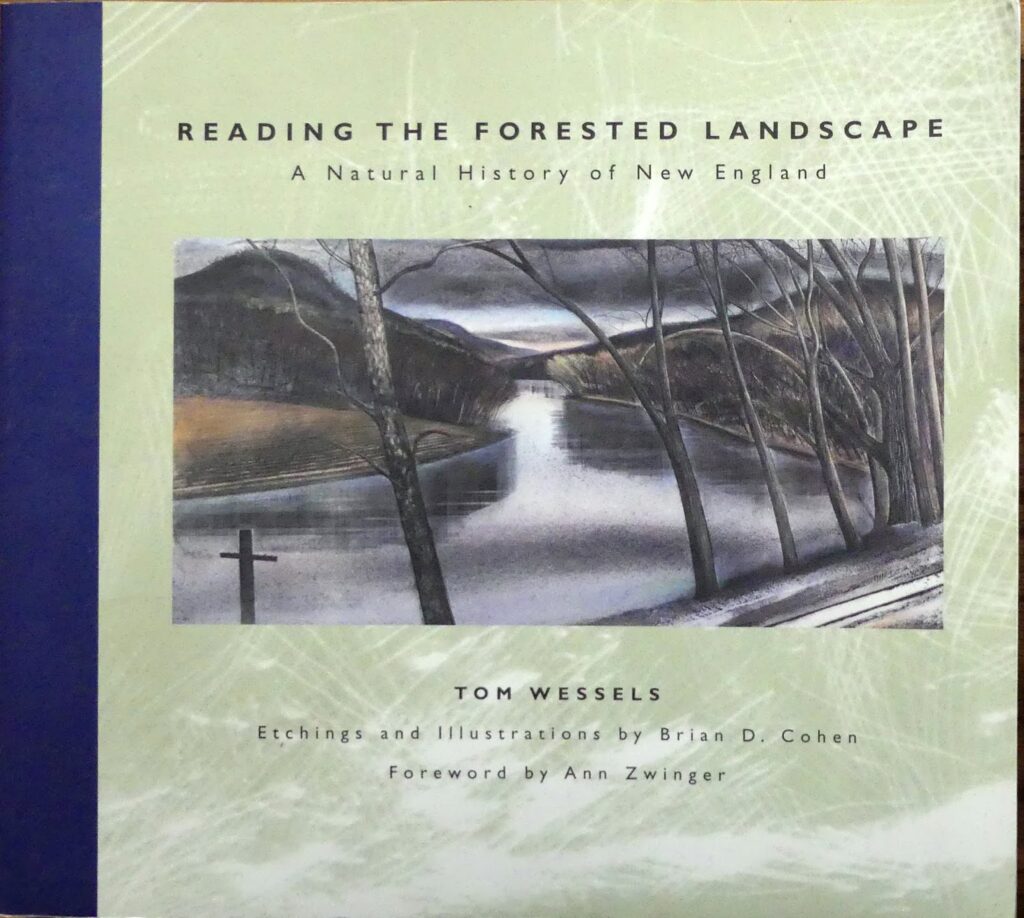
Reading the Forested Landscape: A Natural History of New England, by Tom Wessels

Tom Wessels’ book helps me understand what I’m looking at when I examine the woods that come almost up to my porch. Although I live in the mid-Atlantic, we share the same type of forest as southern New England, one of seven types in the U.S. Ours is called the Central Forest. There are differences, but the trees I see from my porch are those I saw in Massachusetts: oak, maple, white pine, honey locust, maple, ash. We also have sweet gum and black walnut, which are not found up north, or at least not yet.

This is not a tree identification book, however. It’s more like a magic decoder ring. It gives the information you need to look at a patch of woods and make a pretty good guess at what it looked like 100 years ago and what has occurred to disturb it in the meantime.

Wessels sets up each chapter as a mystery, starting with an etching of a forest by Brian D. Cohen and then pulls out the clues that tell us what has happened there. Was it once a pasture or farm that was left to reforest itself? Has it been logged, and if so, how many times? Has there been a hurricane or a forest fire? Have the trees been affected by blight? What do the trees tell us about the soil and topography?

At the end of most chapters, he takes a look back at the historical context of the disturbance. For example, in precolonial New England, Native Americans used fire as a forest management tool. They burned the litter on the ground and low-growing vegetation to control insects and make it easier to move silently. “These precolonial, fire-managed woodlands looked dramatically different from New England’s present forests. They were parklike, with massive hardwoods creating a canopy over forest floors carpeted with grasses and berry bushes.”

However, the diseases brought by settlers decimated the Native American population, whose knowledge was then lost. “Within fifty years of the landing at Plymouth Rock, the Native American, fire-managed ecosystems of southern New England became a memory,” replaced by the dense, almost impenetrable forest that I see from my porch.

There are also fascinating nuggets buried in this irresistibly engaging book. For example, in the last major gypsy moth outbreak in central New England in the summer of 1981, scientists found that “the oak trees not yet attacked by the gypsy moth larvae changed their leaf chemistry, apparently in anticipation of the approaching insects.” The trees were communicating with each other using an airborne chemical message (jasmonic acid).

This discovery reminds me of another book I’ve heard of but not yet read: The Hidden Life of Trees: What They Feel, How They Communicate — Discoveries From a Secret World, by Peter Wohlleben. A German forest ranger, Wohlleben explains that trees are social beings, working together in networks and sharing resources. I’m looking forward to reading this book.

Now when I stand on the porch, I can read the history of the trees in front of me. More than that, I’m aware that what I see are not the separate individual trees I’ve always thought them, but rather a community. These trees are talking to each other in ways that I cannot decipher.

What book has changed your view of the natural world?

Anything That Burns You: A Portrait of Lola Ridge, Radical Poet, by Terese Svoboda

9781936182961_p0_v2_s192x300

How could I have never heard of Lola Ridge before? A central figure in Modernist poetry, she seemed to know everyone: from Robert Frost to Amy Lowell to H.D. Praised by people like Stephen Vincent Benét and Louis Untermeyer, she was considered one of the top American poets. Her fiery poems describe the real life of immigrants and others struggling to get by. A lifelong anarchist, she was devoted to the ideal of personal and artistic freedom. She worked for years with Emma Goldman and participated in many political protests, including the outcry against the Sacco and Vanzetti executions and the railroading of Tom Mooney.

I have become accustomed to the way once-popular artists and activists disappear from the cultural consciousness. I have heard the argument that the guardians of the Western canon needs to let go of the belief that only white men can write lasting literature, and add more women and minorities (and new majorities!). I’ve shaken my head at the way hysteria around World War II and McCarthy’s reprehensible anti-Communist tactics attempted to wipe out the memory of the social reformers, labor activists, anarchists, socialists and, yes, communists who were active in the first half of the 20th century. But I’m still surprised that I’d never heard of such a prominent figure.

This biography rescues Ridge from history’s dustbin. Svoboda embeds us in her life, from her birth in Dublin in 1873 through emigration to New Zealand as a child, then to Australia, and finally to the U.S. in 1907 where she mainly lived in New York City. Her travels didn’t stop there though. Always on the edge of bankruptcy and starvation, she scrounged money for trips to Mexico, Baghdad, Taos, and California. She was awarded residencies at Yaddo and the MacDowell Colony.

And always she wrote poetry. By including so many poems and fragments of poems, Svoboda give us what is truly a writer’s story: Ridge’s experiences and convictions drive her fierce work that captures the lives of the poor and disadvantaged, the dreams that possess them and the forces that beat them down. Here is a poem from her first collection The Ghetto and Other Poems:

Debris
I love those spirits
That men stand off and point at,
Or shudder and hood up their souls—
Those ruined ones,
Where Liberty has lodged an hour
And passed like flame,
Bursting asunder the too small house.

Described as fragile and intense, Ridge often invoked images of fire in her work. She went on to publish three more collections, each more popular than the last. She won awards like the Guggenheim, and edited the avant-garde magazines Others and Broom, as well as Margaret Sanger’s magazine on birth control. While editing Others and afterwards, she hosted weekly soirées in her one-room apartment to discuss art and freedom. These lively gatherings drew famous and not-so-famous writers and artists and activists, including William Carlos Williams, Hart Crane, Marianne Moore, Man Ray, Alfred Kreymborg, Mitchell Dawson, Jean Toomer, John Reed, Louise Bryant, and Evelyn Scott.

The New Critics, who rose to ascendancy during WWII and afterwards, insisted that poetry should not be political in any way and claimed that women, with their overactive emotions and weak intellect, were unsuited for writing anything but love poetry. Perhaps, then, it is no surprise that Ridge’s poetry, so famous in her lifetime, sank into obscurity after her death in 1941. Svoboda compares the way Ridge’s influence on Crane and others has been lost to the way few today know of how TS Eliot drew on Hope Mirrlees’s Modernist masterpiece Paris while writing The Waste Land.

I hope that Svoboda’s biography helps to bring her back into the light.

What early 20th century poet fires your imagination?

Disclosure of Material Connection: I received a digital copy of this book free from the author. I was not required to write a positive review. The opinions I have expressed are my own.

On Wings of Song: A Journey into the Civil Rights Era, by Molly Lynn Watt

41RcvTm+xnL._AA160_

Molly Lynn Watt’s latest poetry collection is a memoir of her work in the Civil Rights movement in 1963. It compellingly captures the time and the emotions surrounding it, the dangers and the innocence.

The book opens with a few poems describing incidents from her childhood that introduced this New England girl to racism and Jim Crow. The bulk of the book is made up of poems describing a time in the pivotal year of 1963 when she and her husband and two toddlers went to Tennessee to lead the new Highlander School, dedicated to training interracial volunteers to register voters in the South.

Traveling through the South, they are exposed to Jim Crow in chilling incidents. Their integrated caravan is refused service at restaurants and gas stations. Worse, they learn that trying to register voters can have fatal consequences.

She captures the fear in terse, direct lines. From “Tonight”, describing their first night at the Highlander School.

fireflies spark by the window
cans rattle in the alcove—
Mr. Tillman Cadle is arriving

we’re weary fake sleep
feel Tillman hover
sense his shotgun over us
throughout the night
Tillman stumbles and mutters
there’s going to be trouble

As it turns out he is the owner of the land, which he’s provided to the school. He’s there to guard them, not harm them, but as the author says later in the poem “Tillman Cadle/knew trouble when he smelled it”. The young family and their friends are about to meet trouble first-hand.

The final section of the book ponders the changes since that time, from her elderly mother’s apology for refusing their phone calls back then to her granddaughter’s refusal to vote, not understanding how fragile and incomplete this armistice is.

Watt says that she chose to write this memoir in poems “to limit my discomfort” in reliving that terrifying time when hatred and prejudice bared their face to her. For a memoir to matter, for it to grab the reader and not let her go, you have to plunge back into the storm, the one you thought you’d come to terms with long ago. The emotions are still there for you to find if you dig deeply enough.

Watt does. Each poem rings true.

There are plenty of other reasons for using poetry to write memoir. Poetry’s concentration of experience into a few lines makes the reader pay attention to every word and has the power to shock us into experiencing a revelation or moment of deep emotion.

Too, poetry’s use of imagery can assuage the author’s fear of revealing too much. Wrapping secrets in metaphor and motif not only gives the reader a tantalizing challenge, but also offers the author a semblance of protection. And a poetry collection, by breaking the story into fragments, mimics the way our memory works: an image here, a bit of dialogue there, a certain smell or glance of light.

Watt’s book is something to treasure, capturing a time and a body of experience that too many now forget. It’s a valuable resource for anyone curious about using poetry to write memoir. Most of all, though, it is a collection of powerful poems that leap from the page.

Have you read a memoir written as poetry? What did you think of it?

Disclosure of Material Connection: I received a digital copy of this book free from the author, who is a friend of mine. I was not required to write a positive review. The opinions I have expressed are my own.

Penelope Fitzgerald: A Life, by Hermione Lee

9780385352345_p0_v1_s192x300

I like to read biographies of authors. When the biography is as good as this one, I like to stop and read the author’s books just before they are discussed. Yes, the works stand alone; you don’t need to know details of the author’s life to appreciate them. But as a writer, I am curious about how her experiences shaped the author’s perspective and choices.

I’ve been particularly curious about Penelope Fitzgerald for two reasons: I’ve loved her novels, and she was 60 years old when her first novel was published. She did publish two nonfiction books, one when she was 58 and the other the same year as her first novel. I wondered how her life story meshed with the stories described so vividly in Tillie Olsen’s Silences.

Indeed, it does. While working at the BBC during WWII, she married Desmond Fitzgerald, whom she’d met at Oxford. Within six months, he’d been sent to North Africa with the Irish Guards. Like so many soldiers, he returned damaged in ways less visible than a missing leg. His misadventures meant that the family lived in poverty, even being homeless for a while before gratefully moving into a council flat. Working to support the family and raise her children left Fitzgerald little time for writing, but she was storing up ideas and experiences that enabled her to produce nine novels and three biographies in just 20 years.

In this rich and readable biography, Hermione Lee gives us not just Fitzgerald’s story, but also a discerning evaluation of her work. Lee incorporates excerpts from Fitzgerald’s speeches and writings: letters, reviews, essays. Without being didactive, she suggests places in the novels where Fitzgerald made use of her experiences. Fitzgerald’s first five novels draw on her own past, but even the later novels reveal traces of past preoccupations and concerns.

Lee gives us the events and people that shaped and influenced Fitzgerald as a writer. For example, knowing that her beloved father, Edmund “Evoe” Knox, wrote for Punch, adds a new perspective to her brisk, humorous prose. Her father and his siblings provided a rich, if unusual, environment for the young writer.

In talking about the novels, Lee traces some common threads, such as, “Bourne-Jones attracted her, too, because she felt a strong imaginative pull towards characters at odds with their world: the depressives, the shy, the unworldly, the emotionally inarticulate.”

Her own experiences enabled her to sympathise with such characters. In an interview, Fitzgerald spoke of “the courage of those who are born to be defeated, the weaknesses of the strong, and the tragedy of misunderstandings and missed opportunities which I have done my best to treat as comedy, for otherwise how can we manage to bear it?”

In her later works, she experimented with an impressionistic style, putting together fragments that push the reader to actively engage with the story. This style is most effectively used in The Blue Flower, her story based on the life of the German Romantic poet Friedrich von Hardenberg, known as Novalis. It is especially effective because it mirrors his own style. In an early notebook, Fitzgerald wrote, “Novalis wrote: One can imagine stories which have no coherence, but only association of events, like dreams, or poems which at most have single verses which can be understood, like fragments of the most various objects.”

Lee pins down another aspect of this novel, saying, “she has been thinking all her writing life about the relation between biography, history and fiction. Now she merges the genres to create a new kind of book.”

What most impressed me in this account of Fitzgerald’s life and work was the incredible amount of research she did for each book, not just for the biographies, but for each novel as well. For Beginning of Spring, for example, Lee says, “there is a great deal of homework in her notebooks on printing works, alongside notes on merchants, railway stations, ministries, churches, birch trees, dachas and mushrooms.” Some extensive reading may only be come a detail, such as the sandstone towers of a market in Moscow.

For me, this remarkable biography sheds new light on Fitzgerald’s novels. Plus I love that it sent me back to read all the novels again.

What biography have you read recently that gave you new insight?

World War One: History in an Hour, by Rupert Colley

As we approach the 100th anniversary of the start of the first Battle of the Marne on 5 September 1914, I want to mention this excellent introduction to WWI. Colley has written a number of these History in an Hour books intended to give you basic information about a subject in an easily digestible form. At only 60 pages and illustrated by photographs, this ebook provides an accessible and accurate primer on the war, from Sarajevo to the Paris Peace Conference. Appendices identify key people and provide a timeline for easy reference.

I've long been interested in this war and have three shelves of books on the subject to prove it. As Colley says in his Introduction:

This, the first ‘world' war, was not just about armies winning and losing battles, but whole populations mobilized for war, at the mercy of the enemy, civilians starved and bombed. It was an industrial war where a country's whole economic output was geared to war; a war of empires that pulled in combatants from nations across the globe. It was a war of land, air and sea, a war of politics, espionage, and also the Home Front. For the first time in history, this was total war.

For me, immersed in the literature of England as I have been all my life, August 1914 was when the world changed. It spelled the end of the British and Ottoman Empires, but more importantly it was when the long enlightenment ended and the modern era began, when notions of duty and honor were replaced by cynicism and disillusionment. At the outbreak of the war, Edward Grey, 1st Viscount Grey of Fallodon, the Foreign Secretary from 1905-1916, said, “ The lamps are going out all over Europe. We shall not see them lit again in our life-time”.

Aside from facts memorised in school, I first came to the war through its poets: Rupert Brooke who died before he could lose his idealism, Wilfred Owen who learned to write a new kind of poetry in the trenches and mental hospitals, Siegfried Sassoon whose satiric poetry reflected his disenchantment, and others, all of whom seemed to know each other.

In “The Send-Off”, Owen wrote:

Down the close, darkening lanes they sang their way
To the siding-shed,
And lined the train with faces grimly gay.
Their breasts were stuck all white with wreath and spray
As men's are, dead.
. . .

Shall they return to beatings of great bells
In wild trainloads?
A few, a few, too few for drums and yells,
May creep back, silent, to still village wells
Up half-known roads.

Once I started going to Europe and visiting the sites, I began reading more widely, memoirs, histories, even a modern guide to the war's locations. I became fascinated by the role played by supply chain logistics, the Spanish Flu pandemic, the Russian Revolution, and the much-delayed entry of the U.S. Reading Timothy Findley's book The Wars brought home to me what wrestling with the mud must have been like. As Colley says of the Battle of Passchendaele, “guns disappeared into it, tanks sunk in it, a quarter of the men killed at Passchendaele drowned in it.” I began to understand J.R.R. Tolkien’s remark that the Dead Marshes where Frodo and Sam saw the faces of the dead looming up at them through the mud and water had their source in the Battle of the Somme.

And of course, the war was not won. It ended with an armistice, which as it turned out, only provided a breathing space until the war resumed as what we now call World War II.

With all I have read, I still found it good to come back and review the facts of the war in this short book.

Which WWI poets have you read?