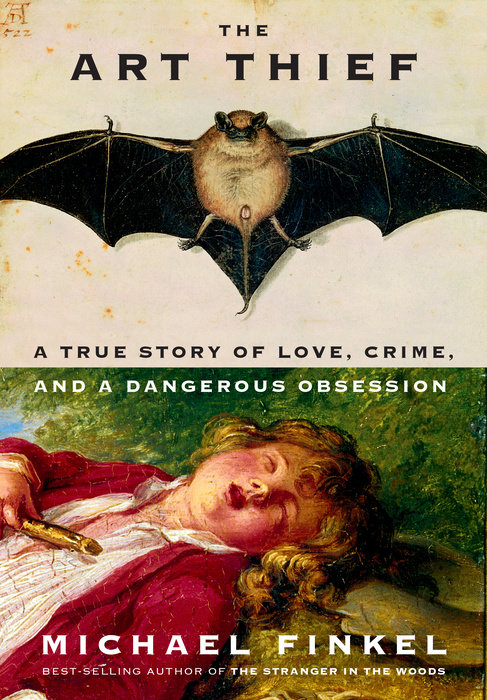
The Art Thief, by Michael Finkel

Why would a young man commit over 200 heists, stealing artworks and stuffing them into his attic bedroom? Finkel investigates the true story of Stéphane Breitwieser who stole nearly $2 billion worth of art—paintings, sculpture, tapestries, etc.—mostly from small museums that couldn’t afford a lot of security. Unlike other art thieves, he didn’t do it for the money. He claimed he did it to surround himself with beauty.

The first pieces he carefully displayed in his bedroom in the attic of his mother’s home in the French city of Mulhouse, but he couldn’t stop stealing and his loot began to pile up, as in any other hoarder’s lair. Breitwieser had no friends and didn’t work, but he did have a girlfriend who helped him pull off his heists.

Finkel’s earlier nonfiction book The Stranger in the Woods, about Chris Knight who spent 27 years living alone in a tent in the Maine woods, surprised me. Though curious to know a little more about Wright, I thought the story wouldn’t be substantial enough to fill a book—a feature article in a magazine, sure, but not a book. I was wrong. The depth of Finkel’s research, including in-person interviews with Knight and forays into the lives of the solitaries, kept me reading. I couldn’t help but catch his fascination with and curiosity about his subject.

Similarly here, Finkel keeps up the suspense to the last page. My book club all expressed their surprise at how spellbound they were by Finkel’s in-depth character study and by the artworks themselves.

We do have artists among us and all of us appreciate art. We’ve visited museums large and small, recognising sadly how scanty the security measures often are at the latter. How could they afford more? I remember many a small museum in Europe where, after paying a small fee at the door, I was free to wander about, no guards in the rooms and few other patrons.

We were also compelled by curiosity about Breitwieser himself. What kind of person would commit such selfish crimes? Not only did he endanger the art by taking it out of its controlled environment, but he hid it where only he and his girlfriend could enjoy it, denying the rest of us access. We were also interested in the two women who enabled him, the girlfriend who actively assisted him and his mother who pretended not to see what he was taking upstairs.

We called on the experts on law and psychology among us and speculated about his pathology. We all thought him such a strange person to act this way. But when we considered all the people these days who are greedily grabbing whatever attention, power, and money that they can, without the least regard for other people’s feelings, much less our lives and well-being—well, he’s not so strange after all. 

Also, while we deplored the thefts, we did feel a twinge of sympathy. A funny thing happened near the end of our discussion. One person admitted that every time they visit a museum she and her partner played a game of identifying which piece they wished they could take home with them. Several of us admitted to doing the same; I added that I usually tried to find a postcard of my chosen piece in the museum gift shop. We had a good laugh about how narrow the line is between our art appreciation and Breitwieser’s thefts. Yet it is a line none of us would ever consider crossing.

And therein lies the value of stories such as this. We’re not so different as we might think. Yet that difference is an important one.

What true crime story have you read that surprised you?
Best Books I Read in 2025

As a writer, I learn something from every book I read. In no particular order, these are twelve of the best books I read in 2025. Please check the links to the blog archive for a fuller discussion of those I’ve reviewed.

Fiction

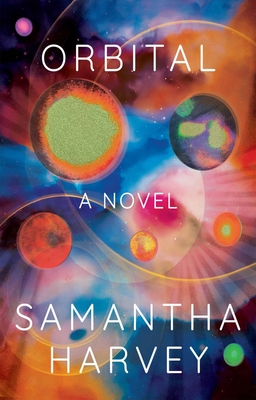
1. Orbital, by Samantha Harvey
Put six people from five countries into the International Space Station orbiting Earth and leave them there for several years. Now write about a single day, which encompasses sixteen orbits, meaning sixteen sunrises and sixteen sunsets. I immediately imagined around a dozen different stories that could come out of this premise. I never imagined Samantha Harvey’s Orbital.

2. The Painter of Silence, by Georgina Harding
In 1950s Romania a nurse named Safta recognises a new patient as her childhood companion. They’ve been separated by the war and the years and the changes wrought by Stalinist rule. Deaf and mute, Tinu only communicates through his art. This is the novel I have been waiting for. Hoping for. It is quiet and asks much of the reader as it unfolds.

3. In the Fall, by Jeffrey Lent 
In Virginia during the last days of the Civil War, a wounded Union soldier becomes separated from his comrades and is found near death by an escaped slave who saves him. Norman Pelham and Leah Mebane become inseparable and, after he is demobilised and they marry, the two decide to walk to his home in Randolph, Vermont. This story of three generations of Pelhams made me forget everything else in order to finish it.

4. The Summer Book, by Tove Jansson
The twenty-two chapters that make up this brief novel combine surprisingly poignant discussions between two women, one very young and one very old, with closely observed details of the natural world  on a tiny island in the Gulf of Finland. The chapters are deceptively plain yet leave the reader aware that each seemingly normal summer adventure holds a deeper meaning. Jansson’s simple and direct language leaves a silence similar to the white space around a line of poetry, space where a reader can bring forward her own memories.

5. Mrs. Dalloway, by Virginia Woolf
Reading this classic novel now, more than fifty years since I first encountered it as an undergrad, is quite a different experience. Back then I was confused and thrilled by Woolf’s modernist, experimental style that expanded forever my idea of what a novel could be. Now I see it as a story of midlife, in several senses of the word.

6. Middlemarch, by George Eliot
What stood out to me on rereading this classic is the theme of what it means to live a good life. By that I mean a life of integrity, one we can be satisfied with when we lie on our deathbeds. In Middlemarch we have all these lives, all of these people intending to do the right thing yet derailed by temptations and compromises and the pressures of daily life. As we follow each storyline, we get to see various permutations of what a good life might look like—or not.

7. Birds of Paradise, by Paul Scott.
A reread of one of my favorite books, I found this story of William Conway looking back and trying to make sense of his life as good as I remembered. Conway revisits people and memories from his childhood in India during the Raj, his English education, and his suffering in a Japanese prison camp during WWII. So much is obscured in our lives, so much we don’t understand at the time.

8. Brother of the More Famous Jack, by Barbara Trapido
I looked for some light reads this year and this one really tickled me.

Nonfiction

1. A Woman in the Polar Night, by Christiane Ritter
In 1934, the painter Christiane Ritter leaves her comfortable life in Austria to join her husband Hermann for a year in Spitsbergen, an island in the Svalbard archipelago, which lies between mainland Norway and the North Pole. Ritter’s journal summons the experience of surviving such a punishing climate and its surprising rewards.

2. Spell Freedom: The Underground Schools That Built the Civil Rights Movement, by Elaine Weiss
This well-researched and engaging book tells the story of some of the less well-known leaders of the Civil Rights Movement, courageous people who came before the famous speeches and laid the foundations for the Movement’s success by creating the citizen schools that prepared Black Americans in the Jim Crow South to register to vote.

3. Ghostland: In Search of a Haunted Country, by Edward Parnell 
A fusion of travelogue, literary review, and memoir that reminded me of (and mentions) W. G. Sebald’s Rings of Saturn, it sent me off to read many of the books I didn’t already know. And I discovered a story that sent me to the heart of something that has haunted me for a while.

4. The Lost Words, by Robert MacFarlane and Jackie Morris
When the Oxford Junior Dictionary was updated, it was found that around forty common words had been dropped—all of them words to do with nature. In response, MacFarlane and Morris came together to create what they call a spell book to help young readers rediscover the natural world, believing that unless we experience and learn to love the world of nature around us, we will not work to save it. This is the most beautiful book I’ve seen in a long, long while.

What are the best books you read in 2025?

Spell Freedom, by Elaine Weiss

Many people contributed to the success—partial as it was—of the Civil Rights Movement of the 1960s. We’ve all heard the names of the famous leaders, their words and deeds. In this book, subtitled “The Underground Schools That Built the Civil Rights Movement,” Elaine Weiss tells the story of some of those we haven’t heard of, courageous people who came before the famous speeches and laid the foundations for success by creating the citizen schools that prepared Black Americans in the Jim Crow South to register to vote.

These unsung heroes had to start the school in secret, sometimes in the back room of beauty parlor, and create their own materials, adapted to the needs of an illiterate or barely literate adult population. Weiss doesn’t shy away from the difficulties, the terrible repercussions they all risked from a South wedded to White Supremacy.

Participants in the schools learned not just how to read and write, but also how to decipher the voter registration literacy tests intended to keep them from voting. They also learned what their rights were and gained the confidence to exercise them. By the time the Voting Rights Act passed in 1965, these secret schools had spread across the South, helping thousands of people register to vote.

I came to this book reluctantly when it was selected by my book club for this month. I figured I already knew about the Civil Rights Movement. I couldn’t miss it, growing up in Baltimore in the 1950s and 1960s. And then there are all the books, articles and discussions I’ve absorbed since. Yet once I started reading, I was hooked. And as it turns out, most of the book was new to me.

Weiss begins with the 1954 Brown v. Topeka Board of Education ruling that said racial segregation of public schools was unconstitutional. She shows how that news was received by Septima Clark, a 56-year-old teacher from South Carolina; Esau Jenkins, a Sea Island aspiring businessman and bus driver; and Bernice Robinson, a beautician from Charleston. The three of them understood that doing away with segregation would take work, dangerous yet necessary work.

Septima Clark came to the Highlander Folk School in rural Tennessee, a training ground for labor organizing created by Myles and Zilphia Horton that was pivoting to support civil-rights activism. Initially mistrustful of the fully integrated school, Mrs. Clark was shocked to share a room with a White person and sit at a table with White people for the first time. Yet the vision of White and Black people working together day after day to come up with practical plans for challenging segregation is one that would stay with her and encourage her for the rest of her life.

She brought Mr. Jenkins and Mrs. Robinson to Highlander. The compelling portraits of these three unlikely leaders fuel the story: ordinary people doing extraordinary things. The writing is clear and compelling; Weiss transforms her extensive research into riveting stories. We do meet the famous leaders in these pages but usually in the context of these unsung heroes.

Weiss also doesn’t shy away from the movement’s internal struggles and the sexism of its leaders. Most of all she brings home to the reader the terrible dangers faced by these teachers and organizers, as well as by everyone sitting in at a store counter or trying to register to vote. They are fired from jobs, kicked out of their homes, beaten and shot.

We need their stories today. We need to remember how hard they had to fight for the right to vote—now in danger once again—and that they did win again and again. We have much to learn from Mrs. Clark, Mr. Johnson, and Mrs. Robinson: the way they organised within their communities, found creative ways to help people, and got up each time they were knocked down.

Elaine Weiss kindly came to our book club meeting and proved to be a fascinating speaker with a sure command of her material. She said that her interest in this story began when she heard of the March 2019 firebombing of the current Highlander Center, complete with White Nationalist symbols. She wondered what this place could be doing that it should still be such a powerful symbol. 

Then she was curious about people like Septima Clark, whom most people haven’t heard of. She found a brief autobiography, Ready from Within, that Mrs. Clark wrote of her early life and an academic biography, Freedom’s Teacher, that focuses on her teaching techniques. In her research, Weiss was shocked by the systematic oppression and the economic punishment for attempting to vote. She reminded us that Septima Clark was financially insecure for the rest of her life; her friends had to get together to pay for her grave marker.

I hope many people will read this book. There is so much that will fire your imagination and strengthen your resolve in these dark times. Elaine Weiss said that in tough moments she often thinks What would Septima do? From now on I will, too.

Where are you finding courage these days?

Incidental Inventions, by Elena Ferrante

“I have to say that I write with greater dedication when I start digging into common, I would almost say trite, situations and feelings, and insist on expressing everything that—out of habit, to keep the peace—we tend to be silent about . . . I’m interested in the ordinary or, rather, what we have forced inside the uniform of the ordinary. I’m interested in digging into that and causing confusion, pushing myself to go beyond appearances.”

That’s Elena Ferrante in her essay “Digging,” one of 51 brief essays in this collection. Originally published in the Guardian every week for a year, she wrote them in response to a question from an editor. This was at her request, because she “had no experience with that type of writing” and was both “flattered” and “frightened.”

Oddly enough, that’s the same way Jan Struther (AKA Joyce Maxtone Graham) wrote the Mrs. Miniver columns. When the London Times wanted her to write a column about ‘an ordinary sort of woman – like yourself,’ she asked them to provide a question or prompt.

I did not expect much from these essays, each only about 500 words. And yet I found myself reading the next and the next, unable to stop until other voices called me away. Part of what makes them so addictive is that for all she talks about constructing a public image—“[Daniel Day-Lewis] is a sort of title by which I refer to a valuable body of work . . . If he should suddenly be transformed into a flesh-and-blood person, poor him, poor me.”—and for all she conceals her own identity, there is an openness in her writing that makes me believe she is opening her most secret self and telling the truth.

She writes about keeping a diary and why she avoids exclamation points, about lying and insomnia, about long marriages and her fear of plants. She writes about the positive side of change, and yet “We cannot tear off what once seemed to be our skin without pain; something endures and resists.” She writes about her favorite film and why it “seduces and sometimes scares me.” And every now and then she talks about writing.

In her introduction, she says she usually writes by “putting one word after another . . . what I find at the end—assuming that I find something—is surprising, especially to me. It’s as if one sentence had generated the next, taking advantage of my still uncertain intentions.” Yet here, constrained by time and space, she “rummaged through memory in search of small illustrative experiences; impulsively drew on convictions formed by books read many years ago . . . pursued sudden intuitions . . .”

And yet, each essay is tightly constructed. They begin with a clear statement such as: “I was a terrible mother, a great mother.”  Or “Stereotypes are crude simplifications, but generally they don’t lie.” Then we are off into memories and thoughts until a punchy last line, such as “We’ll always know too little about ourselves.”

These are the two sides of writing: the mystery of how one word or thought leads to another with sometimes surprising results and the careful crafting of that hot mess into a clear and cogent whole. She says:

My effort at faithfulness [in writing] cannot be separated from the search for coherence, the imposition of order and meaning, even the imitation of the lack of order and meaning. Because writing is innately artificial, its every use involves some form of fiction. The dividing line is rather, as Virginia Woolf said, how much truth the fiction inherent in writing is able to capture.

She admits that “The yearning to give written form to the world isn’t a guarantee of good literature.” Also, even when our efforts succeed, “We remain dissatisfied and, successful or not, the writing will continue to remind us that it’s a tool with which one can extract much more than we have been able to.”

Still, the energy that drives these essay, and all of her writing, is “the wonder—the wonder of knowing how to read, to write, to transform signs into things.”

The illustrations by Andrea Ucini at the start of each essay are not only charming, but also add another layer to the piece. The cover illustration of a woman peeking out from among the pages of a book is the one for “Keeping a Diary.”

What draws you to Elena Ferrante’s writing?

The Real Mrs. Miniver, by Ysenda Maxtone Graham

The Real Mrs. Miniver, by Ysenda Maxtone Graham

We’ve seen the movie, of course, and thought it a sentimental film about a woman who is practically perfect in every way keeping her family together and holding the home front together during the Blitz—the bombing of London during WWII. The book the film is based on, a collection of columns from the London Times, was something else altogether: an idealised portrait of an ordinary upper middle class woman’s life in pre-WWII England.

Those columns were written by Joyce Maxtone Graham (née Anstruther) using the name Jan Struther, and she modeled the family on her own husband and three children. However, as we learn from this biography by her granddaughter, the loving Miniver family was a far cry from Joyce’s own. Her marriage to Tony Maxtone Graham, initially fun-loving and amusing, had dried up as he’d been taken hostage by golf, leaving Joyce to her articles and poems many of which were published in Punch among other periodicals.

Joyce had been a tomboy as a child, loathing the ceremonial tea parties and dance lessons, preferring to run and shoot with the boys. She and Tony initially shared a comic view of the world. I loved the way they shared the silly things they noticed during their days: pebbles, as she called them, like children turning out their pockets at the end of the day. As they drew further apart, Joyce fell deeply in love with Dolf Placzek, a penniless Jewish refugee from Austria gifted with intelligence and a strong appreciation for the arts.

The Mrs. Miniver columns depict a happy, loving marriage that was a far cry from what Joyce’s had become. Yet for many, those columns embodied an England that was being destroyed by the war and a reminder of what they were fighting for. Mrs. Miniver’s upper middle class life was comfortable, with a London house and a weekend cottage in Kent, a son at Eton, and servants to do the chores. The columns contain the small things she notices during the day, some pleasurable, some not—like the pebbles she and Tony used to exchange. While Mrs. Miniver could be critical of her social circle, she was alive to its charms.

Joyce—now Jan all the time—was shocked by the surprising success of the book and the reading tours and talks that followed. She came to be haunted by Mrs. Miniver. Many fans assumed they were the same person. She struggled to finding a firm place to stand.

Of all emotions, she perhaps felt the emotion of missing most acutely. At a party, she missed solitude. Abroad, she missed home. Cut off from her children, she longed to be with them again. When she was, she longed again for solitude. The raggle-tangle gypsy in her head beckoned her to escape.

Why read biographies? In my twenties I read lots of biographies of women writers and artists, looking for inspiration during a time when women were second-class citizens when it came to the arts. I was also looking for ideas for how to write while wrangling two babies and an ex who refused to contribute. Just keeping the heat on and some kind of food on the table was a miracle. Forget about finishing a story and sending it out.

These days I still look for inspiration from brave women and men as I struggle with how to live a moral life in an increasingly compromised and chaotic world. I’m especially drawn to women living during dark times. I’m also interested in the wide range of life choices people make. One thing that is so fascinating in this book is the contrast between the life of Mrs. Miniver—a model for womanhood at the time—and that of the woman who created her.


Sometimes with a biography, it is enough to see myself in a reckless tomboy unwilling to knuckle under to social norms or an almost accidental writer. Now if only I can catch the zeitgeist the way Jan Struthers did! Perhaps it’s better I don’t. Her story is yet another cautionary tale of how too much success and celebrity can wreck a person.

It’s been difficult lately to find books that hold my interest. My reading record is full of DNFs. This one, though, fascinated me and kept my attention right through to the end. Jan reinvented herself several times over, which I find wonderful. And she changed the course of history, inadvertently perhaps and not alone, but for sure. What kind of world would we be living in today if the U.S. had refused to join the Allies fighting Hitler and Mussolini in Europe and Africa?

I take courage from her story and the stories she wrote about the ordinary people of Britain as we fight today’s fascism.

Have you read a biography that inspired you?

Rain, by Melissa Harrison

While rainy weather sends most people indoors, Harrison suggests that “if you only ever go out on sunny days you only see half the picture, and remain somehow untested and callow.”

In this quiet gem of a book, she takes us on four walks in the rain in different parts of England. In January we visit Wicken Fen in Cambridgeshire; Shropshire in April; the Darent Valley in Kent in August; and Devon’s Dartmoor in October. Different landscapes, different seasons, yet all of them reveal how our world is different in the rain, as well as its effects on us.

For some of us, rain induces a pleasant melancholy; one friend of mine calls it a blown-flame mood: not the thrill of fire but the lingering scent that turns us inward. Memories open like petals, and the past is no longer a foreign country.

Wet weather offers other rewards to walkers willing to brave it. Aromas become more intense: The difference between walking in a pine forest in dry or wet weather is astounding. Some creatures emerge while others hide. The air may be softer on your skin, the sounds more mysterious.

When the Kent sky—already overcast—darkens, it does so suddenly. A restless wind gets up, bullying the muggy August air so that the ripe wheat shifts uneasily, gusts pushing its golden surface this way and that like a nap . . . The downpour that follows seems to fall with more force than mere gravity could provide, and as lightning flickers—first distantly, then much closer—and thunder renders the sky, I weigh the risks of standing beneath the bankside trees against the discomfort of getting drenched.

Harrison explores the way rain transforms the landscape whether it be by storms or floods or the minute trickling of drops upon stone. She calls our attention to the way minerals create soil from which grow the plants and trees that support insect, bird and animal life.

The old drystone walls bounding the road where we walk are shaggy with moss and dog lichen and pinned with medals of pennywort and the delicate buttonholes of maidenhair spleenwort, all beaded silver with rain. A few paces ahead of us a stonechat perches on the top of the wall and flicks his wings insouciantly. The call he makes echoes almost exactly the clash of wet pebbles loosed from the disintegrating road surface under our boots.

As a genre, travel writing encompasses a wide range of formats. Most commonly its purpose is to encourage readers to visit places near and far. These pieces could be simply description of a place with suggestions for dining and lodging.  They could highlight single endevours such as a farm that offers field-to-kitchen cooking classes. Or they could be a biography of the place, so to speak, incorporating history and legends, famous and not-so-famous residents, hidden gems and well-known sites which come together to portray the personality of the place.

Travel pieces may also be a story about the author’s particular experience there, their exploration and encounters with places and people and how they are changed. I’m thinking of Colleen Kinder’s Letter to a Stranger: Essays to the Ones Who Haunt Us and associated website. Or a  travel book can be a record of the travels of the author’s mind as they move through the world, as in W.G. Sebald’s The Rings of Saturn.

Fusion with memoir is common because our experiences are grounded in certain locations, such as in Martha Gellhorn’s Travels with Myself and Another or Edward Parnell’s Ghostland which combines travel with literary review and memoir. With fiction, as well, we sometimes say the location is a character in the story.

This gentle series of four walks is none of these. To me it felt like a guided meditation, as though the author simply invites me along on a walk with her. Look over here; feel this leaf; does this remind you of something from your childhood?

In amongst the luminous descriptions are tidbits of history, poetry, memory and story. I especially enjoyed hearing about the volunteer-driven British Rainfall Organisation, “a quintessentially eccentric body and one of the first examples of what we now call ‘citizen science’.” Harrison also incorporates legends and folklore, such as the belief that thunder on Sunday portends the death of great men but on Monday the deaths of women.

She’s fascinated by local dialect and includes an appendix of 100 Words Concerning Rain as well as a Glossary of Meteorological Terms for Rain and a Bibliography.

This short (less than a hundred pages) and lovely book is one I will return to often. It reminds me of the many walks I’ve taken in England and elsewhere, and encourages me to be more attentive to the world around me, not just the natural world, but the glimmers of history and memory that it evokes.

Have you read a travel book or piece that stood out to you?

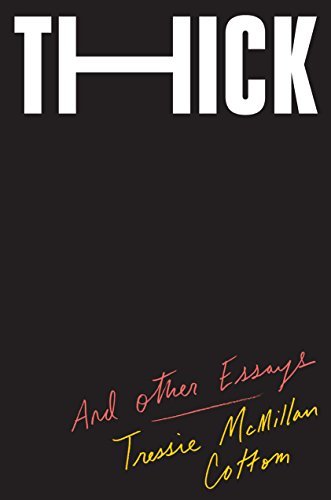
THICK and Other Essays, by Tressie McMillan Cottom

Reading this collection of essays has been like sitting down with a friend and asking, So tell me—what do you really think? Cottom draws on her academic training and her lived experience to create pieces that blur the line between sociology and personal essay. One editor said she was “too readable to be academic, too deep to be popular, too country black to be literary, and too naïve to show the rigor of my thinking in the complexity of my prose.”


If in her academic life she is chided for her popular success on social media and for using herself as a subject, she responds that “The personal essay had become the way that black women writers claim legitimacy in a public discourse that defines itself, in part, by how well it excludes black women.” Writing about your personal experience is a way in because your authority about your own self cannot be denied. Also, by its very form the personal essay invites empathy from readers.


I was, like many young women, expected to be small so that boys could expand and white girls could shine. When I would not or could not shrink, people made sure that I knew I had erred….[I was] thick where I should have been thin, more when I should have been less.

She writes about black women’s (and girl’s) problems, ones that are too often dismissed by others, in lucid prose that invites you into the conversation. But don’t be fooled by the casual tone. Yes she can be snarky and funny, but she can also pull out the statistics to support her statements and references to the work of other academics and deep thinkers. I often found myself setting the book aside between essays to follow the links in the endnotes for more detail.


I especially appreciate that she keeps probing at an issue. For example, in “Dying to Be Competent” she starts from our common desire to be able to manage our own lives, despite the fact that much of what happens to us is unpredictable and outside of our control. She goes on to tell a heart-wrenching story of trying to navigate the healthcare system, and the shock that despite her academic credentials and middle-class status markers, she has to fight for treatment and medication because the staff assume that she is incompetent and ignorant and thus can be ignored.


All this is presented in a cool tone and then buttressed by study after study about the high mortality rate of black women giving birth in the U.S., as well as by the example of what even celebrity tennis superstar Serena Williams had to go through to get a needed treatment, one that likely saved her life.


But Cottom doesn’t stop there. “Sociologists try to figure out how ideologies like race and gender and class are so sticky . . . The easiest answer is that racism  and sexism and class warfare are resilient and necessary for global capitalism.” A further analysis takes us to Patricia Hill Collins’s idea of “controlling images, those stereotypes that are so powerful they flatten all empirical status differences among a group of people to reduce them to the most docile, incompetent subjects in a social structure.” Such reduction is needed because “This moment of global inequality demands incompetent subjects.”


This is just one example from one essay. If I’ve made it sound like heavy going, believe me when I say that it is not. I read most of the essays twice, just for the sheer delight of following her argument. This is a book that has given me much to think about.


What book or podcast or blog has given you new insight into our culture?


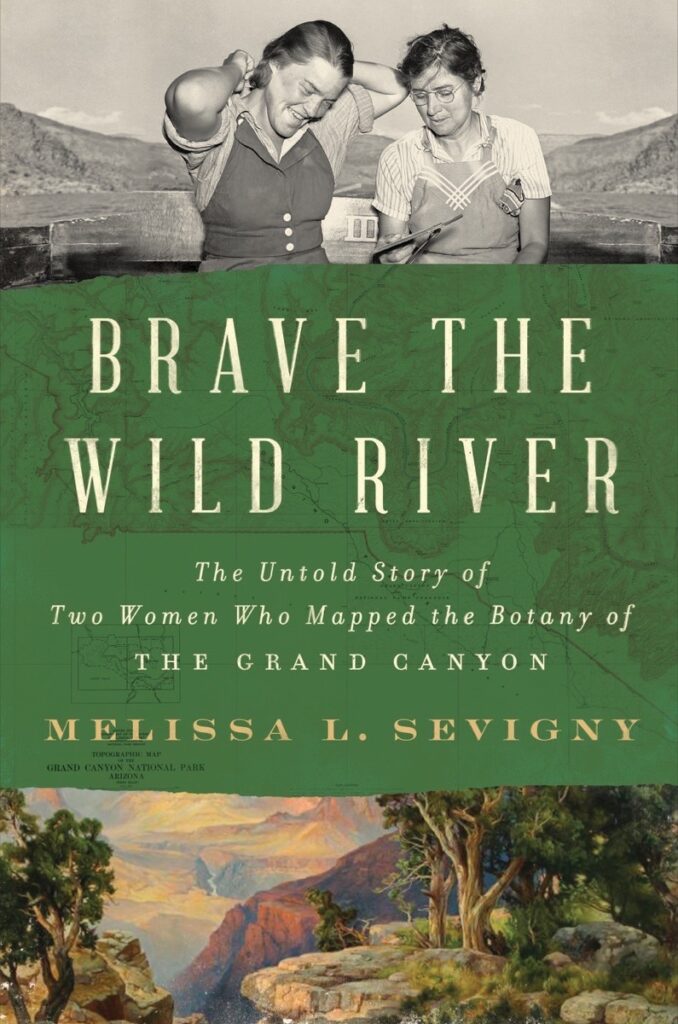
Brave the Wild River, by Melissa L. Sevigny

Subtitled The Untold Story of Two Women Who Mapped the Botany of the Grand Canyon, this nonfiction book rescues a story, misrepresented at the time and now forgotten by all but scientists. In 1938 botanist and University of Michigan professor Elzada Clover and her student Lois Jotter set off down the—at the time—untamed Colorado River with four men in homemade boats.

The women’s goal was to survey the plant life of the Grand Canyon for the first time. Only a very few people had ridden the Colorado—considered the most dangerous river in the world—through the Grand Canyon and survived. The media, of course, went wild over the idea of women going on such an expedition, and throughout the entire experience concentrated on their clothes and appearance, without mentioning botany or the women’s work.

Drawing on the journals of Clover, Jotter and three of the men, as well as her own background as a science journalist, Sevigny has created a thrilling and very human story of these two women and their accomplishments, which botanists and ecologists still rely on today. She brings to life the sensation of entering each new section of the river: the rapids, the soaring stone walls, the way storm clouds seem to boil down into canyons.

The interactions between the group are touched on lightly: the inevitable irritations, the teasing, and the mutual support and little kindnesses that carry the day. While the story concentrates on Clover and Jotter’s experience, the others are presented as well, especially the expedition leader Norman Nevills and Buzz Holmstrom (who did not travel with them).

Holmstrom was one of the few who had run the river and survived and, on hearing of the projected expedition, famously said, “Women . . . do not belong in the Canyon of the Colorado.” However, he came to respect and support Clover and Jotter. He followed their journey and, when possible, provided assistance. Afterwards, he was the only person Clover could talk with about how much she missed the river.

The author also slips in bits of background as needed. Much of the science we take for granted today was still in flux, such as evolution, the great age of the Earth, or the idea that plants or animals could become extinct. Continental drift was first proposed in 1912 was still considered nonsense. Geologists “did not yet believe land masses could unmoor themselves and go rollicking around the planet like bumper cars.”

Sevigny brings out the different ways plant life was being categorized and understood at the time, such as the idea that “plant communities advanced through stages of development to a final, stable stage, which might be forest, prairie, tundra or desert, depending on the region’s climate.” This culmination of this process—called succession—was thought to be a “climax community” which would then never change again. Of course, we see today how that explanation is insufficient, but Clover and Jotter were among the first to advocate a systems approach—what we understand as ecology today.

This is a gorgeous story of courage and camaraderie. Whether you’re looking for a thrilling adventure, an immersion in a strange and beautiful landscape, or a forgotten piece of women’s history, this is a great read.

Can you recommend a narrative nonfiction book about a forgotten piece of history?

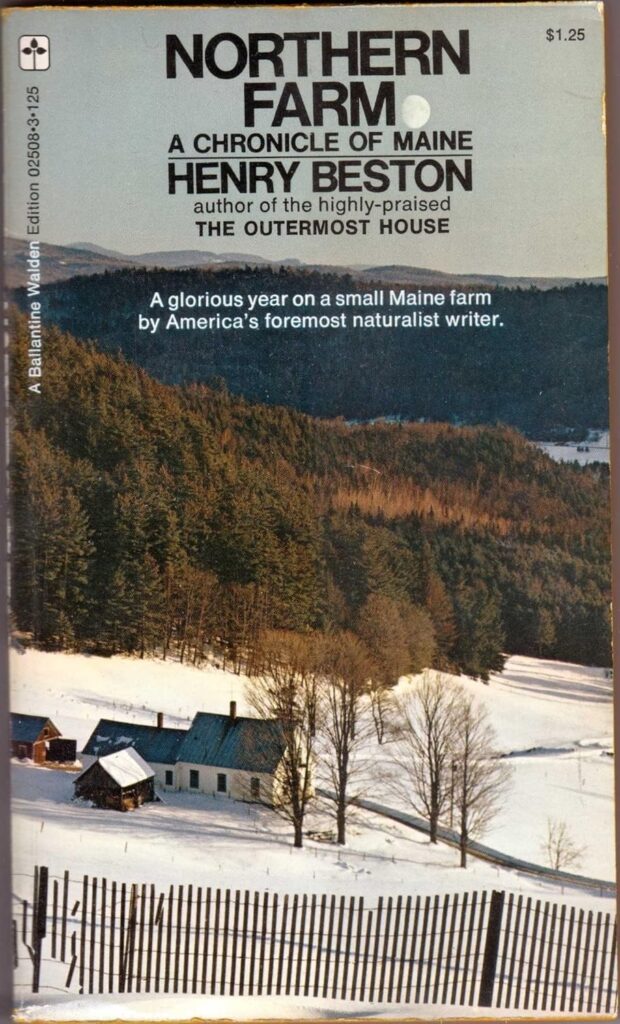
Northern Farm, by Henry Beston

From the writer-naturalist author of The Outermost House, comes an invitation to share in the daily life of a farm in Maine. I found this book so comforting that I stretched it out over a couple of months, only reading one or two short chapters first thing in the day.

Looking for a quieter life than could be found in the Boston suburbs, Henry Beston and his wife, writer Elizabeth Coatsworth, moved to Chimney Farm in Nobleboro, Maine, in the 1930s and lived there for the rest of their lives.

Published in 1948, the book describes a life I thought long gone: heating with wood, using horse-drawn farm  equipment, finding dirt roads impassable in mud season, gathering for community suppers at the grange, and—most heartening—neighbors clad in red-plaid flannel helping each other out with seasonal chores. Yet when I moved to Vermont a few years ago, I found all this and more. Yes, even horses being used instead of tractors on some farms.

Home again from a visit to friends in town, glad to be back where everything doesn’t come into the house along a wire or down a pipe. What a relief it was to get into my farm clothes and have a reasonable amount of physical work to do!

These chapters, which take us through a single year on the farm, originated as a series of country-living columns in The Progressive. Each starts with a few pages full of closely observed description of Beston’s surroundings and often something of his activities that day. Here is an excerpt from a winter walk.

Then, even as I looked, something touched me on the shoulder with a new awareness, and the scene became transformed. The shadows which were but shadows turned to pools of a deep gentian blue, a color tranquil and serene, and the water, which had been but water in snow pool close beside the shadows, became a mirror of some blue and glowing vault of heaven—this other blue being as pure as the first, but perhaps more bright, and with the brightness a measure more delicate. By contrast the sky beyond both the pool and the winter shadows appeared more green. The sun shone, there was no sound, and there I was standing in the road and staring at two of the most beautiful appearances of color in Nature which I think I have ever seen. Only a ridge of purest white snow separated the shadows from the pool.

 It was as if Nature, in the depth of our winter, had called into being the delicate colors of a garden.

That section is followed by excerpts from his Farm Diary, scraps of details that evoke daily life on the land and in the community. Each chapter closes with a paragraph or two of philosophy, sometimes referencing his lifelong theme of cultivating a closer communion with the natural world.

Who would live happily in the country must be wisely prepared to take great pleasure in little things. Country living is a pageant of Nature and the year; it can no more stay fixed than a movement in music, and as the seasons pass, they enrich life far more with little things than with great, with remembered moments rather than hours. A gold and scarlet leaf floating solitary on the clear black water of the morning rain barrel can catch the emotion of a whole season, chimney smoke blowing across the winter moon can be a symbol of all that is mysterious in human life.

I’ve also been reading Braiding Sweetgrass, by Robin Wall Kimmerer, which many of you have probably already read. She draws on her own Potawatomi heritage and her scientific training as a botanist to describe—beautifully—a way of relating to the land and its plants and trees with respect and gratitude.

Both have been a balm during this terrible time, reminding me of the good in people and what is worth defending.

What are you reading to prepare for next month’s Earth Day?

A Time to Dance, No Time to Weep, by Rumer Godden

In my search for comfort reads to give me a rest from what’s going on in our world, I’ve turned to Rumer Godden, whose novels are set in earlier times and places. I’m looking forward to rereading old favorites like The Greengage Summer, and in the meantime picked up this memoir of her early life. I completely ignored the note that it covers the years from her birth in 1907 to 1946, thus landing me once again in the experience of a woman at least temporarily distant from Hitler’s reign of terror.

As Godden sets out to trace the beginnings of her life as a writer and her formative influences, one theme that emerges immediately is the contrast between her charmed childhood in Narayanganj—then part of colonial India, now Bangladesh—and her stints in England. In India, where her father worked as a shipping company executive, children were “left to grow” where in England they were “brought up.” When she and her sister Jon as tweens were briefly sent to their aunts, “[f]or the first time we had to live by rules, strict rules.”

Throughout her life in India, she ignored the privileged cocoon of the members of the British Raj in favor of getting to know the local people. As it turned out, she was thus able to store up experiences she later drew on in her novels. Her unconventional attitude sometimes landed her in trouble, such as when she starts a dance school in town. “In Calcutta’s then almost closed society, ‘nice girls’ did not work or try to earn their living.”

She had to start the dance school because her charming but irresponsible husband had recklessly run up debts that ate up all of her income from her surprisingly successful novel Black Narcissus.  She chose to live apart from him for much of their marriage, her struggles as—essentially—a single parent again taking her outside the bounds of convention.

Godden’s prose did indeed carry me away. Her vivid descriptions of people and places and her extraordinary encounters make the story come to life. She also intersperses excerpts from her diary and letters to capture the essence of the moment.

In 1942, with the war affecting Calcutta, she and her children move to Kashmir as an “abandoned family,” meaning the family of a soldier normally stationed in India but serving abroad in wartime. They were more abandoned than most, since her husband spent all of his pay on himself and couldn’t be bothered with them. The place where the British government housed them in Srinigar was rife with disease, forcing her to take the children first to a houseboat and then to Dove House, a dilapidated building isolated up a steep mountain path.

The path went up to a knoll where a gap in a baked-earth wall served as a front gate; inside the wall spread a garden of terraces and fruit trees which led to a rough lawn and there, set so perfectly that it seemed to nestle into the side of the mountain, was the house. It was built of pink-grey stone with a wooden verandah and a roof of wooden shingles. Beside it the stream fell from terrace to terrace and in front, rising almost as high as a gabled window in the roof, was a magnolia, one of the slender kind that would have white flowers and purple buds.

Their life in Dove House is extremely primitive, since she has almost no money. But in fact that is where she learns the difference between her circumstances and the true poverty of the local people. For example, when winter finally turns to spring, she is so enchanted by the blossoming almond trees that she breaks off a spray to bring home, eliciting a frown from her gardener/car.etaker

“It’s only one spray.”

“You do not know what it is to be poor,” said Nabir Das.

Further experiences reinforce this lesson. As once a single parent living in poverty myself, I felt equally chastened. As we teeter on the edge of catastrophe, I draw strength from remembering how much worse it can be and has been. It may yet be, but for now I’m ready to return to the fight.

What comfort reads have you found? What strength have you drawn from them?