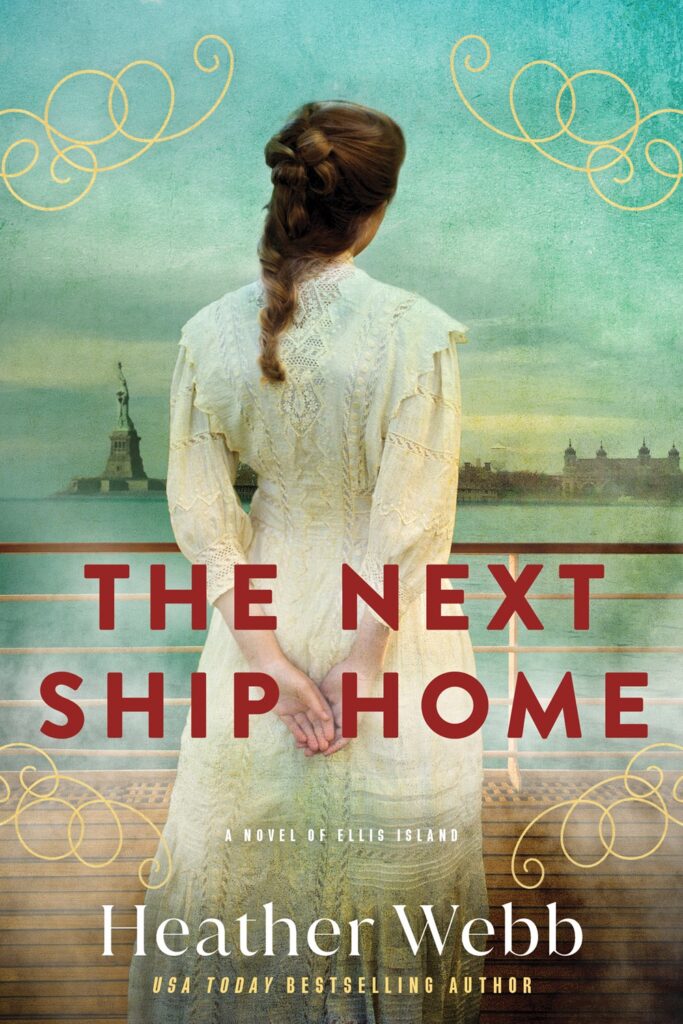
The Next Ship Home, by Heather Webb

Two sisters from Sicily arrive at Ellis Island in 1902 after a nightmare ocean journey. Fleeing their abusive father, they hope to build a new life together in the U.S. However, Francesca worries that her beloved sister Maria will not pass the health exam; she has become ill in the crowded and unsanitary third-class compartment where they were confined. They might both be sent back to Sicily on the next ship.

Meanwhile Alma, a second-generation German-American, lives in a tenement in the Lower East Side’s Little Germany where her stepfather owns and runs a bierhaus in the basement. He thinks Alma is worthless and mocks her interest in learning languages spoken by their Irish and Italian neighbors. Deciding her unpaid labor in the bierhaus and home is not enough, he forces her to take a job at Ellis Island processing new arrivals telling her she must give her pay to him to help support the household.

Although Alma starts her new job filled with the prejudice against immigrants she’s learned at home, her compassion is stirred by the fear and suffering she encounters, and she gradually learns that these are just people like herself. Becoming especially close to Francesca and Maria, Alma works hard at her language skills so she can help by translating for those who don’t speak English. She also tries to find ways around the roadblocks put in place by the bureaucracy and some corrupt officials.

At first Alma doesn’t believe the whispered stories of extortion and abuse at Ellis Island—carefully researched by the author and based on real events—but Francesca has first-hand knowledge of them. The courage of two women and the growing friendship between them are inspiring.

Unlike some historical fiction that glosses over the practical details of everyday life, the author gives us a full picture of these women’s lives. I love that Webb has chosen to portray this neglected but important part of history: the corruption at Ellis Island, the mutual support of the downtrodden, and the dreams that women fight for despite the forces arrayed against them.

The story also follows Francesca after she leaves Ellis Island, providing unusual insight into this critical phase, including the hoops that new immigrants—especially women—must jump through and the traps they must avoid. I’m learning so much these days about the immigration process as I follow the news, so I appreciate the author’s depiction of the inner lives of both Francesca and Alma.

As we confront and protest against the atrocities visited upon legal immigrants in this country by a rogue regime, I found both comfort and inspiration in this story. Corruption and the abuse of immigrants have a long history in the U.S. and Webb’s portrait of the Ellis Island bureaucracy shows the range of workers, from those who actively abuse arriving immigrants to those who look the other way to those who try to help the new arrivals as best they can. At the same time, Webb shows what seemingly powerless people can accomplish by working together.

Can you recommend a fiction or nonfiction book about the history of Ellis Island?
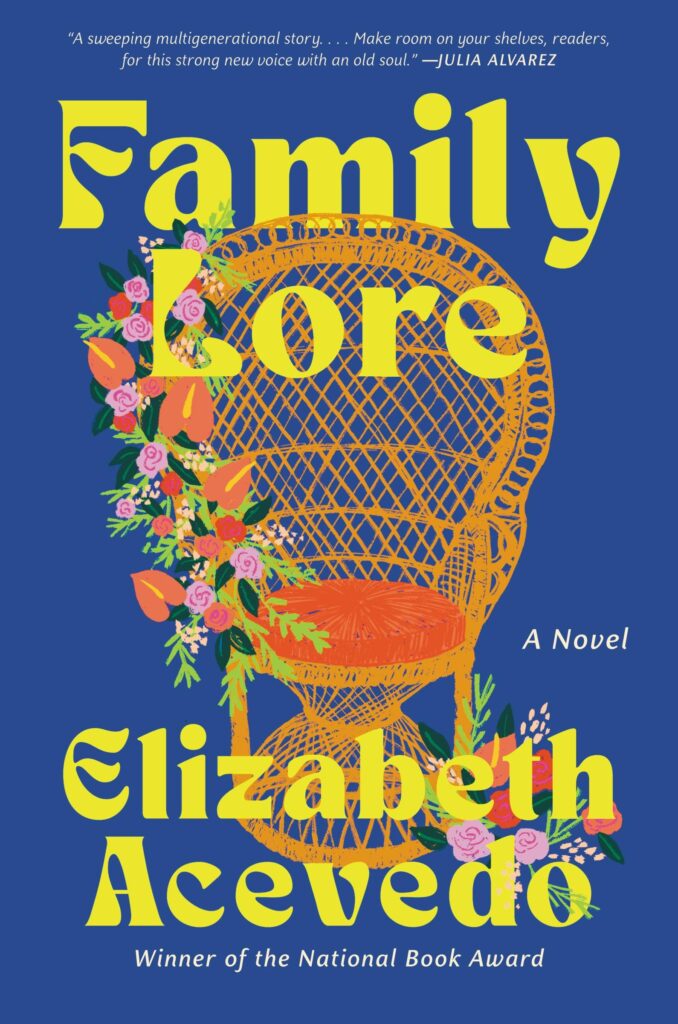
Family Lore, by Elizabeth Acevedo

Seventy-year-old Flor decides to throw herself a living wake, alarming her three sisters because they know Flor has a special gift: she can predict when someone will die. They, too, have special gifts: Pastora can tell whether or not someone is telling the truth, and Camila, the youngest, creates herbal tonics and medicines that always heal.

The occasional narrator, Flor’s daughter Ona, has a magical vagina, and Pastora’s daughter Yadi has a mystical relationship with limes. The oldest of the four sisters, Matilde, doesn’t have a magical gift, but her salsa moves are beyond brilliant, and she loves deeply and loyally.

The first adult book by children’s author Acevedo weaves together the stories of these six women with a sure touch. This enchanted tale moves between New York and Santa Domingo, slipping through time, interleaving English with bits of Spanish. The Spanish was not a problem for me, though I don’t speak the language, because the context clues were sufficient.

Reminding me of early Isabelle Allende, like The House of Spirits, the novel delivers a feast. Little by little, Acevedo fills in the lives of these women, their care for each other tugging against their push for independence.

Normally I struggle with multiple narrators and time jumps, but here I didn’t have any trouble keeping the characters and timelines straight. However I did look back at the list of characters at the front of the book for about the first quarter of the book, which I wouldn’t have been able to do if I’d be listening to the audiobook. Also, I wouldn’t have had the formatting that signaled time jumps, so I might have gotten confused

Some of the members of my book club did indeed find the book confusing. They also struggled to get into the characters, perhaps because of the difficulty of tracking so many characters.

One member of my book club noted that she was surprised by what the sisters didn’t know about each other, but secrets within a family are not that uncommon. And actually for a couple of us, seeing the minute changes in their relationships was part of what we enjoyed about the book.

I found the writing joyous and fresh. For example, introducing the story of Flor and her husband: “Pedro had approached her like a strong breeze through an open doorway, unexpected, soft on the skin even if it did scatter a few things to the ground.” 318

When the sisters turn to Yadi, Pastora’s daughter, to look up information on the internet: “The younger generation brought new ways of doing things, these new inventions, and the hermanas touched their fingers to gadgets, or their tongues to new words, and sewed the technology into the fabric of their lives the way one embroiders lace.” 274

I was also intrigued by the way the women went back and forth between New York and Santa Domingo, each city giving them something the other couldn’t. So different from the usual emigrant narrative of longing to return home and not being able to, or of not wanting to return ever. I also saw this in Junot Diaz’s The Brief Wondrous Life of Oscar Wao. Discussing this idea sent my book club into the history of the Dominican Republic to look at political changes in that country and whether they related to the waves of immigration.

The relationship between these women—and they with their men—are nothing like what I’ve experienced. Well, now I have, thanks to Acevedo. If you want to understand what a family can be, this is the book for you.

Sisters, sisters! What novel can you recommend about sisters?