Incidental Inventions, by Elena Ferrante

“I have to say that I write with greater dedication when I start digging into common, I would almost say trite, situations and feelings, and insist on expressing everything that—out of habit, to keep the peace—we tend to be silent about . . . I’m interested in the ordinary or, rather, what we have forced inside the uniform of the ordinary. I’m interested in digging into that and causing confusion, pushing myself to go beyond appearances.”

That’s Elena Ferrante in her essay “Digging,” one of 51 brief essays in this collection. Originally published in the Guardian every week for a year, she wrote them in response to a question from an editor. This was at her request, because she “had no experience with that type of writing” and was both “flattered” and “frightened.”

Oddly enough, that’s the same way Jan Struther (AKA Joyce Maxtone Graham) wrote the Mrs. Miniver columns. When the London Times wanted her to write a column about ‘an ordinary sort of woman – like yourself,’ she asked them to provide a question or prompt.

I did not expect much from these essays, each only about 500 words. And yet I found myself reading the next and the next, unable to stop until other voices called me away. Part of what makes them so addictive is that for all she talks about constructing a public image—“[Daniel Day-Lewis] is a sort of title by which I refer to a valuable body of work . . . If he should suddenly be transformed into a flesh-and-blood person, poor him, poor me.”—and for all she conceals her own identity, there is an openness in her writing that makes me believe she is opening her most secret self and telling the truth.

She writes about keeping a diary and why she avoids exclamation points, about lying and insomnia, about long marriages and her fear of plants. She writes about the positive side of change, and yet “We cannot tear off what once seemed to be our skin without pain; something endures and resists.” She writes about her favorite film and why it “seduces and sometimes scares me.” And every now and then she talks about writing.

In her introduction, she says she usually writes by “putting one word after another . . . what I find at the end—assuming that I find something—is surprising, especially to me. It’s as if one sentence had generated the next, taking advantage of my still uncertain intentions.” Yet here, constrained by time and space, she “rummaged through memory in search of small illustrative experiences; impulsively drew on convictions formed by books read many years ago . . . pursued sudden intuitions . . .”

And yet, each essay is tightly constructed. They begin with a clear statement such as: “I was a terrible mother, a great mother.”  Or “Stereotypes are crude simplifications, but generally they don’t lie.” Then we are off into memories and thoughts until a punchy last line, such as “We’ll always know too little about ourselves.”

These are the two sides of writing: the mystery of how one word or thought leads to another with sometimes surprising results and the careful crafting of that hot mess into a clear and cogent whole. She says:

My effort at faithfulness [in writing] cannot be separated from the search for coherence, the imposition of order and meaning, even the imitation of the lack of order and meaning. Because writing is innately artificial, its every use involves some form of fiction. The dividing line is rather, as Virginia Woolf said, how much truth the fiction inherent in writing is able to capture.

She admits that “The yearning to give written form to the world isn’t a guarantee of good literature.” Also, even when our efforts succeed, “We remain dissatisfied and, successful or not, the writing will continue to remind us that it’s a tool with which one can extract much more than we have been able to.”

Still, the energy that drives these essay, and all of her writing, is “the wonder—the wonder of knowing how to read, to write, to transform signs into things.”

The illustrations by Andrea Ucini at the start of each essay are not only charming, but also add another layer to the piece. The cover illustration of a woman peeking out from among the pages of a book is the one for “Keeping a Diary.”

What draws you to Elena Ferrante’s writing?

Rain, by Melissa Harrison

While rainy weather sends most people indoors, Harrison suggests that “if you only ever go out on sunny days you only see half the picture, and remain somehow untested and callow.”

In this quiet gem of a book, she takes us on four walks in the rain in different parts of England. In January we visit Wicken Fen in Cambridgeshire; Shropshire in April; the Darent Valley in Kent in August; and Devon’s Dartmoor in October. Different landscapes, different seasons, yet all of them reveal how our world is different in the rain, as well as its effects on us.

For some of us, rain induces a pleasant melancholy; one friend of mine calls it a blown-flame mood: not the thrill of fire but the lingering scent that turns us inward. Memories open like petals, and the past is no longer a foreign country.

Wet weather offers other rewards to walkers willing to brave it. Aromas become more intense: The difference between walking in a pine forest in dry or wet weather is astounding. Some creatures emerge while others hide. The air may be softer on your skin, the sounds more mysterious.

When the Kent sky—already overcast—darkens, it does so suddenly. A restless wind gets up, bullying the muggy August air so that the ripe wheat shifts uneasily, gusts pushing its golden surface this way and that like a nap . . . The downpour that follows seems to fall with more force than mere gravity could provide, and as lightning flickers—first distantly, then much closer—and thunder renders the sky, I weigh the risks of standing beneath the bankside trees against the discomfort of getting drenched.

Harrison explores the way rain transforms the landscape whether it be by storms or floods or the minute trickling of drops upon stone. She calls our attention to the way minerals create soil from which grow the plants and trees that support insect, bird and animal life.

The old drystone walls bounding the road where we walk are shaggy with moss and dog lichen and pinned with medals of pennywort and the delicate buttonholes of maidenhair spleenwort, all beaded silver with rain. A few paces ahead of us a stonechat perches on the top of the wall and flicks his wings insouciantly. The call he makes echoes almost exactly the clash of wet pebbles loosed from the disintegrating road surface under our boots.

As a genre, travel writing encompasses a wide range of formats. Most commonly its purpose is to encourage readers to visit places near and far. These pieces could be simply description of a place with suggestions for dining and lodging.  They could highlight single endevours such as a farm that offers field-to-kitchen cooking classes. Or they could be a biography of the place, so to speak, incorporating history and legends, famous and not-so-famous residents, hidden gems and well-known sites which come together to portray the personality of the place.

Travel pieces may also be a story about the author’s particular experience there, their exploration and encounters with places and people and how they are changed. I’m thinking of Colleen Kinder’s Letter to a Stranger: Essays to the Ones Who Haunt Us and associated website. Or a  travel book can be a record of the travels of the author’s mind as they move through the world, as in W.G. Sebald’s The Rings of Saturn.

Fusion with memoir is common because our experiences are grounded in certain locations, such as in Martha Gellhorn’s Travels with Myself and Another or Edward Parnell’s Ghostland which combines travel with literary review and memoir. With fiction, as well, we sometimes say the location is a character in the story.

This gentle series of four walks is none of these. To me it felt like a guided meditation, as though the author simply invites me along on a walk with her. Look over here; feel this leaf; does this remind you of something from your childhood?

In amongst the luminous descriptions are tidbits of history, poetry, memory and story. I especially enjoyed hearing about the volunteer-driven British Rainfall Organisation, “a quintessentially eccentric body and one of the first examples of what we now call ‘citizen science’.” Harrison also incorporates legends and folklore, such as the belief that thunder on Sunday portends the death of great men but on Monday the deaths of women.

She’s fascinated by local dialect and includes an appendix of 100 Words Concerning Rain as well as a Glossary of Meteorological Terms for Rain and a Bibliography.

This short (less than a hundred pages) and lovely book is one I will return to often. It reminds me of the many walks I’ve taken in England and elsewhere, and encourages me to be more attentive to the world around me, not just the natural world, but the glimmers of history and memory that it evokes.

Have you read a travel book or piece that stood out to you?

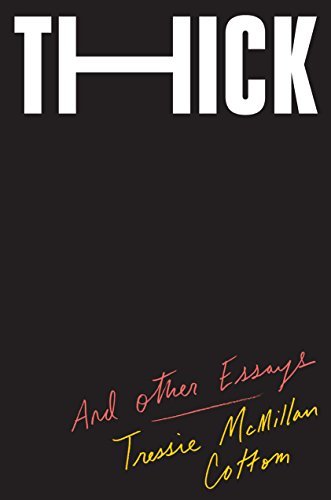
THICK and Other Essays, by Tressie McMillan Cottom

Reading this collection of essays has been like sitting down with a friend and asking, So tell me—what do you really think? Cottom draws on her academic training and her lived experience to create pieces that blur the line between sociology and personal essay. One editor said she was “too readable to be academic, too deep to be popular, too country black to be literary, and too naïve to show the rigor of my thinking in the complexity of my prose.”


If in her academic life she is chided for her popular success on social media and for using herself as a subject, she responds that “The personal essay had become the way that black women writers claim legitimacy in a public discourse that defines itself, in part, by how well it excludes black women.” Writing about your personal experience is a way in because your authority about your own self cannot be denied. Also, by its very form the personal essay invites empathy from readers.


I was, like many young women, expected to be small so that boys could expand and white girls could shine. When I would not or could not shrink, people made sure that I knew I had erred….[I was] thick where I should have been thin, more when I should have been less.

She writes about black women’s (and girl’s) problems, ones that are too often dismissed by others, in lucid prose that invites you into the conversation. But don’t be fooled by the casual tone. Yes she can be snarky and funny, but she can also pull out the statistics to support her statements and references to the work of other academics and deep thinkers. I often found myself setting the book aside between essays to follow the links in the endnotes for more detail.


I especially appreciate that she keeps probing at an issue. For example, in “Dying to Be Competent” she starts from our common desire to be able to manage our own lives, despite the fact that much of what happens to us is unpredictable and outside of our control. She goes on to tell a heart-wrenching story of trying to navigate the healthcare system, and the shock that despite her academic credentials and middle-class status markers, she has to fight for treatment and medication because the staff assume that she is incompetent and ignorant and thus can be ignored.


All this is presented in a cool tone and then buttressed by study after study about the high mortality rate of black women giving birth in the U.S., as well as by the example of what even celebrity tennis superstar Serena Williams had to go through to get a needed treatment, one that likely saved her life.


But Cottom doesn’t stop there. “Sociologists try to figure out how ideologies like race and gender and class are so sticky . . . The easiest answer is that racism  and sexism and class warfare are resilient and necessary for global capitalism.” A further analysis takes us to Patricia Hill Collins’s idea of “controlling images, those stereotypes that are so powerful they flatten all empirical status differences among a group of people to reduce them to the most docile, incompetent subjects in a social structure.” Such reduction is needed because “This moment of global inequality demands incompetent subjects.”


This is just one example from one essay. If I’ve made it sound like heavy going, believe me when I say that it is not. I read most of the essays twice, just for the sheer delight of following her argument. This is a book that has given me much to think about.


What book or podcast or blog has given you new insight into our culture?


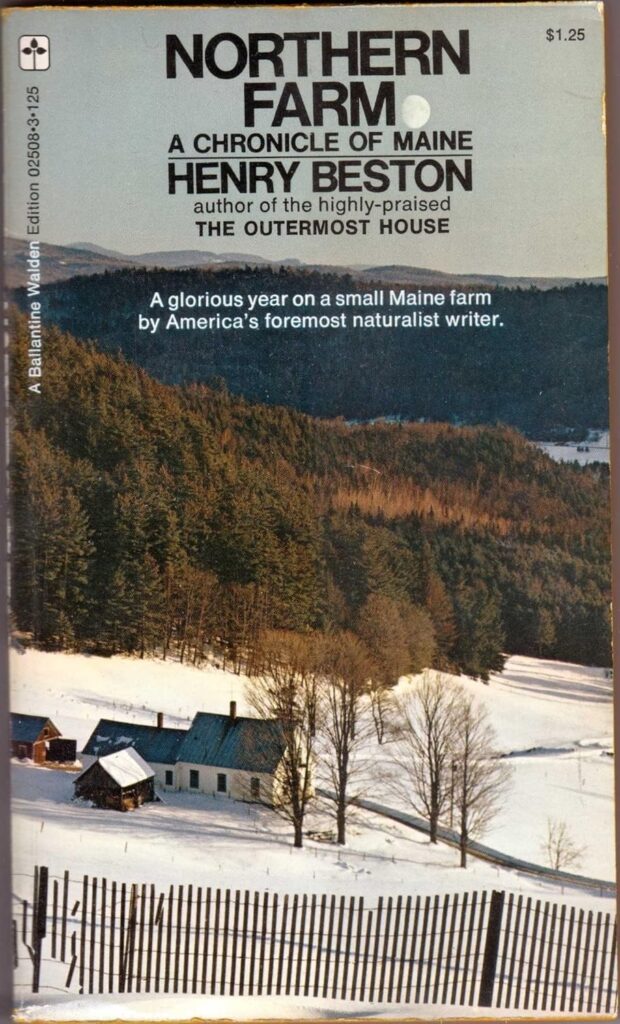
Northern Farm, by Henry Beston

From the writer-naturalist author of The Outermost House, comes an invitation to share in the daily life of a farm in Maine. I found this book so comforting that I stretched it out over a couple of months, only reading one or two short chapters first thing in the day.

Looking for a quieter life than could be found in the Boston suburbs, Henry Beston and his wife, writer Elizabeth Coatsworth, moved to Chimney Farm in Nobleboro, Maine, in the 1930s and lived there for the rest of their lives.

Published in 1948, the book describes a life I thought long gone: heating with wood, using horse-drawn farm  equipment, finding dirt roads impassable in mud season, gathering for community suppers at the grange, and—most heartening—neighbors clad in red-plaid flannel helping each other out with seasonal chores. Yet when I moved to Vermont a few years ago, I found all this and more. Yes, even horses being used instead of tractors on some farms.

Home again from a visit to friends in town, glad to be back where everything doesn’t come into the house along a wire or down a pipe. What a relief it was to get into my farm clothes and have a reasonable amount of physical work to do!

These chapters, which take us through a single year on the farm, originated as a series of country-living columns in The Progressive. Each starts with a few pages full of closely observed description of Beston’s surroundings and often something of his activities that day. Here is an excerpt from a winter walk.

Then, even as I looked, something touched me on the shoulder with a new awareness, and the scene became transformed. The shadows which were but shadows turned to pools of a deep gentian blue, a color tranquil and serene, and the water, which had been but water in snow pool close beside the shadows, became a mirror of some blue and glowing vault of heaven—this other blue being as pure as the first, but perhaps more bright, and with the brightness a measure more delicate. By contrast the sky beyond both the pool and the winter shadows appeared more green. The sun shone, there was no sound, and there I was standing in the road and staring at two of the most beautiful appearances of color in Nature which I think I have ever seen. Only a ridge of purest white snow separated the shadows from the pool.

 It was as if Nature, in the depth of our winter, had called into being the delicate colors of a garden.

That section is followed by excerpts from his Farm Diary, scraps of details that evoke daily life on the land and in the community. Each chapter closes with a paragraph or two of philosophy, sometimes referencing his lifelong theme of cultivating a closer communion with the natural world.

Who would live happily in the country must be wisely prepared to take great pleasure in little things. Country living is a pageant of Nature and the year; it can no more stay fixed than a movement in music, and as the seasons pass, they enrich life far more with little things than with great, with remembered moments rather than hours. A gold and scarlet leaf floating solitary on the clear black water of the morning rain barrel can catch the emotion of a whole season, chimney smoke blowing across the winter moon can be a symbol of all that is mysterious in human life.

I’ve also been reading Braiding Sweetgrass, by Robin Wall Kimmerer, which many of you have probably already read. She draws on her own Potawatomi heritage and her scientific training as a botanist to describe—beautifully—a way of relating to the land and its plants and trees with respect and gratitude.

Both have been a balm during this terrible time, reminding me of the good in people and what is worth defending.

What are you reading to prepare for next month’s Earth Day?

Best Books I Read in 2024

As a writer, I learn something from every book I read. In no particular order, these are ten of the best books I read in 2024. Please check the links to the blog archive for a fuller discussion of those I’ve reviewed.

Note: I did not include poetry here, though I read the work of some amazing poets, such as Richard Wilbur, Sam Schmidt, Linda Pastan, Ellen Bryant Voight, and Mahmoud Darwish. If you’re interested in reading a wider range of poets, consider joining in on the monthly Poetry Discussion Group I host. Free, no experience necessary, and copies of the poems are provided. Details on my website.

Fiction

  1. Our Missing Hearts, by Celeste Ng

Twelve-year-old Noah Gardner receives a letter from his mother, who disappeared several years earlier. It has been opened by the authorities of course, and is covered with drawings of cats. Noah and his father, formerly a linguistics professor but now demoted to a janitor, live in a U.S. that shows what our current country could easily become. Noah decides to find out once and for all what happened to his mother, a famous Chinese-American artist. A powerful story that puts our current social and political tensions into a (so far) fictional authoritarian world.

  1. The Cartographers, by Peng Shepherd

Nell Young loves maps and once dreamed of working with her brilliant father in the Map Room of the New York Public Library. Her even more brilliant cartographer mother died when Nell was a toddler. When Nell gets an emergency call from the New York Public Library, she embarks on a quest to identify the monster behind a string of thefts and murder. The delightfully complicated plot uses maps in surprising and satisfying ways.

  1. The American Queen, by Vanessa Miller

This fascinating novel is based on the true story of twenty-four-year-old Louella Bobo who in 1865 leads a group of her fellow former slaves to build a community in the Carolinas. The part I enjoyed most was the building of the Happy Land: how Louella managed to negotiate what they needed, the ways they found to make the money they needed, and the success of their communal sharing of all resources.

  1. Small Mercies, by Dennis Lehane

Mary Pat Fennessy just wants to find her daughter. It’s 1974, and life is hard in the grinding poverty of South Boston’s housing projects. She’s buried both her first husband and her son, who fought in Vietnam but came home to Southie to overdose on heroin. Her beloved second husband left her, and now her remaining child, Jules, has not come home from a night out with friends. In this complex story, Lehane shows how difficult it is to go against your tribe. It is a cracking good read, and accurate in its depiction of the time and place, at least according to my memories.

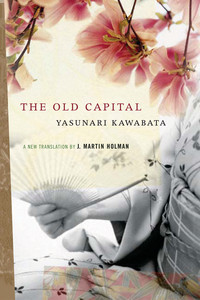
  1. The Old Capital, by Yasunari Kawabata

Chieko lives with her parents in the same building that houses their shop in Kyoto. This gentle story of a few months in her life begins with three images that embody themes central to Japanese literary tradition while later, more modern themes emerge. The microcosm of Chieko and her family holds a much larger story about how we handle the past—what we keep and what we discard—not only traditions but also our memories and our own identities.  This beautifully written story is one that will haunt me.

Nonfiction

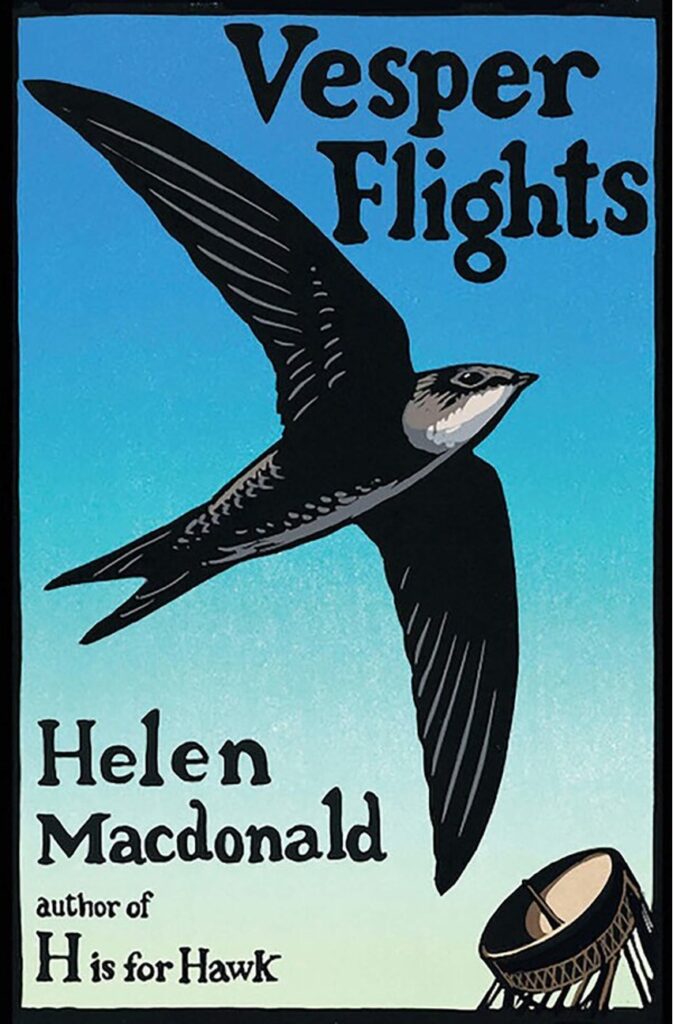
  1. Vesper Flights, by Helen MacDonald

The author of the exquisite and deeply moving memoir H Is for Hawk returns with this collection of essays. She compares them to the objects you might find in an 18th-century cabinet of curiosities. As MacDonald opens the doors on these wonders of the natural world, she encourages us to see nature as something other than a reflection of ourselves. I read and reread these essays, loving the way she communicates the “qualitative texture of the world.”

  1. Burning Questions, by Margaret Atwood

Subtitled Essays and Occasional Pieces, 2004 to 2021, this is Atwood’s third collection of essays, speeches, book introductions, and reviews. What astonished me was how readable this heterogeneous collection is. Of course, we have Atwood’s voice throughout: intelligent, calm, learned, self-deprecating, and witty. For a more global understanding of the issues facing us, their interconnectedness, and how we can move forward, this book cannot be beat.

  1. Normal Women, by Phillipa Gregory

This astonishing book should be required reading everywhere in the Western world. This history of women in England for the last 900 years is fascinating and infuriating. Women have suffered ever since William the Conqueror brought his patriarchal ideas about the superiority of men over women to England in 1066, obliterating the more equitable society he found there. In this book, every assertion is backed up by example after example drawn from primary sources, starting with the Norman laws that dictated the so-called natural inferiority of women, morally, mentally, and physically. As the book progresses through the centuries, we get stories of many extraordinary women and their struggles.

  1. The Equivalents, by Maggie Doherty

Subtitled A Story of Art, Female Friendship, and Liberation in the 1960s, Doherty’s fascinating new book tells of the Radcliffe Institute for Independent Study, created in 1960 to provide a stipend, office space, and a like-minded community to help women advance their careers as scholars and artists while also caring for a family. Doherty concentrates on a few of the first fellows: poets Anne Sexton and Maxine Kumin, writer Tillie Olsen, sculptor Marianna Pineda and painter Barbara Swan. The book provides fascinating insight into the creative life and what can inspire or hinder it. It’s also a wonderful portrait of that era and of these remarkable women.

  1. Proust’s Duchess, by Caroline Weber

Even those who don’t care who inspired Proust’s Duchess of Guermantes may enjoy this biography of three fascinating women in fin-de-siécle Paris. At a time and in a society where women had no power, these three embarked upon “a conscious strategy of self-promotion.” Like so many today, they became famous for being famous. However, Weber goes beyond that easy judgment and delves into their lives, showing us that in striving to be celebrities, they wanted to be noticed. They wanted to assert some agency over their lives.


What are the best books you read in 2024?

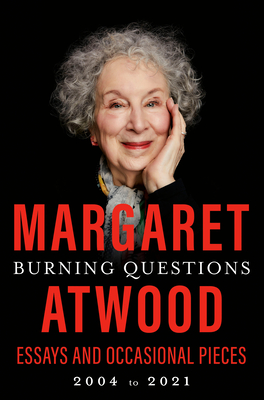
Burning Questions, by Margaret Atwood

Subtitled Essays and Occasional Pieces, 2004 to 2021, this is Atwood’s third collection of essays, speeches, book introductions, and reviews. What astonished me was how readable this heterogeneous collection is. Of course, we have Atwood’s voice throughout: intelligent, calm, learned, self-deprecating, and witty.

In today’s world, where so many people value opinions and beliefs over fact, it is a huge relief to communicate with someone who actually believes in science. Both of her parents were scientists–an entomologist and a nutritionist–and she spent much of her youth in the woods of Northern Ontario. She talks about the family pulling over when an infestation was spotted so that they could collect the invading critters. “Other families stopped for ice-cream cones. Ours stopped for infestations.”

That early influence shows in her concern with the threats to our environment, both in her fiction and her nonfiction, including a number of pieces in this collection. She writes of how this concern fueled her Oryx & Crake trilogy and her MaddAddam trilogy, as well as a moving tribute to Rachel Carson, calling her “a pivotal figure of the twentieth century” and “Saint Rachel.”

Another theme that threads through this collection is the way autocracies try to silence writers and control women. She has been a force in founding Pen Canada and acted as its president in the 1980s. In “If We Don’t Defend Free Speech, We Live in Tyranny” she writes about the attack on Salman Rushdie and the murder of translator Hotoshi Igarashi. In another piece she states that “There is nothing that repressive governments desire more than imposed silence . . . secrecy is an important tool not only of power but of atrocity.”

She generously continues to write about The Handmaid’s Tale, noting that “absolutist governments have always taken an inordinate interest in the reproductive capabilities of women.” She adds that writing a dystopia from a woman’s point of view “does not make The Handmaid’s Tale a ‘feminist dystopia,’ except insofar as giving a woman a voice and an inner life will always be considered ‘feminist’ by those who think women ought not to have these things.”

These pieces are not all darkness with a glimmer of wit. In “Literature and the Environment” she writes that “as long as we have hope—and we still do have hope—we will be telling stories, and—if we have the time and the materials—we’ll be setting them down; because the telling of stories, and the wish to listen to them, transmit them, and derive meaning from them, is built into us as human beings.”

Indeed, the pieces I most appreciated were about how essential the arts are to our well-being and about writing in particular. Parsing out her approach to these short pieces taught me so much about her methodology. Often she starts with a clear statement of purpose: “I’ll divide my talk into three parts, and I’ll even tell you what they are, just so you know what’s coming.” That’s from a speech honoring the Department of Forestry’s centennial. I’m touched by how, despite her blockbuster status, she’s willing to turn up and speak at so many events.

After the statement of purpose, she wanders here and there in the best tradition of essay-writing. She includes asides, rhetorical questions, digressions, allusions. She explores the question without answering it, instead opening our minds—gently and respectfully. I also especially appreciated the pieces about other authors and about her late husband, author Graeme Gibson: both joyful moments and mor trying times as he drifted deeper into dementia.

While some readers may be unnerved by this collection’s length, diversity, and chronological structure (rather than thematic), I found it a joy to read. Most of the pieces are quite short, making it a perfect bedtime book: you can read a few pieces and chuckle at her quips before you turn out the light.

I’m grateful to Atwood for collecting these pieces—no small task—and putting them out for us to absorb. In fact, for a more global understanding of the issues facing us, their interconnectedness, and how we can move forward, this book cannot be beat.

What have you read by Margaret Atwood? Her novels, poems, and/or essays?

Vesper Flights, by Helen MacDonald

The author of the exquisite and deeply moving memoir H Is for Hawk returns with this collection of essays. She compares them to the objects you might find in an 18th-century cabinet of curiosities, a Wunderkammer, where objects of many sorts from the natural world are displayed so that their strangeness and accidental proximity might inspire wonder and perhaps prompt a larger discussion.

Like the best sort of host, MacDonald opens the doors on these wonders and then lets us make of them what we will. There’s no lecturing. Although she is a presence in the book, it is not about her. Instead, her evocative prose bears witness to these marvels, inviting us to experience them ourselves.

The essays range around the world and into varied environments: from fields and forests to volcanos and the Empire State Building. As MacDonald tells us about wild boars, boxing hares, and several sorts of birds, she encourages us to see the natural world as something other than a reflection of ourselves.  “What science does is what I would like more literature to do too: show us that we are living in an exquisitely complicated world that is not all about us. It does not belong to us alone. It never has.” We are introduced to animals and birds as sentient beings in their own right, with their own needs and wants.

Another theme that runs through these essays is the effect of the loss of habitat on these creatures: those we have lost, such as the wood warblers, and the adaptions some have made, such as the peregrine falcons nesting on the decommissioned power chimneys of the Poolbeg Power Station in Ireland.

For much of the 20th century, falcons were celebrated as romantic icons of threatened wilderness. The mountains and waterfall gorges where they chose to nest were sublime sites, where visitors could contemplate nature and meditate on the brevity of human existence. But there’s a romanticism to industrial sites too. The rusting chimneys and broken windows of the Poolbeg site have their own troubling beauty, that of things that have outlasted their use. Falcons haunt landscapes that speak to us of mortality, mountains by virtue of their eternity, industrial ruins by virtue of their reminding us that this too will in time be gone and that we should protect what is here and now.

Although she deplores the idea that the natural world should be preserved because we humans find it useful in lifting our moods or teaching us about ourselves, insisting instead that it has its own right to exist independently of us, she is not averse to showing how we benefit. She says, “At times of difficulty, watching birds ushers you into a different world, where no words need be spoken. And if you were watching urban falcons, this is not a distant world but one alongside you, a place of transient and graceful refuge.”

Among my favorite parts is the titular essay, which is about chimney swifts and their still mysterious ascent. Twice a day, at dusk and dawn, they fly up out of human sight, where “flying so high they can work out exactly where they are, to know what they should do next. They’re quietly, perfectly orienting themselves.” Another thing I learned is that “Unlike other birds, they never descend to the ground.” Now, when I walk in the evening and see the swifts whirling above, her words speak to me: “Swifts are magical in the manner of all things that exist just a little beyond understanding.”

Another, related theme in these essays is loss: the lost paradises of youth, the chestnut and elm trees that once graced our streets, the extinction or near-extinction of many species. This spring I was thrilled to hear a cuckoo while walking in England, where their population has dramatically declined. She says:

Increasingly, knowing your surroundings, recognising the species of animals and plants around you, means opening yourself to constant grief.

And:

Their loss is not about us, even though when that meadow disappeared, part of me disappeared, too, or rather, passed from existence into a memory that even now batters inside my chest. Look, I can’t say to anyone. Look at the beauty here. Look at everything that is. I can only write about what it was.

Yet there is hope here as well, and treasures to embrace. Even her “Eulogy” for her friend Stu is filled with peace and hope along with the sadness, its ending giving me goosebumps just remembering it.

I keep thinking I’ve finished this book, yet find myself coming back again and again to this essay or that one. I love the way she communicates the “qualitative texture of the world” and opens for me some of its wonders.

What essay or book have you read that reminded you of the wonders of the natural world?

Best Books I Read in 2022

As a writer, I learn something from every book I read. In no particular order, these are the ten best books I read in 2022. Please check the links to the blog archive for a fuller discussion of those I’ve reviewed.

1. The Wall, by Marlen Haushofer
The narrator wakes from a nap to find herself alone. She’s visiting family members at their hunting lodge on the edge of the Alps, and they have gone into town, leaving her with their dog Lynx. She walks down the road to meet them, but both she and the dog run into an invisible wall that separates them from the rest of the world. This journal of her solitary life in the years that follow is stunning.

2. Hamnet, by Maggie O’Farrell
O’Farrell’s tour de force focuses on Agnes, Hamnet’s mother, Shakespeare’s wife, and in so doing immerses us in the day-to-day experience of raising children and managing a household in Elizabethan England. What makes this novel so stunning is the author’s evocation of the details of each scene. It is a powerful reading experience that gives us insight into Shakespeare’s work, but even more into the lives of the many women who loved, married, and bore children in obscurity.

3. Generations: A Memoir, by Lucille Clifton
Lucille Clifton is one of my favorite poets and a huge influence on my writing. In this memoir, originally published in 1976 and now a new edition from New York Review Books, she brings a poet’s sensibility to crafting her story. The chapters, while prose, in their brevity exhibit the conciseness of poetry; anything not absolutely necessary is pared away, leaving the kernel. And you, the reader, bring your own understanding and experience to fill in the spaces.

4. Memorial Drive, by Natasha Trethewey
Trethewey is another of my favorite poets, so I looked forward to reading her memoir. Not needing to know anything more than the author’s name, I plunged in, only to emerge finally, astonished and awed. With a poet’s concision and musicality, she conjures her rural Southern childhood. Trethewey’s voice is quiet—quiet as Black women’s voices have had to be. Yet with all that, her voice carries the emotions held in check by her composure, a tribute to the author’s exquisite use of language. She has created a moving exploration of memory and of how we manage, or fail to manage, our painful past.

5. Migrations, by Charlotte McConaghy
Arriving in Greenland with only her research gear, Franny Stone is determined to study the last of the Arctic terns. She says that even though her expedition has been canceled, she intends to follow the terns on what will be their final migration to Antarctica. The book is set in the near future when climate change has wiped out most birds, fish, and animals. Although disapointing at times, this profound story is worth your attention.

6. The Tradition, by Jericho Brown
I am astonished by these poems, the power and sheer artistry of them. They are personal and political, specific and universal. Brown deploys the tools of poetry—enjambment, white space, personification—boldly. Some of the poems take up hardly any space, lines only two or three words long. Yet even with that limitation they are remarkable, the fragmentation creating a rhythm in counterpoint to and with the rhythm of the words. He also creates his own tools, complex forms that defy gravity.

7. The Crane Wife, by CJ Hauser
This book of essays, anchored by the superb title essay, is about the stories we tell ourselves about our lives and about who we are. Hauser balances personal stories with those of others, sometimes her friends, sometimes writers or their characters, sometimes the natural world.

8. The Warmth of Other Suns, by Isabel Wilkerson
From 1915 to 1970 almost six million Black citizens left the south for northern and western cities looking for better lives. For the first time Wilkerson’s monumental book gives us a history of the Great Migration. The book is long but eminently readable, due to Wilkerson’s approach. By closely following stories of three individuals, she captures the reader’s attention and sympathy and keeps us turning pages.

9. Parable of the Sower, by Octavia E. Butler
This 1993 novel begins in the then-distant future of 2024, which startled me at first. Due to her mother’s drug abuse while pregnant, teenager Lauren Olamina actually feels all the sensations she witnesses in others. She calls it “sharing” and finds it a liability in her world, a dreadful world that is only too likely how things will turn out here, given the trends already present in the 1990s and only worse today. A brilliant story of one woman’s journey.

10. Miss Benson’s Beetle, by Rachel Joyce
London in 1950 is still recovering from World War II, with food rationed, ruined buildings being cleared, another generation of men wiped out, and women chucked out of their wartime jobs. Middle-aged spinster Margery Benson finally cracks and quits her job teaching domestic science in an elementary school with out-of-control children. She decides to set out on the adventure of a lifetime: an expedition to New Caledonia to find a mythical golden beetle. So much fun!

What were the best books you read in 2022?

The Crane Wife, by CJ Hauser

9780385547079-1084277655

I was first alerted to Hauser’s essay “The Crane Wife” by the Longreads list of best essays in 2019 which sent me to the Paris Review where it was published. I thought it brilliant.

So I looked forward to reading this book. Hauser calls it “a work of personal nonfiction,” saying “These essays reflect my life as I remember it and the stories I’ve made of that life to understand how to keep living in it.”

In “The Crane Wife” Hauser goes to Texas to study the whooping crane shortly after calling off her engagement. Sections alternate between her engagement and her experience with the cranes. Equally important are those who study the cranes, the motley collection of volunteers who welcome her to this Earthwatch event.

She gives a poignant recounting of her deteriorating relationship, constantly setting aside her own needs as shameful. Men are entitled to have needs, but “when a woman needs, she is needy.” At the same time she is measuring the small things that fill the needs of these whooping cranes who are on the verge of extinction.

The Crane Wife is a story from Japanese folklore about a crane who fell in love with a human man. She didn’t want him to know she was a crane, so every night she plucked out all of her feathers. “Every morning, the crane-wife is exhausted, but she is a woman again. To keep becoming a woman is so much self-erasing work.”

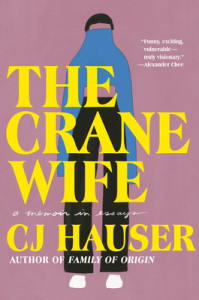
I found the book’s cover image disconcerting: a person, presumably a woman though not obviously, whose turtleneck is pulled up to erase her face, leaving her vulnerable stomach bare. I suppose it’s meant to refer to the title essay and Hauser’s erasure of herself, but it doesn’t reflect the collection and ultimately felt demeaning.

What makes these essays so good is the way she balances personal stories with those of others, sometimes her friends, sometimes a story’s characters, sometimes both. I especially enjoyed her bookish roamings through Rebecca and Shirley Jackson’s oeuvre. I also liked her travails in deciding what to say when asked to officiate at her friends’ wedding, wanting to capture the breadth and depth of the women’s relationship, while also discussing her obsession with The X Files and what she calls its MSR: Mulder-Scully Relationship.

Another reason these essays are so absorbing is her use of specific details, like shopping for nylon hiking pants that zipped off at the knee, and incisive incidents like a bit about Christmas stockings. Mostly, though, it is her openness that makes these essays hit home, her willingness to be vulnerable.

Many of them have to do with her love life, which I would have found more interesting thirty years ago. Still, I enjoyed them and even listened to the entire collection twice. It is read by the author, whose voice has a bubble of laughter under it, even during the sad parts, keeping me a little off balance, which is not a bad thing.

Near the end of the book she returns to the idea of the stories we tell ourselves about the events of our lives, stepping back from the story to comment on her authorial choices. This is a smart book and gave me a lot to think about.

What essay or essays would you put on your best-of-this-year list?

Author Tours

IMG_0356

When I went to Toronto many years ago to visit my son who had moved there, he took me on a tour of the city to show me the places in Michael Ondaatje’s masterful novel In the Skin of a Lion. I had loved the novel, along with the other Can Lit books my son had recommended (Timothy Findley, Alistair MacLeod, Jane Urquhart, David Adams Richards, Margaret Laurence, etc.) at that time not available in the U.S. Somehow, seeing the actual places mentioned in Ondaatje’s book made it come alive for me in a different way.

Perhaps you have had this experience. If you read a book set in a place you know well, you have a different relationship with the story. When I read an Anne Tyler book or one by Laura Lippman, I recognise the places in and near Baltimore that they mention, and the story becomes that much more real.

A few years ago when I was in Edinburgh, I went on an Ian Rankin tour. His books are true works of literary art, and I highly recommend them. I first found one in a Toronto bookstore; they weren’t available in the U.S. and the online bookstore thing hadn’t taken hold yet. He immediately became one of my favorite authors, and I’ve enjoyed watching his immense talent increase with every book, especially those featuring detective John Rebus.

The tour was fun, taking us to places that cropped up in his books as well as to buildings where he and fellow Edinburgh authors lived. I also made an effort to look on my own for things referenced in his books, such as the miniature coffins found on Arthur’s seat and Rebus’s favorite bar.

Recently I enjoyed a tour in Quebec City that took us to places mentioned in Louise Penny’s Bury the Dead. Seeing where the incidents in the story took place, following Inspector Gamache’s footsteps, enjoying the restaurants and bistros mentioned made the story real in an entirely different way. If nothing else, I saw how short a distance it was in some cases from one place to another, making it easier to understand how Gamache could move so quickly between them.

Our tour guide Marie had some inside information: Penny herself had stayed in the house where Gamache stayed with his friend Emil in the story. Marie had seen inside and verified that it matched the description, just as we could verify the descriptions of other, more public places mentioned.

Marie speculated that Penny had eaten in these restaurants, ridden the funicular, visited the Cathedral-Basilica of Notre-Dame de Quebec. I thought: Of course she did! That’s how you research a book. All good writers do that.

When you travel, I encourage you to read novels set there and, if possible, take a tour of the places mentioned. Let me know how that changes your perception of the book.

Have you ever taken a tour of places mentioned in an author’s book? If you read a book set in a place you know well, how is the experience different?