Reprise: Diamond in the Window, by Jane Langton

In one of my book clubs, we decide on a theme for the month and then each talk about the book we read. Our choices inspire great conversations and often end up on each other’s to-be-read lists. Our last theme was a favorite childhood book, so of course I chose this one which I wrote about in the early days of my blog. Here’s my earlier post about it. Note: the previous week I’d written about March, by Geraldine Brooks.

…………………………………

Before leaving the Transcendentalists, I wanted to reread this young adult book where I first heard about them.  I found it one cold, rainy day at Whippoorwill Girl Scout camp where—having escaped from the prescribed activities—I was poking around some bookshelves in a dark corner of the hall.  Behind some mildewed Readers Digest Condensed Books, I found one with corners of the cover frayed by mice and the pages brown-spotted with damp.  I hid behind a chair to read it and got through the first few chapters before being discovered by one of the leaders and told to put it back.

It took me almost two years to find the book again and finish it.  I couldn’t remember the title or the author’s name, only the story, and after a while I began to believe that I had dreamed it.  When I finally came across it on my local library’s shelves, I couldn’t believe it.  It was as though a fantasy had suddenly become real.

Ned and Nora live in a Gothic monstrosity of a house in Concord, Massachusetts, with their aunt and uncle.  Aunt Lily teaches piano lessons to support the family because Uncle Freddy—who used to be a famous scholar—has lost his mind and spends his days arguing with marble busts of Thoreau and Emerson.  The children have a run-in with a couple of town worthies who consider the house and the family a blot on their sacred soil and threaten to take it for unpaid taxes and burn it down.

The children discover a mysterious room at the top of the house with some dusty toys and two twin beds.  Confronting Aunt Lily, they learn that Lily and Freddy’s youngest sister and brother had gone missing from that room as children, followed by Lily’s sweetheart, Prince Krishna.  Ned and Nora decide to sleep in the room themselves.  However, in their dreams, they are plunged into magical adventures, adventures which turn dangerous.

There are a few books I read as a child whose images have become so ingrained in my thoughts that they have become part of my private mythology.  This is one of them.  It wasn’t until I was grown and had read Emerson and Thoreau for myself that I recognised that each adventure embodies one of the Transcendentalist ideas and images, such as the rough wooden harp they found while climbing in an elm tree, an aeolian harp, although it is not named in the book.  The wind blowing across the harp strings translated the voices of nature into sounds they could understand:  “ ‘These trees and stones are audible to me,’ ” as Uncle Freddy quoted Emerson.

The adventure that I think about most often, though, is the one where they go into a mirror and find two statues of each of them, a little older than their current age.  Ned and Nora separate, each choosing one of their statues.  Behind that one stand two more.  Their choices eventually lead them to statues of themselves as adults, at which point they are able to see if they have chosen wisely.  Unlike real life, though, they are able to go back and make different choices.

What was one of your favorite books as a child?

The Painter of Silence, by Georgina Harding

A sick and emaciated man collapses on the steps of a Romanian hospital in the town of Iași. He is deaf and mute and (we learn) has been since birth so is unable to communicate with anyone. A nurse named Safta recognises him as Augustin—Tinu for short—who shared her childhood on her parents’ estate Poiana. Although Tinu was the cook’s son and Safta the cherished daughter, they had a special bond. She encourages him to draw, as he did as a child, but at first he refuses.

It is the early 1950s and Stalin’s Russian holds the country in its grey and relentless grip. Yet, in trying to get through to Tinu, Safta begins to talk of their golden childhood, something she has refused to even think about for years.

She talks and talks, as do others who, unlike her, seem freed by knowing that he does not hear what they are saying. The theme of communication winds through the book. There is much that we, like Tinu, must intuit. Safta, too, must discern how best to help Tinu when he is released from the hospital.

Place and the social environment are important aspects of the story. The settings are described only briefly, yet come alive in the imagination. Here is the Poiana of their childhood:

The house at Poiana was imposing at first glance. There was its whiteness, the long neoclassical front, the pedimented porch and ranks of green-shuttered windows. It looked larger than it was because it was only one room deep. If a person came up the drive and looked in he might see right through the glimmer of glass to the garden beyond.

It was a place that light passed through, the light of successive windows thrown onto fine parquet floors in rooms that opened one on  to another, the doors of the rooms always open – save when great and irritated effort was made to close them during the coldest stretches of winter – since this was a house which people moved through freely, like the light: family, servants, visitors, villagers, who came on errands or to make a request or seek advice, the children of the house and the children of the servants. 

This is the novel I have been waiting for. Hoping for. It is quiet and asks much of the reader as it unfolds.

It is not that the language is gorgeous, though each sentence is remarkable in its elegant simplicity. It is not that the plot is thrilling, though terrible things happen and people must learn to live with them and with their own actions. It is not that the characters entertain us or steal our hearts, though we cannot help but walk with them as they move through a world that has changed beyond recognition. Yet it is a balm.

World Wars I and II destroyed a way of life that had seemed as though it would last forever. In England, it was the Victorian/Edwardian age, the age of empire; in Romania, it was the age of its birth as a relatively democratic constitutional monarchy. Romania had only become a country in 1859, gaining independence from the Ottoman Empire in 1878. Siding with the Entente Powers in WWI, Romania grew and prospered during the inter-war period, a time of wealth and privilege for the great families and stability for those who served them. Initially neutral in WWII, Romania eventually allied with Germany and Austria-Hungary to protect themselves from Russia.

That war (WWII) is mostly offstage in Harding’s story. Tinu notices the refugees and later the troops before he is himself apprehended. He does not understand why these things are happening, why everything keeps changing. Far away in Iași Safta resolutely puts one foot in front of another, keeping her head down, working as a nurse. It is only when Tinu turns up that she begins to allow memories of her childhood to emerge and to reckon with all she has lost.

We may not all be suffering through a world war or see our country invaded by Stalin’s Russia, but we all understand loss. Eventually, we all experience what Jane Smiley called the Age of Grief. We all have lost paradises of some sort or another and have things we cannot speak of, except perhaps to someone who cannot hear.

I have always felt our civilisation to be tenuous and had nightmares about its eventual rupture. Perhaps that is a legacy of growing up in the shadow of the bombs that destroyed Hiroshima and Nagasaki. Perhaps all of us, no matter when we were born, carry a secret store of anxiety. Harding’s story places a gentle hand on that wound and reassures me that I’m not alone. It asks me to remember what has been lost, cherish what is beautiful, and watch out for one other.

Have you read a novel that you didn’t know you were looking for?

The Liar’s Dictionary, by Eley Williams

In 21st century London, Mallory works as a low-paid intern at Swansby’s, helping prepare their dictionary to be digitised. As the sole employee, she also must fend off threatening anonymous calls from a man angry about the dictionary’s newly inclusive definition of marriage.

When owner David Swansby finds a mountweazel—a non-existent word sometimes added to catch plagiarists—he  assigns Mallory to go through every single entry to verify that it is a real word. Mallory’s girlfriend Pip, a barista, decides to help, resulting in a fun version of Fictionary.

The absurdity of such a tedious task is increased by the fact that the last volume of Swansby’s Encyclopaedic Dictionary was never finished; all the men working there went off to war in 1914 and the printing presses were melted down. Now David Swansby wants to preserve his family’s work by putting the existing volumes online and closing down his great-grandfather’s company.

Alternating with Mallory’s story is that of Peter Winceworth, a laborer in the trenches of Swansby’s in 1899. Socially inept, Peter is the butt of jokes from his co-workers. He has affected a lisp since his youth, perhaps out of boredom or to annoy his father, and now clings to it as his secret way of showing contempt for his tormentors. Of course, he has been assigned to the “S” section of the dictionary.

He has another secret way to assert himself: He has begun to insert his own words into the dictionary. Some are fun sniglets—words that don’t appear in any dictionary, but should—while others are more personal, such as “winceworthliness, (n.), the value of idle pursuit.”

As a confirmed logophile, I enjoyed the audacious and whimsical use of language here. The etymologies and definitions, both real and fake, are like candy to me, and the whole enterprise of determining real words from fake raises interesting questions. For example, when Swansby explains to Mallory that a mountweazel is “a made-up word”:

“All words are made up,” I said.

“That is true,” David Swansby replied, “and also not a useful contribution.”

The term refers to a fictitious entry in the 1975 New Columbia Encyclopedia about Lillian Virginia Mountweazel, a fountain designer turned photographer, deliberately placed as a copyright trap. Continuing the joke, there is actually a Lillian Virginia Mountweazel Research Collection which displays photos attributed to her, though a footnote acknowledges that “All the materials presented here as her works are authentic pieces created by other photographers, repurposed or collaged from media that are in the public domain.”

There are also some Easter-egg tributes to Lillian in this book. Don’t be put off by the mock-pompous preface about creating an ideal dictionary. Once past that and into the A-Z chapters, the story becomes a sprightly tale about two characters who hide themselves: Mallory who wants people to think she’s straight and Peter who shields his heart with lisps and lies. There’s occasional wordplay in the text as well, such as this from Peter on a park bench.

The best benchside exoticisms January could offer were all on show—the starling, the dandelion, the blown seeds and the birds skeining against the grey clouds, hazing it and mazing it, a featherlight kaleidoscope noon-damp and knowing the sky was never truly grey, just filled with a thousand years of birds’ paths, and wishful seeds . . .

Such language can overwhelm a story yet here it just seems part of the fun. The story itself is light, a mere trifle, despite a few dark moments. I’m eager now to read the author’s two short story collections.

What is your favorite made-up word?

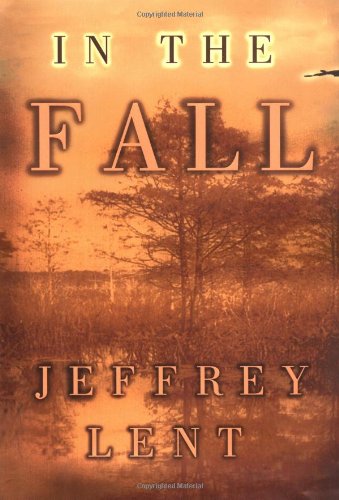
In the Fall, by Jeffrey Lent

In Virginia during the last days of the Civil War, a wounded Union soldier becomes separated from his comrades and is found near death by an escaped slave who saves him. Norman Pelham and Leah Mebane become inseparable and, after he is demobilised and they marry, the two decide to walk to his home in Randolph, Vermont. As they pass through nearby Bethel, his fellow veterans—already home for several months—watch for him.

So they saw him pass along the road that Indian-summer morning with the sugarbush maples flaring on the hillsides and the hilltop sheep pastures overgrown with young cherry and maple. Word ran along the road ahead of him so near all his neighbors and townspeople saw him walking in the long easy stride of one who counted walking in months and years not miles, a rucksack cut from an issue blanket strapped to his back and by his side a girl near his own height in a sunfaded blue dress and carrying her own cardboard suitcase bound with rough twine.

Norman’s father has died while he was fighting, leaving the farm to him. His mother and two sisters, while abolitionists, are so shocked and troubled by Leah that they move into town, leaving the young couple to begin their new lives on the farm. Fired by their fierce love for each other, they ignore the scorn of their neighbors by keeping to themselves and plunging into the hard work of making a living from a hill farm.

Thus begins this saga of three generations of Pelhams, haunted by their troubled legacy of what Leah left behind and by America’s ongoing racial tensions.

This debut novel was a huge bestseller when it was released in 2000. I told the friend who recommended it to me that I didn’t know whether to bless her or curse her because I found it thoroughly addictive reading—the prose so luscious that I read slowly to savor it and could hardly bear to set it aside until I’d finished all 565 pages.

Lent takes his time with the story, enclosing me in the worlds of nineteenth-century farm life and early twentieth-century bootlegging, in New England’s mountains and North Carolina’s tobacco and cotton fields. I especially enjoyed the very specific details about tools and descriptions of places and processes in these time periods; they added so much richness to the fabric of the story. I could tell how fully the author inhabited each moment of the story as he wrote.

The partridge went up, a sudden burst of speckled animation that hit a long going-away glide down the mountain and he passed the splendid moment where his mind left him and was all out ahead of him, pinned down only on the flying bird as the gun came up. Then there was a pinwheel of feathers and both dogs broke past him and he was back.

A few things surprised me. For example, some significant events are skipped over in a sentence or two while others that seem lightweight unfold with great leisure. A possible reason could be that this is a story about men, so the female characters’ stories—aside from aspects that influence the men’s stories—are just not that important. Or maybe the reason is that we are in the men’s point of view and they simply don’t understand the women’s experiences. Maybe it’s something else altogether.

Much as I eventually loved the book, I almost stopped after the first couple of pages. Why? Because I don’t like when a chunk of text from later in the book is stuck in front as a prologue. It feels like an attempt to motivate the reader to plow through hundreds of pages until we finally meet these people and find out who they are, instead of just trusting the story. I’m not opposed to all prologues; some are great. But this book doesn’t need a prologue; Chapter One begins with a splendid hook. Once I got there, I was caught by the prose and the lovely grounding in time and place and character and theme.

I truly did not want this book to end. I keep opening it up in random places and looking closely at a single paragraph, trying to see how Lent works his magic. I read it aloud. Sometimes I copy it, writing in longhand, to get the feel of the sentences in my fingers. It really is beautifully done. I’m eager to read some of his later books.

Have you read a novel where it felt like falling into a dream from which you never want to wake up?

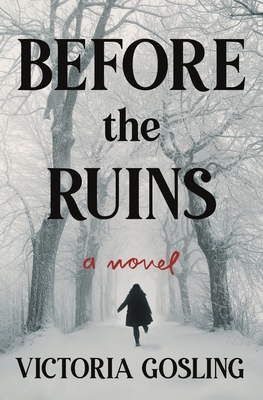
Before the Ruins, by Victoria Gosling

“The year Peter went missing was the year of the floods.” Thus begins this tale from Andrea (Andy) set in the present-day but reaching back twenty years to the summer of 1996 when she and her friends have finished their final exams. A bored teenager with few prospects, Andy enriches her life by coming up with games to play with her three best friends: Peter, Marcus and Em. The guardrails come off when Andy’s alcoholic mother predicts the apocalypse is about to occur—if the world is ending, their actions have no consequences—and the four friends take over an empty manor house near Marlborough in Wiltshire.


Learning that a valuable diamond necklace had been stolen at the manor fifty years earlier and never recovered, they embark on a new game of playing detective. Em acquires a cheap copy of the necklace—a tourist item in town—and they take turns hiding it, a game that has the added relish of perhaps actually finding the real necklace and changing their lives. Another teen, the suspiciously charismatic David, turns up one day, claiming to be a friend of the absent owners and quickly becomes a part of the group.  


Yet there’s an ominous push-pull within the group as they practice deceiving one another. Relationships fray; secrets and lies erode trust; betrayals lurk in the shadows. The story builds gradually, moving between the search for Peter in the present and unpacking the events of the past, turning them this way and that, looking at them anew.

Memory is a house, a castle with many rooms. Some of the rooms are deeper inside, honeycombed away. Each has a thousand keys – an image, a smell, a sound. Behind each door are a thousand other doors.

I was drawn to this novel because I like the narrator of the audiobook, Kristin Atherton, and because a reviewer compared it to Tana French’s work. My favorite is The Likeness of which I said, “French captures so well the fun of being part of a tight group of friends, when you’re young, and it’s all happening for the first time, and everything seems unbearably sweet.” Gosling’s story comes at youthful friendship from another angle, capturing its mystery and beauty, but also its fragility and fear.


To sleep on? Or to wake? This was the question facing me. To sleep, or to wake and face the reckoning, to find out what had been lost.

I thought Before the Ruins would be another in a long line of gothic mysteries about a narrator revisiting formative events in the past, secrets that come to light, etc. However, I underestimated the book. It rewards deeper investigation, from the pun in the title (before) to the use of diamonds as a MacGuffin to the sly use of imagery (floods, treasure, playing games, losing your nerve at the prospect of a leap).


Caught up in the story I noticed little else, but on reflection I wish we could have gotten to know the characters other than Andy a bit better. The way they are presented makes sense since we are getting the story through her point of view which comes with her own blinders; only near the end do their actions indicate more complexity. I would also have welcomed more description of the manor itself.


As a writer, several things in this book impressed me: the complexity of the narrative with multiple storylines and reveal after reveal; Gosling’s willingness to let the slow burn unfold in sentence after delicious sentence; and the way she hits the reader flat out near the end, signaling that whatever you thought the theme was, it’s so much more. No spoilers here, but be prepared to discover layers upon unexpected layers of this story.


Have you read a novel that turned out to be much more than you expected?


Mrs. Dalloway, by Virginia Woolf

Reading this classic novel now, more than fifty years since I first encountered it as an undergrad, is quite a different experience. Back then I was confused and thrilled by Woolf’s modernist, experimental style that expanded forever my idea of what a novel could be.

Now I see it as a story of midlife, in several senses of the word. The story unfolds as a day in the lives of a handful of people in London going about their ordinary business, and we get thrown right into the middle of things. Clarissa Dalloway is preparing to give a party. Newly returned from India, Peter Walsh sets out to recapture the past by exploring London and visiting Clarissa, his first love. Richard Dalloway is off to lunch with old friend Hugh Whitbread at Lady Bruton’s. Septimus Smith, a damaged veteran of the Great War, and his wife Rezia are walking through the park, on their way to an appointment with a doctor.

Since Clarissa, Peter and others are in their early fifties, we have another sense of midlife. It’s a time of life when we look back nostalgically, but also when we measure ourselves—and others—assessing how we have changed with age, and calculating what we have made of our years. Have we measured up to our early promise?

Time comes up frequently, not just in the characters’ reflections on how they and each other have aged, their memories of the past, and the bustling busy lives of their present; but also in the more linear sense of the clocks sounding the hours of the day. Time in this novel is both infinite and finite.

Another sense of midlife underpins the story: the Bible’s “Media vita in morte sumus”—“In the midst of life we are in death.” Death comes up frequently, whether it’s Septimus thinking of suicide or Clarissa hearing old Mrs Hilbery at the party say “how it is certain we must die.” Clarissa herself has recently been ill which has turned her hair white and left a concern still about her heart.

In my youth the book’s theme that struck me most strongly centered on solitude versus society. Plunging into this novel, we have opportunities to see most of the characters alone—really see them; right into their jumbled, chaotic thoughts, sublime ideas, and snarky digs. We see Peter like his namesake in Kensington Gardens never having fully grown up, and Clarissa awash in memories of a golden childhood and gloriously loving her present life—until she’s brought low by self-doubt or sensing criticism from others.

We also see them with others, whether through intimate conversations or Clarissa’s crowded party. In some instances simply exchanging a look with someone else—a young woman in the park or an elderly woman in a window across the street—becomes a vital communication.

Clarissa believes that her strength is that she knows what other people are feeling. In fact, all the characters think they do, but they are mistaken. Richard is certain that Clarissa will know he loves her without his saying so. Peter thinks he and Clarissa read each other’s minds. The worst offenders are the two doctors to whom Septimus goes for treatment; they burst with confidence that they know what is wrong with him, but their pompous, one-size-fits-all solutions are worse than useless.

There’s a reason why so many books and essays and dissertations have been written about this novel. It is so rich—so full of life. You can look at it through the lens of class or gender; you can hold it up to Woolf’s own life; or consider the fragility of a world that is on the cusp of change—the book came out in 1925, so this year is its centennial.

For me in this reading it is the sense of time that demands my attention. Like these characters I strain to reckon the long years behind me: the golden times that I weave into stories for my grandchildren and the bitter griefs and regrets that I keep to myself. I consider what I will do with the few years that remain, knowing how much I value being alone and how much I enjoy being with others.

We are all born and we all die. That is what we have in common. What comes in between is our own unique story. By slicing one day out of the lives of this small group of people, Woolf gives us a glimpse of the extraordinary richness of the lives humming all around us.

If you’ve read Mrs. Dalloway, what did you think about it? If you’ve reread it, did your opinion change?

Note: My thanks to Tash for her discussion of the novel on her Woolfish! Substack and to all the commenters there as well for expanding my understanding of the novel.

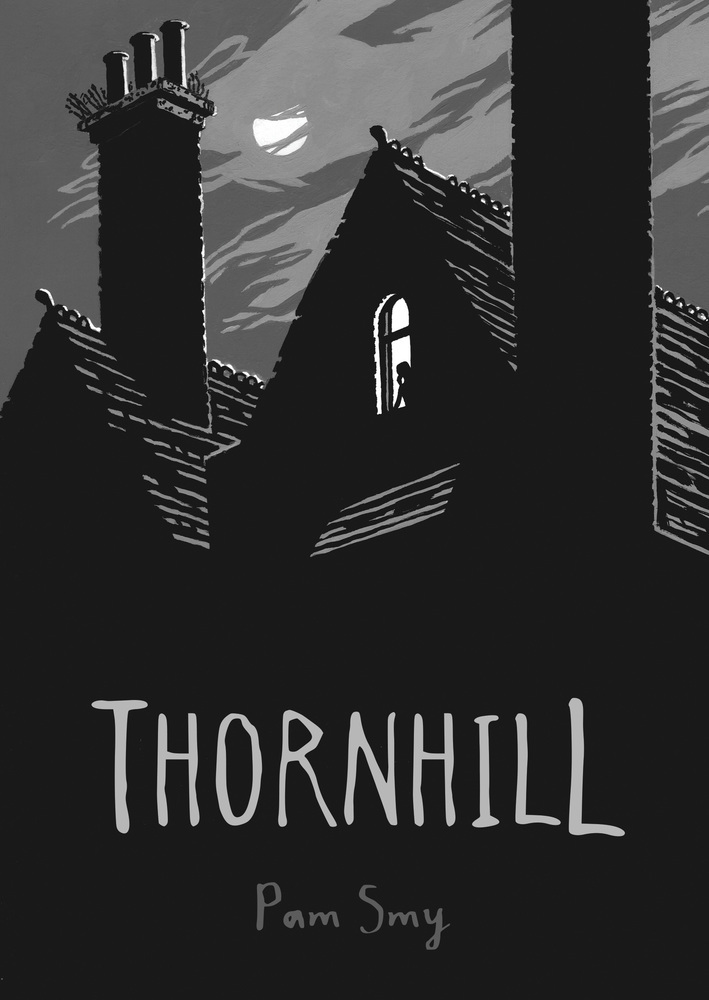
Thornhill, by Pam Smy

This unusual Young Adult (YA) novel is perfect end-of-October reading: stark, a little sad and a lot spooky. Part graphic novel and part journal, it’s a stunning portrayal of what many people experience, especially those on the tender, unpredictable cusp of adolescence.

Lonely Ella has just moved to town, her modern-day story told in striking black-and-white graphics, the only words being those occasionally written on items in the scene. We see an upstairs room, packing boxes, a window—and through that window a strange gothic ruin of a house buried in an overgrown garden.

The Thornhill Institute for Children, a boarding school for abandoned and orphaned children, closed in 1982. Mary is one of the last to leave, and it is her journal that runs parallel to the silent pictures depicting Ella’s life. Mary writes of terrible goings-on at Thornhill, especially the bullying directed at her. She takes refuge in her attic room, locking the door against the nightly bangings of her chief persecutor. There she makes puppets and dolls—creating her own friends—and reading.

Ella’s mother has apparently died, and her busy father seems to have little time for her. Sometimes we see through a crow’s eyes; is it the crow or Ella who first sees a shadow in an attic window of the dilapidated Thornhill? Ella finds a way into the property and begins exploring.

The book made me consider what we see and what we don’t see. The adults at Thornhill don’t see Mary’s suffering, nor does Ella’s father see her loneliness and her grief for the loss of her mother. Mary’s diary reveals her uncertainty about whether to trust what she sees, such as overtures of friendship from her persecutor. It also shows her hiding from view in her room, more and more as the story continues.

We readers see only Mary’s words and the pictures of Ella’s life. I found this distancing  effective because it made me create their stories myself. That happens with the best traditional novels, of course, but I felt newly challenged here. I was reminded of what writer/teacher/agent Donald Maass has said about creating emotion in our stories. Just describing the emotion doesn’t make the reader feel it. Instead, we have to set up a situation that invites the reader to remember feeling that emotion themselves; their own memories then supply the emotional heft.

I certainly found that to be true here. I was flooded with memories of that awkward, in-between time. Mostly I remember glorious days, enchanted moments, etc. but I was reminded that there were some bullying and loneliness; there was the need for a friend.

Another part of my thinking about what we see and how we see it was remembering a show of Andrew Wyeth’s paintings at the National Gallery entitled “Looking Out, Looking In.” His paintings of windows and doors made up the exhibition and sent me down a path considering point of view in a way that had nothing to do with first or third person but everything to do with where we are standing, whether we are inside or outside.

In Thornhill, we have windows and doors, walls and secret gardens, mysteries and ghosts. It’s a quick read, but the story may stay with you a long time.

What are some of your favorite spooky reads for October?

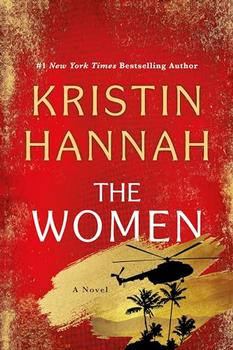
The Women, by Kristin Hannah

Frankie McGrath, a naïve 23-year-old “California girl” and nursing student, enlists in the Army Nurse Corps because it is the branch of the military that will send her to Vietnam as quickly as possible. It’s 1965, and she has an idealistic vision of meeting up with her brother who is deployed there.

Unsurprisingly, once there she’s overwhelmed by the difference between her dreams and reality. The author recreates the day-to-day chaos and destruction of a medical station during the Vietnam war through Frankie’s eyes and emotions. Frankie manages to adjust and become a superb surgical nurse, very much thanks to Barb and Ethel, two fellow nurses who befriend and support her. Friendship, loyalty and betrayal are themes that run through the book.

At the end of her second tour in 1969, Frankie returns to California, and the second half of the book is about the antipathy she encounters. Confronted by antagonism that ranges from pretending she (as a woman) could not have been in Vietnam to outright hatred and abuse, she struggles to find her feet. As her mental health deteriorates she calls constantly on Barb and Ethel who repeatedly drop their East Coast lives to fly to California to help her.

All the conflict in this part of the book comes from the supposed hatred of Vietnam vets. True, there are romantic and work problems, but it is her emotional and mental fragility in the face of this hatred that makes her unable to deal with these normal problems.

I do not question the PTSD suffered by returning Vietnam veterans of all genders and, indeed, all of our veterans deployed in war. However, I was active in the antiwar movement at the time, and I NEVER saw protestors spitting on returning veterans and calling them baby killers, not in person, not on tv. Just the opposite. We were on the side of the soldiers, working to help them come home safe from a senseless war—something most of the soldiers in country wanted as well.

So I have long believed that all that supposed fury of protestors against veterans is a story—a lie—created by the warmongers to discredit the antiwar movement. It’s an urban legend. Here’s what Snopes has to say.

The claim that anti-war protesters spit on Vietnam veterans returning from the war is a persistent one, but there is no clear evidence that this was a widespread occurrence . . .

The persistence of this claim, despite lack of clear contemporary evidence, suggests it may be more of an urban legend that gained traction over time rather than a documented widespread occurrence. However, the available Snopes archives do not contain a comprehensive fact-check specifically addressing the broader claim about anti-war protesters spitting on Vietnam veterans.

Without more specific archival information addressing this claim directly, it’s difficult to make a definitive statement about its veracity. The persistence of the story, even among those who did not serve in Vietnam, indicates how deeply ingrained this narrative has become in discussions about the reception of Vietnam veterans upon their return home.

Other resources are a scholarly book by Jerry Lembke: The Spitting Image: Myth, Memory, and the Legacy of Vietnam and a Wikipedia page, neither of which find any credible proof to support the myth.

These days, we know a lot more about deliberate misinformation—lies—told for political purposes. I’m disappointed that Hannah, a brilliant writer whose other books I’ve enjoyed, has chosen to repeat and amplify this distortion of what actually happened back then.

The first part of the book which takes place in Vietnam, although a bit melodramatic, provides a vivid picture of what life must have been like on the ground for nurses. I applaud her choice to concentrate the second half of the book on how hard life is for returning war veterans. I’m just sorry she stuck to this simplistic—and false—narrative of abuse of Vietnam vets instead of digging into the more nuanced reasons why we see so many vets struggling with depression and suicidal thoughts.

Have you read anything about women in the Vietnam War?

Middlemarch, by George Eliot

I’ve been rereading Eliot’s classic novel this month with Haley Larsen’s Closely Reading group on Substack. It’s been a few decades since I last read it, and different features of the book leaped out at me this time.

The story is about the inhabitants of the fictional town of Middlemarch in the English Midlands around 1830. Eliot does a masterful job of zooming in to a dozen or so characters while giving other townspeople plenty to space to make themselves known.

We first meet Dorothea Brooke, a wealthy and intelligent young (19) woman, who wants to do great things in service to others, starting with better housing for the tenants of her uncle and guardian Arthur Brooke, a hilariously foolish man who can talk himself out of any opinion. Dorothea is extremely religious and denies herself pleasures, such as her mother’s jewelry, in order to sacrifice herself to a greater cause.

That turns out to be marrying Rev. Edward Casaubon, prematurely elderly at 45. A dry stick of a man, who has devoted his life to creating The Key to All Mythologies, he marries her but quickly withdraws into his shell. He rejects her romantic ideas of assisting him in his work, like Milton’s daughters taking down the blind poet’s dictation (as Dorothea dreams), mostly because he fears she will mock him when she sees how little he’s accomplished.  

We also meet Dr. Tertius Lydgate who hopes to modernise medicine In Middlemarch and the lovely, self-centered Rosamond Vincy who sets out to capture him. Her brother Fred loves Mary Garth, nurse to his uncle Mr. Featherstone, and she him. But she won’t marry Fred because he is feckless and a spendthrift, believing himself to be Featherstone’s heir and borrowing on the strength of that.

Mary’s parents Caleb and Susan Garth are kind and generous folks, Caleb being land agent for Featherstone. Then there’s Mr. Bulstrode, a wealthy banker. He’s a pious if hypocritical Methodist who runs much of the town and would like to do more to impose his beliefs on other residents.

A lot of characters—and there are more! However, Eliot wrangles their stories into a coherent story where we touch each person often enough that it’s not hard to keep them straight.

What stood out to me on this reading is the theme of what it means to live a good life. By that I mean a life of integrity, one we can be satisfied with when we lie on our deathbeds. In Middlemarch we have all these lives, all of these people intending to do the right thing yet derailed by temptations and compromises and the pressures of daily life. As we follow each storyline, we get to see various permutations of what a good life might look like—or not.

One aspect of a good life is being a contributing member of society, one which among other things means getting involved in politics. We hear a good bit about the Reform Bill (later the Reform Act of 1832) expanding the franchise to a larger segment of the male population, and about the coming of the railroads that threatens local farmers. There’s an interesting parallel here between the politics of the period and Eliot’s method of concentrating on a few privileged characters while including others to a lesser extent but with equal respect.

Another aspect is our personal relationships. I am fascinated by Eliot’s idea of a “home epic” which is what she calls this novel. She defines a home epic as a story about what happens after the wedding, particularly during the course of a marriage. I am often frustrated by stories that end with a wedding, as though that’s the be-all and end-all of a woman’s life, so I love that she takes marriage as  the starting point instead. I’d expand the definition of Eliot’s term to include domestic stories, stories within a family, not just the married couple. And by family, I mean families of choice too. A home epic might also cover the course of a life and how we interact with others, how we live within communities.

The greatest barrier to a good relationship, whether with a spouse or a neighbour, is embodied in her subtitle “A Study of Provincial Life.” Yes, the town is geographically provincial, but there is a larger meaning to the word. As Rebecca Mead puts it in My Life in Middlemarch, “It is also concerned with the emotional repercussions of a kind of immature provincialism of the soul—a small-minded, self-centered perspective that resists the implications of a larger view.”

Over and over again, we see characters misunderstanding each other. So many conversations where people misread each other’s intentions or fail to comprehend what the other is thinking! We know this because of Eliot’s psychological insights, and her technique of using a narrator to go into each character’s thoughts. Her narrator also pulls out to give us that larger view, sometimes warning us that a character may not be as bad as they appear. The narrator can occasionally seem intrusive but is vital to Eliot’s ability to weave the story together and bring out her theme.

Therefore, to live a good life we must be able to empathise with others. We have to work to actually see things the way someone else does, to set aside our own view of the world and understand theirs. I think this is why our narrator persists in explaining these characters to us. Eliot keeps coming back to the idea that we have to grow out of our natural self-centeredness and recognise that others see the world differently.

It’s not easy. As Eliot says, “If we had a keen vision and feeling of all ordinary human life, it would be like hearing the grass grow and the squirrel’s heart beat, and we should die of that roar which lies on the other side of silence. As it is, the quickest of us walk about well wadded with stupidity.”

Yet we can try.

What does it mean to you to live a good life?

The Lost Words, by Robert MacFarlane and Jackie Morris

When the Oxford Junior Dictionary was updated, it was found that around forty common words had been dropped—all of them words to do with nature—and their place taken by words, many of which have to do with the online world.

In response, MacFarlane and Morris came together to create what they call a spell book to help young readers rediscover the natural world. Unless we experience and learn to love the world of nature around us, we will not work to save it.

In this large-format book, we first see the creature or plant’s environment empty of everything but a scattering of letters. Some of the letters are a different color and spell out what is missing. Then comes the illustrated spell—an acrostic celebrating and summoning the creature or plant—followed by a stunning double-page illustration of it restored to its habitat.

This is the most beautiful book I’ve seen in a long, long while. Jackie Morris’s illustrations are simply stunning. I’ve even propped it open on my grandmother’s rocking chair so I can glance over at it frequently.

Robert MacFarlane’s spells—acrostic poems—summon the lost creature or plant through the music of words, using imagery, alliteration, internal rhyme, personification, and other poetic devices, including Anglo-Saxon kenning. A few excerpts:

“Hold a heartful of heather, never let it wither, / Even as you travel far from crag and river.”

“Kingfisher: the colour-giver, fire-bringer, flame-flicker, river’s quiver. / Ink-black bill, orange throat and a quick blue back-gleaming feather-stream.”

When I read this book to the littles in my life, they were surprised that anyone would think children wouldn’t know—or wouldn’t need to know—these words. The young ones talked eagerly of the bramble berries in their yard and the otters and herons they’ve seen. They wondered how children in even the most urban environments would not be familiar with dandelions. One of the littles is even named Willow, so was indignant that their name would be discarded.

The only one new to them was conker, since in the U.S. that word is not used for the seed of the horse chestnut, something they do know well since they love collecting the seeds from a horse chestnut near us. As far as I know, the children’s game using conkers is not played here in the U.S. My littles were interested in the description, but not eager to try it.

The book has won many awards and moved out into the world in various formats. I applaud its mission of connecting young people to our natural world and in the process helping to save that disappearing habitat. Most importantly it is a feast for the eyes and, when read aloud as it begs to be, for the ears as well. May its spells work.

What children’s picture book have you loved for the illustrations as well as the words?

Jigsaw puzzles available from the book’s website.