The Stranger in the Woods, by Michael Finkel
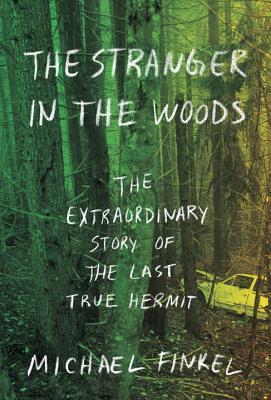
Subtitled The Extraordinary Story of the Last True Hermit, this nonfiction book introduces us to Chris Knight, a man who spent 27 years living alone in a tent in the Maine woods. Not alone the way Thoreau was at Walden Pond, where he entertained guests and took his laundry home to his mother, but truly alone. In all that time, the only word Knight uttered to another person was a gruff Hi to a hiker he ran into.
Obsessed with avoiding discovery, or even another chance encounter, he never built a fire or walked in the woods when there was snow on the ground. When the ground was dry, he knew the woods so well that he could move through them without making a sound or leaving a sign.
In researching this book, Finkel sets out to answer the questions we can’t help but ask: Why would he choose such a life? How did he survive the winters in just a tent? What about food, medicine, etc.? No matter how much you cut back on that etcetera, you surely need a sharp knife, a candle or lantern, clothes to replace those that wear out.
We learn, often in his own words, how Chris broke into nearby cabins to steal food, clothing, reading material, and other things—only dire necessities and only cabins that didn’t have year-round occupants. People in the area told stories about the North Pond hermit, and it was during a theft that he was finally arrested.
Wondering why anyone would choose such a hard path, Finkel delves into the lives of solitaries, from the Desert Fathers and anchorites to solitary confinement in prisons. He reviews current thinking about the autism spectrum and goes further to consult scientists about a physical component.
One’s desire to be alone, biologists have found, is partially genetic and to some degree measurable. If you have low levels of the pituitary peptide oxytocin, sometimes called the master chemical of sociability, and high quantities of the hormone vasopressin, which may suppress your need for affection, you tend to require fewer interpersonal relationships.
Nurture always goes hand in hand with nature, and we learn that Chris’s family was compulsively private, living off the grid and having only minimal contact with neighbors. When 20-year-old Chris disappeared, driving away from his first and only job (one that he’d only barely begun), they didn’t report him missing or try to find him.
Finkel interviews Chris in jail and exchanges letters with him, thus giving us first-person accounts of Chris’s life in the woods. I can only imagine, having worked in one, how awful jail must have been for this man who had lived in silence (aside from natural sounds) for 27 years.
It’s a fascinating story, and one ripe for discussion. Was Chris lucky to be arrested before he aged to the point where he could no longer manage his survival? He was already slowing down. While he never took much, Chris’s thefts scared people and invaded their privacy; only once he was arrested did they return to not locking their doors. And what about Finkel himself? His pursuit of Chris in the face of the man’s reluctance to talk or meet with him borders on stalking. Or does it cross over? Is it okay because he’s brought us this incredible story?
While privacy ranks high on my list of moral imperatives, I have to admit that I’m grateful to know this much of Chris’s story. I make time to be alone, preferably among the trees, when I can. I’ve lived in a tent in the New England woods, though in a shelter with a wood stove in the winter. I would never do what he did, but a part of me understands it.
It’s possible that Knight believed he was one of the few sane people left. He was confounded by the idea that passing the prime of your life in a cubicle, spending hours a day at a computer, in exchange for money, was considered acceptable, but relaxing in a tent in the woods was disturbed. Observing the trees was indolent; cutting them down was enterprising. What did Knight do for a living? He lived for a living.
Have you read a story—fiction or nonfiction—about someone who has turned their back on society?